Sunday, April 17, 2011

Why Dykstra Matters


Were she following the Lenny Dykstra saga, a certain aunt of mine would say of the man: “He’s not right in the head.” And she’d be right on the mark. The fate that has befallen this onetime baseball star, and more recent Wall Street whiz kid, is at once tragic and darkly comedic. Personally, I’d prefer remembering Dykstra as the scrappy spitfire nicknamed “Nails,” who furnished Met fans with one of their greatest baseball thrills in 1986. We will not soon forget his dramatic walk-off home run in the National League playoffs against the Astros.

Fast forward a quarter of century and Dykstra’s athletic sheen has altogether evaporated. The gritty baseball player giving his all, and clearly maximizing his talent, is yesterday's news. In its stead is a freakish caricature wholly divorced from reality. Bankrupt and arrested for selling off things under a trustee’s guardianship, Nails sees things a bit differently. He doesn’t for a nano-second feel he bilked individuals and lenders with what could best be described as No There There investments. In fact, he considers those seeking redress from him “derelict losers” and “whores.” Dykstra even compares himself to "that Indian dude” named Gandhi. After all, just like Mahatma Gandhi, he too has lived on the streets and, of course, been persecuted. Indeed, ol' Lenny believes the big banks might assassinate him.

Nails has apparently had a sea change of heart as well. His new mission in life, he says, is aiding and abetting folks facing home foreclosures. You see: He knows what it’s like to experience a foreclosure. He actually knows what it’s like to face multiple ones simultaneously. Funny, though, but it’s kind of difficult sympathizing with the guy here. He’s hardly a poster child for the genuine victims of foreclosures in what are ugly economic times.

So, you ask, why does ultra-wacky Lenny Dykstra matter—a man who bounced a check made payable to a working girl, which is about as low as one can get? Well, for starters, he typifies so much of what’s gone awry with society of late. The ballplayer who began his career as a skinny kid exits the game a power-hitting RBI man with a Frankenstein monster-sized head and a prematurely wrecked body. Soon after baseball, he amasses some serious dollars in the guise of investment genius. But among the financial rubble of recent times, individual tales of deceit and greed like Bernie Madoff's and Lenny Dykstra's are repeatedly plucked from the cinders. It seems that greed and excess always attract greed and excess.

Friday, April 8, 2011

Gold Coins and the Corrector Class


Many years ago—and I’ve long since forgotten the context—radio broadcaster Barry Farber informed a caller in his distinctive tone of voice, “He that correcteth me handeth me a gold coin.” Being the recipient of a correction, I know, is often unwelcome and a difficult pill to swallow, but it’s sometimes an invaluable learning moment. When mean old Sister Camillus humiliated me in front of my elementary school peers by nastily proclaiming, “Imagine a fifth grader who doesn’t know how to spell 'paid,'” I was indeed handed a gold coin. Granted, I didn't appreciate it at the time, but I never misspelled “paid” as “payed” again.

The Corrector Class has mushroomed in size in the new millennium. The Internet and social networking sites have in fact empowered the formerly powerless, who can now prove how smart they are by correcting their fellow men and women in all kinds of venues. People of all ages, and in all walks of life, are literally lying in wait to catch our mistakes and point out our blunders and missteps to the wider world.

A recent discussion board comment from a fellow writer struck me as at once timely and right on the mark. Responding to a question concerning the pluses versus minuses of plying in this trade of ours, he noted how he receives precious little positive feedback when he gets things right, which is the norm. And when he does get a modicum of credit for a job well done, it’s typically a long time in coming and breathlessly short in its approbation. However, when he errs in the slightest, heaven forbid, the Corrector Class pounces in a nanosecond to broadcast the errors of his ways.

Happily, even amidst the sprawling virtual rubble, there are still countless gold coins to be harvested. But there are also more counterfeits than ever before in the brush. All too many members of today’s considerable Corrector Class appear more interested in inflating their rather poor self-esteems than offering genuine gold coins to their fellow world travelers. This is both a little sad and very annoying. Sister Camillus, where are you when we need you?

Friday, April 1, 2011

Stream of Consciousness

A local newspaper, the Riverdale Press, recently ran a piece about a meandering stream that runs through parts of my neighborhood. Having been covered over by landfill in the fledgling years of the twentieth century, the waterway is now—with the exception of a few visible remnants in nearby Van Cortlandt Park—completely underground and wholly unseen. Most of the area’s current residents, I suspect, are blissfully ignorant of the fact that many private homes and apartment buildings in the area are built atop Tibbetts Brook and its surrounding wetlands.

Several decades ago, a man named William Tieck published a neat history of adjoining Bronx neighborhoods' Kingsbridge and Riverdale. Rare photographs in his book included images of the formerly free-flowing Tibbetts Brook in locations that have long been smothered by concrete and asphalt. For those of us who call home this densely populated nook of New York City, it’s hard to imagine a rowboat tethered to a small wooden dock on what is now a busy cross-street—but some of the old pictures actually paint a Norman Rockwell postcard past of what is now a teeming urban enclave.

While a return to this Rockwellian vista is not possible (nor desired), the newspaper account nonetheless reported on possible future efforts in “daylighting” the brook—bringing it back to the surface where feasible. Interestingly, and on its own, the indefatigable stream seems to be doing just that in snippets of Van Cortlandt that were not very long-ago bone dry but are now swampy marshland. Really, what the city fathers and mothers have in mind at this point in time is merely a theoretical restoration of the brook that runs from the City of Yonkers, just to the north, and empties into the nearby Harlem River Ship Canal, which, by the way, empties into the Hudson River, likewise a stone's throw away.

Growing up on the street that received its name from the stream that runs beneath it, I have something of an intimate acquaintance with its subterranean waters. Along with several others, my grandfather planted a sprawling “victory garden” on an empty lot on the very same street in the late 1950s. Naturally, there was no modern water source to attach hoses or sprinklers to, but there was Tibbetts Brook not too far from the surface.

Italians from the old country knew how to do an awful lot of things back then, which are downright foreign to most of us in the twenty-first century. My grandfather could dig a well—no problem. Utilizing a fifty-gallon barrel with its bottom removed, he dug down several feet through layers of dirt and landfill (ashes of some sort) and struck water, which quickly wound its way up the barrel’s sides. The well worked like a charm for more than a decade in tapping into what proved an inexhaustible water supply. Year after year, and summer after summer, the gardeners on Tibbett Avenue lowered buckets attached to a rope into the drink, watering dozens of tomato plants, pepper plants, eggplants, string beans, and all kinds of flowers. In springtime, after the winter's snow melt, I remember the water reaching the well’s top but never quite spilling over.

Sadly, the garden was bulldozed in 1971 when I was nine years old. Fortunately, though, I had the opportunity to witness the well at work. And if memory serves, the waters of Tibbetts Brook typically appeared crystal clear, almost good enough to drink. However, I'm happy to report that all concerned considered the source and resisted the temptation. When the pilings were being pounded into the very same space for a future six-story building, water pumps labored day and night in spilling out Tibbetts Brook into the street. We knew it was there then, and know it’s still there now, just champing at the bit to reveal itself once again—someday and somewhere.

(Photo from the personal collection of Nicholas Nigro)

Thursday, March 24, 2011

Reality...Unscripted...Yuk!!!


It’s called "unscripted television" now—a quasi-admission by reality show producers that not everything you are seeing is quite real. After all, we don’t ordinarily live our lives with cameras and cameramen—in eyeshot and earshot—recording our every move and every emotion.

Once upon a time we were supposed to accept the basic premise of reality shows that human beings behave naturally when being filmed—spontaneously, even in the most intimate of moments. But apparently, it doesn’t really matter to the viewing public whether it’s truly real, or real in some ambiguous definition of the word, because it's still entertaining.

Albeit in the virtual ether, Facebook shares common ground with unscripted television. There is a mother lode of revelations, support, good humor, bad humor, as well as unhealthy doses of vitriol, too, on people’s personal “walls.” Facebook is real, unreal, and surreal all rolled into one Internet soap opera. By its very nature, this kind of social interaction is akin to having the cameras rolling. Yes, occasionally good old-fashioned reality and total candor shines through. In the instance that I am about to recount, the man’s honesty is absolutely breathtaking.

It seems that a thirty-something fellow, who’s evidently held some responsible adult jobs in his life, had encountered a few financial difficulties in recent years. So, it was with unrestrained joy that he reported to his Facebook family that his financial woes were a thing of the past—the Heavenly Father having intervened on his behalf. He informed one and all he had won a considerable sum from Publishers Clearinghouse.

I never knew of any real person who actually won one of their prizes. These are the people who show up at your door with a bunch of balloons and a colossal-sized check made out to you. Now, had this poor chap posted a photo of the PCH entourage on his doorstep, I may have been more inclined to believe in his good fortune. But within his description of the blessed event—difficult enough to swallow—there were a couple of particulars that didn’t exactly pass the smell test.

Sure enough, a mere day later, he announced on Facebook that his unexpected but very welcome windfall was not to be. He deposited the $26,500 check he received in the mail, he said, only to be asked to wire a $3,000 processing fee to the scam artists before they would permit it to clear. On numerous fronts, this almost-victim of a big-time hoax came across as not too smart. New Jersey-born guys are supposed to be more savvy than that. Seriously, his Facebook info listed his occupation as "financial adviser." He wasn’t an old lady living alone on a fixed income, or some uneducated man trying to make ends meet and support his family. He had a college degree and offered investment advice.

What would you do if you received an unsolicited $26,500 check in the mail? I suspect you’d be skeptical and probably recycle it without further ado. Our guy called a phone number to verify its authenticity. He alerted the world via Facebook about his sudden good fortune without doing a right and proper investigation. Personally, I wouldn’t reveal a financial matter of any kind and under any circumstances on a social networking site. I'd imagine, too, this revelation won't help his future business prospects. Reality…unscripted…yuk!

Friday, March 11, 2011

RIP Greg Goossen


As part of my morning ritual and Internet roundup, I visit various news sites, faithfully read several bookmarked blogs, and call upon a cyber portal devoted to the New York Mets and their illustrious history. Dubbed Centerfield Maz and choreographed by its indefatigable owner, the Zelig of Met fans—check it out and you’ll see what I mean—the website is teeming with memories, as well as a mother lode of “Whatever Became Of?” info and trivia on past players from the well known to the obscure; the stars to the scrubs.

As a devout former Met fan, who considers contemporary professional baseball outright sacrilege, I’d just assume remember the game from a more innocent time. I'd prefer recalling the pure joys of following my team before the onset of steroids and mega-million dollar salaries, which sometimes stretch farther than the eye can see. I cherished America's pastime before the sport became just another appendage to today’s tacky celebrity culture. You know, where the likes of A-Rod’s not particularly interesting off-the-field antics compete with Lady Gaga for ink in the newspapers and its virtual equivalent.

A couple of weeks ago, Centerfield Maz featured former Mets' player Greg Goossen—a catching prospect who subsequently got drafted by the Seattle Pilots, a 1969 American league expansion team that not only moved to Milwaukee a year later, but was forever immortalized in Jim Bouton’s then very controversial inside-the-clubhouse baseball book Ball Four. (Forty years ago, Bouton was actually vilified within the fraternity for violating baseball's equivalent of omerta.)

Anyway, while reading the Goossen account, with a recent picture of him staring back at me the whole time, I couldn’t help but notice how completely unrecognizable he appeared in contrast with his youthful baseball card photos. In his sixties now, he had a distinctively tough-looking and world-weary mug. His rough-hewn but nonetheless noble countenance told me that Goossen had suffered more than a few hard knocks along life's highways and byways.

The final thoughts of Centerfield Maz profiles frequently disclose what ex-players have been up to in their post-career lives. Apparently, Greg Goossen toiled at many jobs and in many professions after baseball. But while his life may have traversed a rocky road, it was off-the-beaten path and quite interesting. Goossen was actor Gene Hackman’s stand-in for many years. He worked too as both a private detective and boxing trainer. But the saddest of all parting shots in Centerfield Maz profiles are sometimes death notices. RIP Greg Goossen, who passed away of a sudden heart attack at the not-so-old age of sixty-five on February 26th.  He, I’d hazard a guess, was more every man than Oprah is every woman.

Tuesday, March 8, 2011

Delivery Boy


Yesterday, I performed unusual courier duties for a close relation of mine. And I wasn’t entrusted with delivering any old package to any old place. No, this was something special—an invaluable fluid coveted by a certain medical institution. To be more specific, I delivered a urine sample to Memorial Sloan-Kettering cancer hospital on Manhattan’s Upper East Side. Life so often drops us in circumstances that not too long ago would have seemed preposterous.

Beginning my journey in the Northwest Bronx, I rode the Number 1 train to Columbus Circle, exited—with the urine safely ensconced in a Trader Joe's shopping bag—and then walked eastward on 59th Street along the periphery of Central Park, which was lined with a fleet of hansom cabs operated by rather non-handsome drivers—a dodgy looking crew if you ask me. I felt bad for the poor horses, which I always do when I spy these noble beasts navigating the mean streets of New York.

Despite having only one biological leg at my disposal, I nevertheless opted to walk across town rather than hop on a bus or a hail a cab. It was a sunny, breezy, and pretty crisp early March morning, but my trusty C-Leg—a computerized knee that nobly attempts to mimic my gait—was definitely up to the task. When I received this state-of-the-art knee, replacing a mechanical one, I asked my prosthetist, “So this leg stops your falls?” He answered, “No…let’s just say that it slows them.” Essentially, with any luck, my new knee would furnish me with the necessary seconds to right myself before I went down for the count. And I can say this much: I’ve had a few close calls that—were I wearing my prior knee—would have landed me on the pavement. But then again, I take many, many more chances with this remarkably stable and trusty friend that I slip on every morning. I walked long distances before—when I was physically whole—and I walk long distances now. I guess there are some things that never change.

In fact, Part A of this New York adventure was such a success that I decided—after turning over the urine sample—to retrace my steps on foot again, but with a slight route change this go-around. I followed the M66 cross-town bus route, which put me on a heavily traveled cross street through Central Park. The sidewalk was a filthy mess and the traffic whizzed by me at high speeds, spewing harsh fumes in my direction. And as a pedestrian crossing in the heart of New York City, it was pretty desolate. I had erred in my return-trip choice of routes, but my C-Leg and I nonetheless overcame the considerable cracks and crevices in the concrete, as well as occasional patches of wet leaves and mud along the way, without a hitch.

At West 66th Street and Broadway, Lincoln Center, where I landed and would catch the subway home, I couldn’t help but recall how I shopped for many years at a multi-storied Tower Records and a Barnes & Noble superstore across the street, which are gone now—casualties of both the times and the passage of time. It seems though that while nothing lasts forever, spanking new and unpredictable adventures await us all.

Saturday, March 5, 2011

Pizza Wars


These are taxing economic times for sure. It should therefore come as no surprise to you that business competition gets mighty ugly on occasion, with one and all fighting tooth and nail for shares of a finite pie. And the pie on our plate right now is a pizza pie. I would like to elucidate on the particulars of the most important news story—bar none—in what has been a very busy news week.

Pizza Owner Number One, you see—the perpetrator in this strange but true account—was, for all intents and purposes, caught red-handed in the act of placing live mice in a nearby competitor's establishment. It was his hope the mice would be fruitful, multiply, and eventually sound the death knell of Pizza Owner Number Two.

It seems, however, that said perpetrator was hopelessly inept in executing Operation Mouse Mayhem. Reports say he entered the competition’s shop sporting a brown paper bag and made a beeline for the bathroom. But when he emerged several minutes later without the bag, Pizza Owner Number Two, who didn’t know who he was, nonetheless sensed perversion afoot. In a twist of fate that proved the undoing of Pizza Owner Number One, there just happened to be two off-duty policemen in the dining room at the time, who were informed of what just transpired and promptly investigated what would soon become—officially—a crime scene. The cops found live mice scurrying about, and also telling footprints on the toilet seat. It seems the perpetrator stood on it in hopes of placing the mice above some ceiling tiles.

Pizza Owner Number One, the hapless perpetrator, was subsequently apprehended in the environs of yet another pizza joint, Pizza Owner Number Three, again not too far away. Mice were also present. He straightaway confessed to his crimes, but claimed his competitors were trying to run him out of business with the very same lethal weapons, and that turnabout was fair play.

So, just what exactly can be gleaned from these Pizza Wars or, if you prefer, Mouse Tales? Yes, there are lots of pizza places around and we eat an awful lot of the stuff. But also that competition for the Almighty Dollar goes bizarrely awry on occasion. Had only Pizza Owner Number One contented himself to posting bogus reviews of his rivals on Internet reviewing sites—which I'm certain countless entrepreneurs do in this age of anonymous libel—he’d be better off. He's not only facing misdemeanor charges of harassment, criminal mischief, and disorderly conduct, but animal cruelty as well. And heaven knows what could have been unleashed had the mice not been discovered and been left to their own devices in a food and restaurant setting.

There is a shred of hope for the perpetrator in these Pizza Wars, which have all the ingredients of a reality show in the making. I wouldn't be at all surprised if Pizza Owner Number One, Pizza Owner Number Two, and Pizza Owner Number Three are all living the surreal life under the same roof in the not-too-distant future, working out their differences with, of course, the cameras rolling.

Thursday, March 3, 2011

Where Less Is Better


I was genuinely disheartened by the untimely death of TV pitchman Billy Mays a couple of years ago. For quite a while he was a part of my life in some perverse sort of way. I enjoyed his over-the-top, boardwalk approach to peddling products—everything from laundry soap to super-powerful silly putty to stick-on wall hooks. I must concede that I always stopped what I was doing and watched a Billy Mays' advertisement, even one I had seen countless times and for which I had no particular commercial interest. Billy Mays' moments were anxiety busters, I guess, taking my mind off my troubles for a split-second in time. It was always about the man’s incomparable style, not the particular product he was pitching.

Ah, but once upon a time Billy Mays was merely a commercial spokesperson and familiar face and recognizable voice to millions. We knew little about the man beyond his TV ad persona. In fact, we only knew his name because it was part of his shtick. He always proclaimed, "Hi, Billy Mays here..." before any and all of his pitches. But that was the long and short of our knowledge of the guy, and we weren't much interested in learning anything more, either. We didn't care whether or not Mays was a Republican or a Democrat, or whether he was a meat and potatoes guy or a vegan.

But as the World Wide Web grew wider and wider, and cable television expanded its ever-metastasizing waistline, personalities like Billy Mays could no longer remain contained and personally anonymous. So, no surprise here: Billy got a reality show of his own, which I dutifully watched. He seemed of decent enough character considering his less than savory line of work, but the bloom was definitely off the rose.

Seeing Billy Mays as merely an enthusiastic pitchman thereafter—perhaps overly boisterous on occasion—for a diverse line of merchandise was no longer possible. Having been ushered into the minutia of his television salesman's world shattered for all time what was once a virgin deception. When Billy willingly unmasked himself in this age of celebrity, the bare bones appeals of his commercials could never be watched with the same wide-eyed innocence.

When I first saw a competitor pitchman named Vince plugging a product called ShamWow, I found the ad uncouthly intriguing on some visceral level. But very soon after, I not only learned Vince's full name but a bit more than I really wanted to know about his background. It seemed that ShamWow Vince was a guy named Vince Shlomi with a less than savory history, who subsequently added to his dossier by doing even more repellent things to a certain lady companion. So naturally, I can’t watch a ShamWow commercial today without this information lodged in my brain, and I wouldn't consider purchasing a ShamWow under any circumstances.

Knowing too much about people obviously has its disadvantages. And this doesn’t only apply to big-mouth infomercial talking heads, but actors, businesspersons, spiritual gurus, sports figures, et al. Excessive info cannot help but soil the simple illusion. And simple illusions have their place, particularly now in this—metaphorically speaking—increasingly colder world of ours.

Saturday, February 26, 2011

The Oaf Factor


For a forty-something guy like me who will be a fifty-something guy before too long, YouTube has been a godsend. Without it, countless memories of my past would be just that—memories—and most of them long forgotten. But now, by merely typing in a few key words, I can unearth a combative and very possibly drunk Norman Mailer on the Dick Cavett Show, a vintage McDonald’s commercial featuring the grisly Willard Scott as the original Ronald McDonald, and the Nanny and the Professor opening TV theme—a mother lode of rather amazing stuff that was, not very long ago, lost to us all. Calling on the Museum of Broadcasting and combing through their massive archives was really all we had at our disposal to possibly unearth a Schaefer beer commercial, or the Cesar Romero, Jack Palance, and Phil Rizzuto appearances on What’s My Line?

But wouldn’t you know it—there’s a downside to such ready access to a seemingly bottomless treasure trove of good stuff from days gone by. Oaf is the word…is the word…is the word. Yes…oaf. The oaf is omnipresent nowadays—in our virtual faces 24/7. The Internet in general, and social networking sites in particular, have empowered him and her as never before. Oafs sound off on Facebook with unrestrained abandon. They comment on YouTube videos, disliking all sorts of things—some in fact that they have little or no knowledge of. They weigh in on news stories big and small. They leave reviews on everything conceivable from movies to restaurants to boxes of cereal.

This diverse breed of oafs is frequently ignorant and often crass. But that’s why they are called oafs, I suppose. They are sometimes preposterously politically correct and ask in all seriousness if the Beverly Hillbillies sitcom's Clampett family was a racist brood because old granny brandished a Confederate flag and thought that Jefferson Davis was still her president. At other times they are downright boorish, moronic, and even a bit scary, believing that President Obama is an Afrikaner and card-carrying commy seeking to transform America into Amerika.

Oafs of all stripes have been furnished bona fide platforms in this Information Age of ours, and we had just better get used to it. There’s no putting this genie back in the bottle. Oafs—young and old—are here to stay.

Saturday, February 12, 2011

Coming Attractions


The better part of this week found me in a hospital setting. The upside, for lack of a better word, is that I wasn’t the patient but a "caregiver" instead. Anyway, without going into too many details, patient and I landed in Memorial Sloan-Kettering’s Urgent Care (triage) wing. This hospital space perpetually brings together a diverse group of cancer patients who are feeling unwell for a variety of reasons, but who are, in most instances, not unwell enough to be Emergency Room caliber.

Having arrived there at around noontime, I didn't leave the premises until ten o'clock at night. (Lucky her: The patient got to stay over a couple of nights to knock out a spot of pneumonia.) It was an extraordinarily long day of uncomfortably sitting around mostly—waiting and wondering, but also observing and listening to the never-ending theater all around us. The place filled up in a New York minute—hey, it’s winter and a bad one at that—and men and women were lined up in the corridor, with some looking more worse for wear than others. Most of the assembled had family or friends at their sides for moral support and physical assistance if needed, but a handful did not. I noticed an elderly woman all alone and seated on chair in the hallway for hours. I took an educated guess that she had both cancer and nobody—an incredibly sad one-two gut punch in life’s waning hours.

I overheard doctors visiting patients and discussing morphine drips and other painkilling options. One man was informed that the drug cocktail given to him wouldn’t rid his pain altogether, but hopefully make his day-to-day existence at least tolerable. I heard another poor fellow feebly cry out, “I don’t want to die.” His doctor reassured him, “We don’t want you to die, either.”

It’s difficult not to reflect on Coming Attractions, and the less than harmonious last legs of life’s journey, while amidst this stark reality snapshot. Really…there just aren’t very many happy endings in store for us. Looking on the bright side, a trip to Urgent Care can be an enlightening experience, too—an eye-opener. (I’ve been there a few times.) While in this milieu, I am always reminded of the endgame, and why it’s absolutely essential to make the most of what's in-between our beginnings and endings.

Sunday, January 30, 2011

Heroes and Villains

When I first began rooting for the New York Mets in defiant opposition to family tradition and the Bronx’s elite home team, baseball’s history actually mattered. Old-Timers’ Day promotions drew big crowds. The eight-year-old me experienced genuine awe in seeing former greats like Joe DiMaggio, Jackie Robinson, and Bob Feller in the flesh. I listened closely when the game's oldsters reminisced about playing alongside and against the likes of Ruth, Williams, and Cobb. By osmosis, I received an education on the old and storied Brooklyn Dodgers-New York Giants rivalry. Of course, I knew the teams' owners—taking the late Horace Greeley’s advice—simultaneously left the city after the 1957 season for the West’s greener pastures. and wondered how this dastardly duo could have done anything so awful.

The prevailing sentiment in this neck of the woods considered Dodgers’ owner Walter O’Malley a bona fide scoundrel, not ever to be forgiven for whisking away Brooklyn’s beloved Bums. Columnist Jack Newfield christened him “one of the three worst villains that ever lived”—the others being Hitler and Stalin. As for Horace Stoneham, the Giants’ owner, any lingering vitriol that existed was tepid by comparison. (And, really, attendance in the antiquated Polo Grounds was 653,923 in 1957, and the city had confiscated an area of its less than ample parking space to erect housing projects.)

I just finished reading Michael D’Antonio’s Forever Blue, a fascinating account of Walter O’Malley, his fabled team, and the rapidly changing times that inspired the controversial move. It could be justly said that the book was sympathetic to O’Malley. He was no Hitler. In fact, when compared to the Boss, George Steinbrenner, in my opinion, he was positively upright, of sound mind, and a paradigm of virtue.

Sure, the Dodgers’ owner was foremost interested in making money—lots of it—and he hungered, too, for accolades regarding his baseball and business acumen. Nevertheless, the more writers and historians unearth, the less cut and dried O’Malley’s purported treachery appears. Despite attendance being down in old Ebbets Field, the Dodgers were still—courtesy of television and radio deals—one of the most profitable franchises in the game (unlike the Giants). O’Malley had also zeroed in on what today would be called his “brand.” He merchandised Brooklyn Dodgers’ stuff before it was the rage. Yes, he wanted a new ballpark in a better location. The increasingly dilapidated Ebbets Field’s seating capacity was only 32,000, with less than 1,000 available parking spaces. It was not particularly accessible by either automobile or mass transit, and the neighborhood was pretty unsavory and not about to get any better. After the war, Long Island and the New Jersey suburbs were where many Dodger fans and their families relocated. Driving to a game at Ebbets Field with a young family in tow was a major hassle.

So, really, O’Malley had a winning case for a new ballpark and found a Brooklyn location that he coveted. However, he needed the help of city fathers to procure the land—or, more aptly, master builder Robert Moses, who wielded the real power back then (but that’s another story altogether). The Dodgers’ owner was actually going to pay in full the building costs of the new stadium. But Moses had his long-term sights set on a stadium complex in some swampy area in Queens called Flushing Meadows. He didn’t care about the Dodgers, and he didn’t like being told what he had to do.

To make a very long story short, the preponderance of evidence suggests that O’Malley sincerely wanted to remain in Brooklyn. Nevertheless, he pushed the envelope by selling Ebbets Field to a developer, meaning that either he got what he wanted, or would pick up his marbles and move elsewhere. Funny…but there would be no Mets without O’Malley’s move—no miracle in 1969, the only truly documented one of its kind. And nobody can argue that the Los Angeles relocation wasn’t ultra-profitable for the O’Malley family and the Dodgers. But, hey, that proposed stadium project in Queens turned out all right as well. The Mets, born in 1962 via league expansion, established an all-time baseball attendance record in 1970—drawing over 2.7 million fans—in a then state-of-the-art ballpark called Shea Stadium. It seems there was a heaping helping of money to be made in New York, and a heaping helping of money to be made in Los Angeles, too. And one final postscript here: When Shea Stadium’s demolition began in 2008, it was standing almost as long as Ebbets Field, built in 1913, had been when it sadly welcomed the wrecking ball. Time flies when you're having fun, it would seem, and all things come to an end. That’s the long and short of it in baseball and in life.

Sunday, January 23, 2011

Strange New World


Some time ago, while Googling my name in concert with a recently published book, I encountered a dreaded citizen review (not the first and, I suspect, not the last). Needless to say, it was not a glowing tribute of my highly touted talents. In fact, I was called many names therein, including an “overly optimistic douchebag” and “asshole.” Now, this particular title of mine importuned its unemployed readership to remain upbeat, not lose hope, and uncover every possible stone in his or her job search. It was not intended to rile the public at large. The book even received a half-page review, and recommendation, from a fellow named Harry Hurt III in the business section of Sunday’s New York Times.

But this is a strange new world that we live in. The virtual equivalent of road rage awaits everybody and anybody who puts himself or herself out there. Indeed, the average Joe and Mary has been empowered as never before—furnished with a venue to express his or her opinion on books, movies, politics, religion, food, and, of course, everything else, including the worth of their fellow human beings.

The woman (least her username suggests the feminine), who tarred and feathered yours truly in a profanity-laced diatribe, decreed at one point that she knew—positively knew—based on the book’s less than somber title, that it would be an awful read and downright offensive to her. But, apparently, she couldn't resist.

Why pray tell? If I have learned anything in life, it’s this: If I absolutely know something is going to be dreadful (a book, movie, etc.), I avoid it like the plague and forage elsewhere for my entertainment and kicks. Ah, but I suspect that the average Joe and Mary Reviewer frequently gets off on being offended, enraged, and on his or her high horse. Unfortunately, in all too many instances, both Joe's and Mary's opining amounts to the virtual equivalent of road rage.

Obviously, I consider myself neither a “douchebag” nor an “asshole.” I would even find fault with the adjective employed in front of the former: “overly optimistic.” But with citizen reviewers poised and ready to pounce, it isn’t just writers, artists, and actors who need fear the verbal guillotine. Merely commenting on an online news article, or in a Facebook thread, is wont to infuriate your opinionated neighbors, who just might call you the worst kinds of names and wish upon you the worst kinds of hardships. Such are the times we live in…we might as well get used to it.

Monday, January 10, 2011

Food for Thought


In a recent conversation, I learned an inconsequential piece of trivia. It concerned a deceased woman named Mary, whom I didn’t know very well. It seems that while among the living, Mary loathed eggs, and anything made with them, with a passion. Obviously, this stance of hers covered a heaping helping of culinary ground.

This little filler of old neighborhood lore came my way during a debate on the taste benefits of Italian hot sausages versus Italian sweet sausages. One relative of mine found it inconceivable that another could honestly dislike hot sausages. From her perspective, it was positively odd—perhaps even a critical character defect—not to appreciate something as super-scrumptious as a spicy hot sausage. Oblivious to the bald-faced irony, the relative accuser conceded to not liking sweet sausages at all—only their fiery pork cousins. And may I add this parenthetical aside: It’s more conceivable to me how somebody could find hot sausages objectionable—seeing as they are so spicy hot—while appreciating sweet sausages.

Anyway, there is a moral to this sausage story—a little food for thought that serves up a bit of insight into human nature, and reveals at least a morsel of why we are so messed up as a species. Granted, some of us are more messed up than others. While I consume the incredible, edible egg in many guises, there are some foods that I absolutely say no to—just like the late Mary. In fact, there are a few of them that physically and sometimes emotionally repulse me beyond any logic or reason. One wouldn’t need to waterboard me to break my spirit. Merely placing me in a colossal bowl of coleslaw, or some fancy salad with gelatinous tomatoes and stinky cheese bathed in pungent vinegar, would do the trick and fast turn me into a blithering idiot. I wonder if our CIA operatives have figured this one out. You know: Uncover the very foods (and various other things) that so nauseate their various prey. Traveling down this route, they could torture a whole lot of folks without violating the Geneva Convention.

While growing up, the utter disdain cast my way for not liking things that were so patently yummy for my tummy was at once palpable and predictable. “You don’t know what you’re missing” and "You don't know what's good" were phrases I heard with great regularity. And, of course, I was accused of seeking attention and desiring to be different in these family food wars of ours. I don't know...maybe this was so...as I cannot say why I loathe certain fare with such fervor to this day. I was also told more than a time or two that I would eventually come to my senses as an adult, and rue all the good feed that I passed on as a boy. For the most part, I haven't.

And I’ve long since learned that an awful lot of people don’t like an awful lot of things, including many things I find pleasing to the palate. Go figure. Once upon a time I thought I was all alone in some gastronomic No Man’s Land. Turns out that I’m not so abnormal after all—in this regard at least—just made to feel so because I see a freshly sliced tomato for what it really is.

Sunday, January 9, 2011

A New Year...the Same Old Focus


In the fledgling days of 1994, a retail store manager, with whom I worked alongside, crafted a document on his then very primitive computer. It nonetheless impressed one and all with its unusual and competing fonts, bold-lettered headlines, and colorful graphics. Headlined “A New Year, A New Focus,” it was specifically produced for the place's staff, who were asked to pore over its inspirational contents and inhale its lofty objectives like they would fresh roses in springtime.

This manager bloke was a disciple of the relatively new and somewhat chic approach to business management called Coaching and Mentoring. You know: Encourage each member of one’s team to boldly go where no employee has gone before by treating him or her like a bona fide human being—for starters—and offering him or her a lunch table of carrots along the way for innovating, working hard, and keeping eyes peeled to the future. Yada…yada…yada.

The major pothole on this business road to good intentions—for lack of a better description—was that there was no there there. This particular retail bossman affixed special titles to virtually every Tom, Dick, and Harriet, many of whom were minimum wage laborers unloading trucks and stocking shelves. Cashiers, for instance, were christened “front-end supervisors.” I’d wager they would have preferred raises. In fact, at that time, I had never even heard of the title. Of course, nowadays the woods are full of such meaningless labels. At the very least, isn’t everyone employed in Big Box Retail Land an “associate” or better than that?

From my observing eyes, “A New Year, A New Focus” quickly degenerated into an “A New Year, the Same Old Focus.” Why? Because it was a bogus bill of goods. Employees working for peanuts and, at best, cashews aren’t easily won over by extravagant promises of future opportunity and security in places with little evident opportunity and minimal security. And calling a pig a gazelle doesn’t make a pig a gazelle. It just makes the pig clamor for a little more bacon. The 1994 New Year's lesson is eternal.

Thursday, December 30, 2010

The Bloomberg Is Off the Rose


My father had a penchant for mangling people’s surnames. Although some of his mispronunciations were sincerely delivered, I long suspected that many more were intentional—his inimitable way of showing disdain for certain folks, most notably in the political class.

His more memorable mispronunciations were of a recent vintage and targeted New York City mayors Giuliani and Bloomberg. Instead of Giuliani, it was always “Gooliani,” and Bloomberg was “Blumberg.” Now, my dad clearly heard these famous fellows’ names mentioned on the television from time to time, but it didn’t deter him from getting their names wrong always and every day. And although he voted for both men in his lifetime, I imagine he just couldn’t bring himself to fully respect anybody who plied his or her trade in the world’s second oldest profession.

While on the subject of Mayor Bloomberg—for whom I voted for three times, with decreasing enthusiasm I might add—the bloom is definitely off the rose. This week’s blizzard has unquestionably tarnished his veneer as a manager with a golden touch. But I don’t blame him for the snow-cleanup snafus. These things happen. However, I do blame Mayor Mike for his runaway haughtiness—his billionaire’s tin ear that has manifested itself through the years, and for which I largely overlooked because he was much preferred to his hack Democrat opponents in this one-party town.

In the immediate aftermath of the snowstorm, Bloomberg’s initial reaction to legitimate complaints was a testy bristle. Festooned in his green Christmas sweater vest, the mayor said something to the effect that the world’s not coming to an end. In other words: Shut your mouths and shovel your snow. I recall him uttering something similarly callous when a smoking ban was enacted in city bars that were previously exempt from the prohibition. Granted, these business establishments traffic in more than a few unhealthy life choices. But they serve adult beverages to adults with free will in a city that never sleeps in the land of the free. Not surprisingly, some proprietors feared their businesses would suffer, or even go under with an enforced ban on smoking. “If a business can’t make it, another one will take its place,” said the always-empathetic mayor.

The third term has not exactly been a charm for Bloomy, who single-handedly cast asunder term limit laws to get it. I don’t know…but maybe two terms of our billionaire nanny may have been enough. And if salt is banned in city restaurants anytime soon, you'll know who to blame.

Monday, December 27, 2010

City Sidewalks, Snowy Sidewalks


Once upon a time we didn’t get nearly as much snow in the Bronx. And it was a time when I actually pined for the white stuff—the more the merrier. I liked looking at it coming down, frolicking in it, and most of all, when it cancelled school, which I must admit—despite my weakness for nostalgia—I especially loathed from the very first day of kindergarten to very last day of high school. The college years were in a class by themselves.

In fact, I just unearthed some interesting statistics for my hometown of New York City. During the 1970s, we got socked with only three snowstorms that surpassed one foot in total; in the 1980s, just one! During the aughties, we’ve experienced ten—count 'em—with a twenty-inch job this past February. And now another two-footer in the same year. To think, Central Park recorded a mere one-quarter of an inch of snow during the entire winter of 1973-74. I can safely assume my grammar school, St. John's in Kingsbridge, never closed its doors for a snow day that school year.

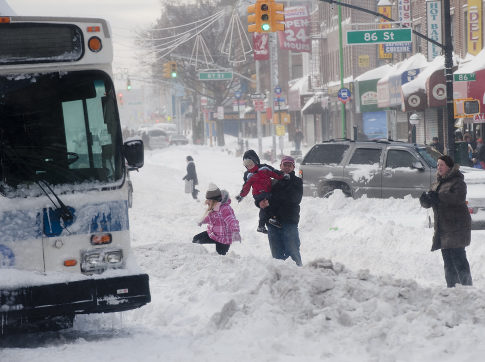
Sure, I still enjoy the sight of snow coming down. There’s something exhilarating about bad weather events occurring in real time. I appreciate, too, the pristine blanket of white upon a storm’s end, which, by the way, doesn’t remain so for very long in these parts. But right now I'm going about my business in the dreaded post-snowstorm days and nights. I just stepped outside and yesterday's shoveled sidewalks are glazed in an icy patina. The crossing of streets necessitate wading through a couple of feet of snow—or more in places thanks to Mother Nature’s wind-swept drifts and sanitation plows man-made concoctions.

There are an awful lot of dog walkers and dogs around town these days. So, the short-lived unspoiled white snow cover is already a urine-yellow in spots, with darker and sunken splotches to be found elsewhere, the extent of which will reveal themselves in all their splendor when the last vestiges of the snow are history. Upon a snowmelt, a city sidewalk isn’t a sight for sore eyes.

By this coming weekend—the first few days of the New Year—it is expected the temperature will climb into the forties, and perhaps top fifty with some rain. Well, those impassable street corners won’t—by then—have two feet of snow on them, which is all well and good, but a foot or so of filthy, ice-cold slushy water instead. Something to look forward, I suppose. Happy New Year!

Thursday, December 16, 2010

May in December


Once upon a time at the behest of his employer Montgomery Ward, a man named Robert L. May penned a children’s Christmas tale. This department store chain desired some kind of holiday giveaway that would win the hearts and minds of little girls and boys and, more importantly, the pocketbook loyalties of their mommies and daddies. And suffice it to say, advertising copywriter May didn’t disappoint with his story, Rudolph the Red-Nosed Reindeer, which chronicled the ups and downs of a somewhat unique member of a very cold society that celebrated sameness above all else.

While Rudolph wasn’t exactly autobiographical—May, after all, wasn’t a four-legged creature with antlers and a nose that, both inexplicably and unpredictably, cast a powerfully bright red luminescence into the ether. Nevertheless, he loosely based the Rudolph character on his own youth as a short and shy boy frequently picked on for being somehow different from the rest. Debuting in 1939, Montgomery Ward dispensed with more than two million Rudolph the Red-Nosed Reindeer booklets at their myriad stores. And even with World War II and a simultaneous paper shortage, six million copies were in print by 1946. This could mean only thing: Rudolph was a bona fide phenomenon. Seeking to take this beloved misfit of a reindeer to new heights, wannabe licensees of all stripes came a-calling.

Unfortunately, from Mr. May's perspective, all rights to Rudolph belonged to the Montgomery Ward Company. And, at the time, his personal life was a sorry mess. His wife, who had long suffered with cancer had passed away, leaving him a widower with a young daughter to raise and a pile of medical bills to pay, which he could not afford. May importuned a man named Sewell Avery, the Montgomery Ward chairman, to hand over the Rudolph copyright to its creator, and Avery complied—a rare act of corporate benevolence that would be inconceivable today. May would no longer have to sweat the bucks and could pay his bills and then some, particularly after two million Rudolph the Red-Nosed Reindeer records were sold with Gene Autry singing the lyrics written by Johnny Marks, who just happened to be Mays’s brother-in-law. Of course, it was the 1964 television special narrated by the avuncular Burl Ives that brought Rudolph and friends to life in perpetuity.

As a footnote here, the original story and the television telling are at odds in a few critical areas. For example, Rudolph had a wholly supportive family in the book. His father wasn’t smudging mud on his nose to conceal his so-called deformity, nor for that matter was he "Donner," a member of Santa's elite team of reindeer. Remember old Donner's embarrassed non-reaction to the oafish and callous reindeer flying coach—a prototype of the typical high school gym teacher—who said, "From now on gang, we won't allow Rudolph to play in any reindeer games." In the book, Rudolph’s family also lived in a working-class community of reindeers, not tony Christmas Town lorded over by the irritable King of Jing-a-ling, who could have, by the way, made Rudolph's young, impressionable life a whole lot less traumatic had he only seen the light a little sooner.

Monday, December 6, 2010

Life: Indifferent and Arbitrary


To follow-up on a previous posting concerning life during, and after, an unplanned and unwanted spell in Hospital Land, I suppose what’s particularly ugly about the overall experience—aside from the incredibly obvious—is the palpable indifference that wends its way through the sterile ether. Now, according to all that I’ve read, I was a patient in one of the best hospitals in New York State. And the doctors were top notch (they saved my life), and the nurses even better than that. Nevertheless, there were many instances when the quality of care was seemingly put on hold, suspended indefinitely.

For example, at some point in my stay I was scheduled for an MRI procedure, which necessitated a three mile or so journey from one hospital hotspot to another. If memory serves, the exam was scheduled for 9:45 in the morning and, of course, I was in transit long before that. When all of this transpired, my pre-amputated right knee was a grisly mess—an open wound that reeked to high heaven. I was also in perpetual pain and on countless meds to help alleviate the worst of it.

Well, to make a very long story short, I didn’t undergo said MRI until mid-afternoon sometime, and didn’t get back into my hospital bed until 7:30 at night, where I had a debriding surgery on the docket for later in the evening. Now, I won’t bore you as to the why it took so long for the MRI, which, by the way, is very unpleasant—a claustrophobic’s worst nightmare. I think one of the operating machines may have been out of order or some such thing. And then I had to wait hours for my ride back from whence I came. But what interested me most of all this day was how I had become a non-entity—somebody else’s problem. There was absolutely no concern that yours truly was in a tremendous amount of pain, and on medications, which didn’t get shipped along with my still breathing body. And so I received no pain relief all day long. And, too, there was no concern that I get a bite to eat, either. While I’m not a medical person, I suspect that when you’re really, really sick and very, very weak, a little nourishment might just do you a bit of good. If it weren’t for a sympathetic receptionist on duty supplying me with Jell-O, a few of packs of saltines, and apple juice from the waiting-room refrigerator, absolutely nothing would have passed between my lips from nine in the morning to about eight at night. Her superior even chided her for such generosity. I recall him saying, “That stuff’s for us.”

So, I spent hours upon hours in a waiting room, with countless people coming and going as if those of us patiently waiting on stretchers for our MRIs were invisible. The office conducted its mundane business as usual. Inconsequential personal conversations also occurred while the sick on stretchers listened in—if we were fortunate enough to be that aware, and some of us weren’t. And, if the majority were anything like me, they took special note of the cold chill in the air—life reduced to total indifference and completely arbitrary in meting out its punishments. Kind of scary, and not something one soon or so easily forgets.

Wednesday, December 1, 2010

Shea Hey


Over the Thanksgiving weekend, a local cable channel, SNY, supplied me with a mini-marathon of New York Mets’ highlight films from the late 1960s through the mid-1970s. I initially recall seeing these—by today’s standards—rather amateurish productions on WOR-TV, Channel 9, during rain delays in the 1970s. They were puff pieces, for sure, narrated by venerable announcers Lindsey Nelson, Bob Murphy, and Ralph Kiner, and written by local sportswriters like Dick Young. They accentuated the positive when, quite often, it was a stretch, and they envisioned light at the end of countless dark tunnels that turned out to be, to put it mildly, mirages. But they were nonetheless highly entertaining, ever-optimistic, and a microcosm of what were, dare I say it, simpler times.

Yes, simpler times when fans came out to the ballpark to see baseball games—period and end of story—that were at once affordable and not part of some interactive and costly theme park experience with perpetual, ear-shattering racket and the wafting aromas of exotic fare far removed from the pedestrian frankfurter. You know: the hot dogs at the ballpark that Humphrey Bogart deemed more scrumptious than “roast beef at the Ritz.” As I sat through these flicks from yesteryear—one after another showcasing teams and players that I fondly remembered from my boyhood—I felt a palpable loss. I really and truly wished that I could switch on a game in the here and now and feel the way I did once upon a time. But I can’t. God knows, I’ve tried.

I didn’t plot in advance to turn in my fan card at some such time and never return to the game that I loved so much. It just happened—inexorably—as the contemporary times intruded on, and ultimately imploded, the American pastime with its generally serene ambiance and quietly unfolding strategy, sprinkled, of course, with unpredictable bursts of high drama.

Recently, I spied a headline in a local daily that read: “Jeter, Yankees $50 Million Apart.” Now, the emphasis here should be on the word apart. The humble St. Derek evidently wants to be recompensed on par with some egomaniacal, smarmy teammate of his who shall remain nameless. Ah...but I’d rather hark back to the radio my godmother bought for me—as a First Holy Communion gift—with a super-cool dial on it. I listened to many, many Mets’ games on that radio—WHN carried the games in the mid-1970s—including during the “Ya Gotta Believe” 1973 comeback season. With the Mets in last place on the last day in August, manager Yogi Berra opined, “It ain’t over ‘til it’s over,” and he was right. That man was a philosopher! When all was said and done the Mets won the eastern division with only 82 wins (against 79 losses). On the final weekend of the season, five teams out of the divisional six had a mathematical chance of coming out on top.

To tie a not so neat bow around this unexpected stroll down memory lane, I remember for some reason the recurring radio spots on old Mets’ broadcasts from a company called Household Finance (HFC). Its jingle will be forever lodged on a YouTube loop in my brain: “Never borrow money needlessly, but when you need to borrow, you get more than money from HFC. More than just money…Household Finance.” Someday when I'm suffering from dementia, I won't remember my name, but I'm certain I'll be able to sing that commercial jingle word for word. Also, I seem to recall the same ad effortlessly segueing back into the broadcast booth where, for several seconds, all one could hear was the din of the crowd and—when home at Shea Stadium—a passing jet plane taking off or landing at nearby LaGuardia Airport. The back to Nelson, Murphy, or Kiner for more play-by-play. Those were the days all right.

Monday, November 29, 2010

Of Mice and Water Bugs


In the weeks preceding Thanksgiving, I was visited by a couple of God’s creatures: a mouse and a water bug. Now, the latter is a periodic caller to my ground floor lair here in the Bronx, most especially in the heat and humidity of summertime, which can be pretty bad in these parts. But the former is rare, which is good because I’m not as nimble as I once was.

As there are infrequent sightings of water bugs at this time of year, this particular visitation was an anomaly of sorts. The bug's stomping grounds, too, were unusual—not along my kitchen or bathroom floors but in my bed and on my head. I awoke feeling something in my hair—the little that remains of it—and brushed my hands through it. Must have been nothing, I initially reasoned, in my nighttime torpor. However, seconds later, feeling something once more, I ran my hands over my head and hair again. This go-around propelled this uninvited intruder to the far end of my bed, which was illuminated by a night-light. I could now distinguish the silhouette of some small creature slowly but surely meandering away from me. And I wasn’t dreaming or hallucinating, either.

Having been visited by a mouse only a couple of days earlier—coming out of the early season cold and pitter-pattering through the enclosed heating pipes along my ceiling—I initially feared the worse—that I had had a mouse on my head only moments before, which was now somewhere in my bed. But as I grew more alert and my senses sharpened with each waking second, I knew the zigzag gait of the creature on the unsteady terrain of my bed's blanket bespoke water bug, and not a more fleet-footed mouse.

Water bugs are pretty harmless. I suspect Andrew Zimmern has very likely even sampled a few in some outdoor marketplace or barbecue. As far as I know, they don’t bite or any such thing. But they are still creepy-looking. Sure, this misunderstood insect is judged largely by its grisly appearance, which as bugs go is downright sinister. They have quite a disagreeable crunch when you squash them, too.

It was about three o’clock when this incident played out. I subsequently got out of bed and switched on my bedroom light. The bug was gone. I searched high and low for this meddling insect, but it had evidently made its escape into some unseen nook and cranny. Still, I thoroughly examined all of my bed’s trappings from sheets to pillows to blanket. I just don't trust water bugs. They have this knack of quietly looming and returning for encores. But there was no sign of it—anywhere. I don't know why, but I opted not to return to my bed, and slept the rest of the night on an uncomfortable easy chair in another room. I let the water bug win. There must be a life lesson here.

Monday, November 22, 2010

Mr. Magoo's Heresy

Recently, I stumbled upon a vintage television commercial on YouTube. It was for a beer called Stag, which I never had the pleasure of sampling. From the early 1960s or thereabouts, its pitchman was none other than Mr. Magoo, a legally blind, beloved cartoon character. The ad’s a bona fide classic featuring the always-frenetic Magoo bumbling about in search of his preferred brew and singing its praises the entire time.

The individual who placed this fifty-year-old commercial on YouTube obviously didn't approve of its underlying message. In fact, he dubbed it “sleazy," and at once indicted and convicted the animated Magoo for “cracking open a few frosties in front of impressionable young minds.” Now, considering that a half-century has passed since the advertisement first aired, pardon me for finding it a bit strange that so many contemporary men and women (see the YouTube comments) get exorcised over TV programming from long before they were born. Come on, when Mr. Magoo salivated over a cold glass of Stag, John F. Kennedy was the president.

And no, I wouldn't condone old Magoo hawking a brand of beer today or, for that matter, Fred Flintstone and Barney Rubble puffing away on Winston cigarettes and promoting this lethal and filthy habit. But really, while they weren’t exactly on par with Family Guy or South Park, both cartoons from yesteryear were sold to predominantly adult audiences, and, I suspect, the aforementioned ads weren’t aired during Saturday morning cartoon times, either.

Not too long ago, somebody uploaded a video on YouTube who disabled the comment option with these words: “I don’t care in the least what the idiotocracy has to say about my video. If you want to watch it—watch it. If you don’t—don’t.” Indeed, it seems that the virtual woods are chock full of folks with agendas these days, not to mention a never-ending parade of crass imbeciles champing at the bit to have their vulgar say on matters great and small.

Again, while I wouldn’t sanction a cartoon colossus like Mr. Magoo promoting a beer in the here and now, pardon me for being skeptical of the notion that we’ve come such a long way vis-à-vis uplifting impressionable minds. I wonder how many innocent youths reached for a Stag brew because the hyper-Magoo liked his few? My friends and I played with toy guns and plastic soldiers as boys, but it never occurred us to bring the genuine articles into school and mow down our classmates. That said, I’m truly glad today's youngsters aren’t exposed to anything like Mr. Magoo on a beer-fueled high. It's at least something to be grateful for.

Saturday, November 20, 2010

Remembering a Pit Bull with Panache


With the omnipresent Sarah Palin weighing in on matters far afield in her latest tome, America By Heart: Reflections of Family, Faith, and Flag, including on the historic, reasoned, and rather eloquent JFK "separation of church and state" speech (which she’s now found fault with), I was reminded of a political personage from the past. His name: Spiro Agnew, at once revered and reviled by competing segments of the population.

I was an eleven-year-old boy when Agnew pleaded “no contest” to criminal charges of tax evasion and resigned as Vice President of the United States. Embroiled in a separate but more epic scandal known as Watergate, his boss, Richard Nixon, followed suit ten months later. Agnew was the proverbial heartbeat away from the presidency for almost five years, and that possibility positively exhilarated a portion of the populace, while simultaneously sending frightful shivers up and down the spines of others. Not unlike Sarah, Spiro was the antithesis of a neutral personality in the antithesis of neutral times.

When Nixon selected Agnew as his running mate in 1968, it stunned most political observers and regular folks as well, who had never heard of the guy. His credentials on the eve of being tapped for bigger and better things: not quite half of a four-year term served as Maryland's governor. Does the man's résumé—or lack thereof—ring a little familiar? Still, it didn’t take Spiro very long to become nationally known on the campaign hustings, and an even more recognized personality as the Pit Bull vice president with the big vocabulary.

Nowadays, we would probably say that Agnew very shrewdly branded himself. And I believe credit should be given where credit is due. Amidst the ongoing and increasingly contentious debacle known as the Vietnam War, Spiro’s speechifying in the early 1970s assumed a life of its own. Regardless of whether one believed he was fanning the flames of division, or a welcome breath of fresh air—my father loved the guy—some of his speeches were bona fide classics. In the gutter world of politics, even calling them literary masterpieces wouldn’t be too far off the mark. Agnew had an uncanny way with words and a forensic aptitude that very few pols before, or since, have exhibited—sorry Sarah.

Political reporter Jules Witcover dubbed Agnew’s delivery “a deceptive calm” in which the vice president unleashed a fusillade of blistering attacks on those whom he perceived as the enemies, which invariably included members of the fourth estate. In the book Very Strange Bedfellows by the aforementioned Witcover, a compelling read that chronicles the improbable pairing and rocky five-year political marriage of Nixon and Agnew, the author reveals that while Spiro employed speechwriters, he also wrote some of his best and most effective lines, including an attack on the “effete corps of impudent snobs who characterize themselves as intellectuals.” His frequent use of alliteration became known as “Agnewisms,” with such memorable hits as “pusillanimous pussyfooters,” “nattering nabobs of negativism,” and “hopeless, hysterical hypochondriacs of history.” Really, if we are going to be subject to divisive, bloviating politicians anyway, I’d just assume be entertained along the way. And I’d like to, perhaps, learn a few new words in the process. 

Thursday, November 18, 2010

Drunks and Lampposts


Legendary baseball broadcaster Vin Scully once said, “Statistics are used much like a drunk uses a lamppost—for support, not illumination.” I’ve since seen this same sentiment applied to people and their preferred sources of news and information.

In other words, most of us want our worldviews bolstered by the news programs we watch, as well as the books, newspapers, and magazines that we read (assuming we do). We are not on eternal quests for understanding and enlightenment. After all, such unquenchable pursuits necessitate, at the very least, some measure of reflection on the front end and a whole lot of digestion on the back end. And with our ever-waning attention spans in full throttle, locating support for what we absolutely believe is true—the way things are—invariably circumvents Illumination Road, where alternative views and gray areas on matters great and small, significant and trivial, reside.

There’s nothing quite like an election to bring out the worst in people—in all niches of the political spectrum. In today’s Information Age—with more interaction between and among individuals from both our pasts and the present—a regular dose of unsolicited ravings is wont to come our way whether we like it or not. Food for thought: Talk of politics and religion in drinking milieus is considered a no-no—not good form. And perhaps this same dictum should be applied to the social-networking bailiwick and the e-mailing habits of certain over-zealous friends, relations, and acquaintances. But, honestly, this noble prohibition is often ignored on the barroom scene. Drunks under lampposts—enjoying support and not appreciating the illumination in the least—are, I suppose, as American as apple pie.

Tuesday, November 16, 2010

Another Deficit Worth Fretting Over...


A recent news story reported how television commercials have gotten shorter and shorter to complement our waning attention spans. Whereas once upon a time many ads ran for a complete minute, fifteen-second spots are preferred nowadays because we the people cannot remain wholly engaged for a full sixty seconds.

The obvious downside of instantaneous communications and a mother lode of information at our fingertips is this corresponding, and apparently ever-widening, attention-deficit chasm. Harking back to my youth, I often wonder how we all survived without computers, the Internet, and only a dozen or so TV channels from which to choose. But we somehow managed and, I daresay, were hardly a less informed and less curious bunch. Running around all day long text messaging, Tweeting, and playing iPhone games hasn’t exactly made us a more literate and interesting lot—quite the contrary. Engaging in personal phone conversations everywhere from the supermarket checkout line to a crowded subway car to a claustrophobic ATM alcove have not ushered in a more cultured, conscientious, and sociable society, either.

Theoretically, with this surfeit of knowledge in the virtual ether, we should—by osmosis—be a more informed and inquisitive brood all across the spectrum. But it appears that not exactly everybody is sampling from the cornucopia of riches at their disposal. The bottom line is that if we cannot remain alive, alert, awake, and aware for a clock minute, or even half of one for that matter, sheer logic dictates that we’ll also read fewer books and newspapers (including online)—the very things that necessitate greater than one-minute attention spans, and that cannot be encapsulated in fewer than 144 characters. The insatiable thirst for less in-depth and multi-layered information is evidently where it's at. Granted, sometimes in life, less in better. However, all too often less comes up short because— as the old saying goes—“A little knowledge is a dangerous thing.” It's even worse, I fear, than none at all.

Saturday, November 13, 2010

In Search Of...


In 1976, a pioneering television program for its day debuted. It was called in Search of, a half-hour documentary of sorts that investigated everything from “lost civilizations” to “extraterrestrials”; “myths and monsters” to “missing persons”; “magic and witchcraft” to “strange phenomena.” Hosted by none other than Mr. Spock, Leonard Nimoy, who did a splendid job at conveying a sense of the mysterious, sometimes even unsettling so, the show boldly went where no TV show had gone before.

After watching in Search of Bigfoot, there was no chance in hell I was ever going hiking or camping in the mountains of the Pacific Northwest. And upon seeing in Search of the Bermuda Triangle, forget about me ever flying over, or sailing through, this voracious and unforgiving expanse of ocean brine. Happily, the Bermuda Triangle, aka the Devil’s Triangle, appears to have been consigned to the Much Ado About Nothing file, and is no longer considered an unsolved mystery. And Sasquatch and the Loch Ness Monster, too, may not exist at all, the latter perhaps being nothing more than an over-sized eel, a big fish, which stuck its over-sized cranium above the lake's surface every now and then, created a few big waves, and frightened a lot of people in the process. With snowballing technology and countless in-depth tools of study at our disposal, so many of these esteemed monsters of the past, as well as purported extraterrestrial visitations, have been put to bed for good. It's actually kind of sad.

Despite the in Search of team of “scientists, researchers, and a group of highly trained technicians” warning us of a possible Ice Age in the offing—this on the heels of the brutal Buffalo, New York winter of 1976-77 and some 200 inches of snow—it was well-done television and indisputably a TV trailblazer, supplying us with ample food for thought on a broad range of diverse topics from Jimmy Hoffa’s disappearance to the legend of Dracula; from poltergeists to the efficacy of ESP. This show was in fact in the vanguard of the New Age.

I think the in Search of opening theme’s disclaimer—and what a resonant and memorable one it is—nicely summed things up with: “This series presents information based in part on theory and conjecture. The producer’s purpose is to suggest some possible explanations, but not necessarily the only ones, to the mysteries we will examine.” Theory and conjecture are always welcome and should be encouraged, but in the end we must defer to hard facts, hard as that sometimes is.

Thursday, November 11, 2010

The Incredible Shrinking Toilet Paper


I recently read an article headlined: "Why Your Toilet Paper Is Shrinking." I thought it oddly coincidental, only because just this past week I detected a very strange phenomenon within arm's reach of my toilet bowl. Whereas my roll of toilet paper used to barely make it into the compartment carved in the wall—the very snuggest of fits—now ½” or so of breathing space exists. I could only draw one conclusion: The manufacturer, Scott, had altered its toilet paper formula without informing the consumer. Perhaps they didn't think we would notice.

I’ve long been aware of this sort of thing—from the can of coffee, which once upon a time was a pound, then thirteen ounces, and now is eleven ounces, to half-gallons of ice cream and cartons of orange juice, which are yesterday's news. Have you noticed your bars of soap lately? Before even the first bath or shower blast, they have considerably shrunk in size. And I don’t know if it’s just me, but these new and smaller soap bars seem to implode more rapidly, too, breaking into pieces, falling into the tub, and clogging the shower drain after only a handful of uses.

I'll plead guilty to having sheepishly accepted all of this less-for-more corporate slight of hand for many, many years now, where companies roundabout raise their prices by making things smaller. But I think they’ve finally gone too far. There’s something downright nefarious with this toilet-paper legerdemain. I’d rather pay twenty cents more for a roll of the original size than suffer the indignity and daily reminder every morning—after a few cups of coffee—of the incredible shrinking roll of toilet paper. Just what can we the people do? Boycott toilet paper? The next time you're sitting on the bowl and reach for a sheet, which is a shadow of its former self, take a moment and reflect. After all, if they are willing to tamper with our toilet paper, then nothing, I fear, is sacred.

Tuesday, November 9, 2010

This Is Your Life...


It was a night unlike no other and, very fortunately, largely forgotten by me. Well, not quite. I recall all too many details from that evening—of both things that were and things that weren’t. But happily, the sheer terror of that night in question has been wholly transformed into a comical, albeit dramatic, reminiscence of a certain life adventure of mine.

As far as putting things in my mouth and swallowing, or inhaling things through my nose with the objective of flying to the Moon, Mars, and Jupiter, I’ve pretty much been a good boy all these many years. I can honestly say that I never desired to trip on a hallucinogen to conjure up Maharishi Mahesh Yogi, or even Yogi Berra for that matter. Popping a pill in the hopes of being embraced by light has never been on my agenda, either. After all, encouraging one’s brain to boldly go where no neurotransmitter has gone before is just as likely to erect a prophet fellow whose name begins with “M,” and a corresponding hallucinatory fatwa, which would be awfully scary.

This is a roundabout segue way into my hallucinatory story. It occurred in a hospital milieu a little over four years ago. Apparently, some thing or things within the medley of meds I was prescribed while vegetating in intensive care caused me to both see and hear things that didn’t actually exist—not a good thing—and, worse still, believe the doctors and nurses on duty wanted to cast me asunder in my hospital bed. My drug-challenged brain was further convinced that an all-encompassing conspiracy was afoot to drive me completely mad. You're nobody until you believe somebody's out to get you.

When my sorry excuse for a leg—thanks to a gnarled mass of tissue and massive blood loss—was undressed and then redressed on this fateful night, I watched a doctor employing a couple of slices of pizza in lieu of bandages to cover the gruesome thing. Pizza had recently been delivered to somebody on the premises. I saw that as well. And the vitals monitor—or whatever it was called— hovering above me no longer recorded blood pressure and heart rate, but instead a This Is Your Life…Nick Nigro facts and information crawl. Boy, were these hospital folks going through a lot of trouble to punish me for my earthly sins. Oh, yes, and they had definitely turned the heat up in my little corner of the world—it had to be at least 120 degrees. Also, I absolutely knew that if I pushed a button to give me pain medicine, which I desperately needed and was told to use, the medications would kill my pain all right.and me right along with it.

Could my eyes have been deceiving me all along, and my brain taken a bizarre and Byzantine detour into the shadowy Land of Paranoia? Well, to make a very long story short, the next morning when I received family visitations, I informed my father that they had to get me out of the hospital and toot sweet, because my life was in imminent danger courtesy of a malevolent staff out to do me bodily harm. Now, this little exchange really shook the old man up, and not because he sensed murder in the sterile ether. He was in pretty bad health at the time, and hardly needed to see his son so physically wracked, but this out-of-the-head addendum was more than he could bear.

It was my mother who eventually clued me in that I was, in fact, hallucinating, and that not a single one of these ghastly things happened, or were happening, to me. I was literally seeing ominous handwriting on the wall and on the ceiling, too. However, once I received this most welcome reality check, the extreme fear and runaway paranoia, which totally gripped me, evaporated.

I was my old rational self again, yet nonetheless still seeing things that weren’t there, and occasionally hearing them as well. Despite the nasty medications playing dirty tricks on my brain, I could at least now separate the real from the unreal. And, trust me, the real was bad enough at the time and the worst was yet to come. Finally, as a footnote here, I apologized to an always patient and compassionate male nurse for accusing him of plotting my demise. He said, “No problem…it happens all the time in this place.” 

Monday, November 1, 2010

Old Meets New...


Tomorrow is Election Day. It’s an especially significant one here in New York City. Oh, not because of any particular person on the ballot, or some earth-shattering proposition that will radically alter our lives. No, tomorrow is the day New Yorkers vote with paper ballots for the first time in a general election, joining the vast majority of Americans in voting that way. All my adult life I have cast my ballots, as it were, in an antiquated machine with a big red lever that closed a shower-like curtain. In the privacy of the voting booth now, there were little black levers next to the names of candidates, which I pulled to cast my votes. Xs would appear upon my making these selections. The final voting act—pulling that large red lever again—both officially recorded my votes and, equally important, opened the curtain to let me out.

I must confess to being fond of the old machines, but can certainly see why their time has come and gone. New York City—the most renowned metropolis in the world—has got to get with the program and vote in step with the twenty-first century. Still, I have this lingering fear about what tomorrow will bring, and it doesn’t revolve around any worries of possibly soiling my ballot and disenfranchising myself. I will figure out the thing. After all, I have rather competently filled in ovals before, starting in the third grade or thereabouts. But it’s the mayhem that I presume will besiege the polling place that fills me with some dread.

From what I've experienced through the years, things are more often than not discombobulated in the vicinity of voters and voting, particularly when there’s reasonably high turnout. The paid volunteers who oversee this annual extravaganza are a diverse hodgepodge of locals with a median age of eighty-seven, I’d guess. I might also add that general crankiness and conspicuous hearing loss appear to be prerequisites for many of the positions. And then, of course, there are the voters from all walks of life and of all ages. When the aforementioned poll workers and the voting populace butt heads, it’s rarely pretty, and even less likely to be so this year with the new voting apparatus in place.

For a whole host of reasons, I have never been especially confident in the integrity of NYC elections. And it’s only partially because of the dedicated, but frequently hapless folks in charge of everything on the ground. It's the city’s Board of Elections, which turns over the whole shebang to this cross-section of regular Joes and Janes, that isn’t exactly on top of the really important things and the nitty-gritty. For starters: Who’s eligible and who’s not eligible to vote? For many, many years now, I’ve spotted dead people on the eligibility rolls—and some rather long gone at that—as well as folks who have vacated the hustle and bustle and crime and grime of Gotham for greener pastures, and who are now registered to vote elsewhere.

If a dead man walking, or current resident of Paducha, Kentucky, showed up to vote in my Bronx precinct tomorrow, the odds are that a ubiquitous table manned by three volunteers would not suspect foul play. But, fortunately, nothing like this ever happens in real life.