Friday, July 7, 2017

Extra…Extra…Read All About It

On Independence Day 2017, I found myself on a subway jaunt into Manhattan and back. Passing the 181st Street—George Washington Bridge—station on my downtown ride on the Number 1 train, I remembered a bizarre rumor that persisted during my boyhood in the early 1970s. It was that the Fuhrer did not, as widely reported, commit suicide in his bunker in April 1945. And the urban myth of local interest took it from there. Somebody somewhere spread the word that the octogenarian monster—who would have been in his eighties in the seventies—had miraculously managed to escape Germany and was very much alive. More specifically, he was peddling newspapers for a measly living in the subterranean recesses of the 181st Street station. I don’t recall what, if any, newspaper—Daily News, New York Post, etc.—figured in this remarkable account.

I do recollect as boy of eight, nine, and ten years old passing by the station—as I did a few days ago—and getting the creeps. That's a phrase we used a lot as kids. We lent credence to stuff as children, I know, that didn’t pass the smell test, including that the 181st Street station was simultaneously under the Hudson River and the George Washington Bridge. Entering and exiting it required a ride on a ferryboat, I guess. A friend and I were once absolutely convinced that the clouds in the sky were stationary. The Earth’s rotation—not wind—was the sole wind beneath their wings. I take some solace in the fact that we were only eight years old at the time with a lot to learn and not making government policy.

Now that I’m on the subject of the extraordinary rumors that permeated yesteryear’s ether, I remember a “doomsday” prediction that got some play. My first thought—all these years later—was that it was one of Jean Dixon’s many prophecies. She was, after all, the psychic du jour in the 1970s. But from what I gleaned in my virtual research, Dixon didn’t forecast the apocalypse in that singular snapshot in time. She had several years earlier—the year I was born—forecast world destruction, but not in my grammar school days. So, I’m betting that what gave me a few anxious moments as a nine year old was evangelist Herbert W. Armstrong’s 1972 prediction of the third rock from the sun’s absolute obliteration. That sounds about right. For I had my whole life ahead of me at the time, which, I suppose, is why the world ending so prematurely mattered. Think of all the pizza slices I would never have tasted. Now, forty-five years later, I say: Let Dixon and Armstrong’s snake-oil successors foretell away—and see if I care.

(Photos from the personal collection of Nicholas Nigro)   

Thursday, July 6, 2017

Fifteen Dollars Richer

I found fifteen dollars on the sidewalk this morning. After grocery shopping at a local Key Food supermarket, I was on my way home when I spotted what appeared to be bona fide American currency—not Monopoly money—in the distance. If memory serves me correctly, I found an orphan five-dollar bill once. But that was the height of my good fortune while wandering to and fro in the great outdoors—until today. I stumbled upon a few stray singles in my fifty-plus years of living, too, but lady luck has been pretty sparing in the lost cash-on-the-ground department. Considering that I’ve lived my entire life in New York City, it would have been nice to unexpectedly find a Ben Franklin, or at the very least an Andrew Jackson a time or two. Why, though, question the fickleness of fate? I’ll happily settle for the Hamilton and Lincoln that came my way today. It is, after all, a free pizza.

Still, I felt kind of guilty when I picked up the money. I nervously looked around to see if anyone was nearby. Had I had spied a bewildered individual frantically searching for something lost, I would have, naturally, approached him or her. But there was nobody in the vicinity who matched that description. And so it was: finders, keepers.

Before my unexpected good fortune on this cloudy and humid morn, I snapped a picture of what in the old neighborhood were known as “Umbrella trees.” They are actually Northern Catalpa trees, I believe. In the 1930s and 1940s, this unique-looking tree with its big leaves, string-bean-like hanging pods, and twisting trunks were, apparently, a favorite with certain builders of homes. The trees were omnipresent in my youth and attracted ladybugs. We youngsters called them “Ladybug trees” and collected the orange-and-black colored insects, which left a foul scent on our hands. I sincerely hope ladybugs are still around and not the victim of over-building or some mysterious toxin. I just haven’t been collecting them for a while, or examining the remaining Ladybug trees to see if they are still there. Call them what you want: Umbrella trees, Ladybug trees, or Northern Catalpa trees. There are still a fair share of the trees around, but I remember them being on the fragile side and not the best big city trees, particularly by the sidewalk’s edge.

I distinctly recall a homemade sign that a neighbor on the next block had painted green on a piece of aluminum, which he affixed to a Ladybug tree on his property. It read: “No dogs allowed here.” In the 1960s and 1970s, most people walked their dogs in the street. They curbed their dogs, if you will. Nowadays, everyone walks their canine companions on the sidewalk and they do what they have to do in the very terra firma where the “No dogs allowed here” was once posted. As the years passed and the tree matured, the bark grew around—above and below—the sign. Soon, it was embedded in the tree—part of the sign and part of a time as well.

Homemade signs are not as common in the here and now. Custom-made or store bought ones with threatening rules are, in fact, the rule. The streets that I grew up on are so much more congested. It would be unwise and pretty much impossible to walk dogs in them as I did a long time ago. You know: when no dogs were allowed by the Umbrella tree, the Ladybug tree, or the Northern Catalpa tree—call it what you will.

(Photos from the personal collection of Nicholas Nigro)

Friday, June 30, 2017

Many Forms Indeed

When my subway car’s doors opened at 79th Street in Manhattan the other day, an advertisement on the platform caught my eyes. It featured a deer and the words: “City dwellers take many forms.” Further, it importuned residents to learn to live alongside them. Personally, I have not as yet laid eyes on any deer in the Bronx or elsewhere in town. But it doesn’t surprise me that they exist in some of the city’s larger parks and open spaces—like Van Cortlandt Park, which is within walking distance for me. It’s a sprawling piece of property that spans more than a thousand acres. The park’s off-the-beaten trails are pretty woodsy, which is where I suspect the deer and the antelope roam.

I am quite willing to live harmoniously alongside these nimble four-legged creatures. It’s some of the two-legged that give me pause. The city’s many bodega owners, for instance, have to put up with a lot of crap in their interactions with a cross-section of humankind, including the bottom of the barrel. Exhibit A: Ali’s, where I regularly purchase pints of Hershey’s “Creamy Vanilla” ice cream, Linden’s chocolate chip cookies, and rolls of Bounty paper towels, which I can actually reach. Apparently, the general rule of thumb in these establishments is to stock paper towels as close to the ceiling as physically possible.

Anyway, as I entered Ali’s recently, Ali in the flesh was being lectured. A patron with a cup of coffee in hand excoriated him for not saying “thank you” upon the conclusion of their transaction. “It’s proper to say ‘thank you’” the customer complained. “It’s basic human decency!” For the record: This exchange was somewhat atypical for the cozy confines of Ali’s deli. Now, I will attest that Ali sometimes says “thank you,” but not always or even most of the time. More often than not he’s engrossed in some tête-à-tête via his earphone. I’m so accustomed to that sort of thing. And chastising Ali for his dubious decorum is not my job. He’s got a lot on his plate after all.

Don’t believe me. Moments after witnessing Ali’s dressing down, a young fellow entered the place. He was engaged in an animated conversation—if you could call it that—on his cell phone. The man effortlessly unloaded F-bombs and B-bombs, too. Further, he spoke of setting his girlfriend—I guess—straight with brutal acts of aggression. It was a surreal experience. A young woman, who had ordered a bacon, egg, and cheese sandwich, was, like me, privy to this spectacle. She muttered aloud, “He should just be taken out and shot!” Meanwhile, Ali’s eyes flitted nervously, not knowing what this raving lunatic had in mind. He probably just wanted a Red Bull. However, I happily missed the final act. The woman, by the way, was of the same ethnicity as the frothing-at-the-mouth young man. So, too, was the man who scolded Ali on his deficient etiquette.

What lessons did I learn in the bright light of day? For one, Ali doesn’t have it so easy. And feral is feral—it knows no race or ethnicity and greatly troubles the non-feral. A footnote to this tale: While I’m against capital punishment in theory, I couldn’t help but heartily agree—quietly and for a brief ugly moment—with the sentiment expressed by the woman patiently awaiting her breakfast sandwich.

(Photos from the personal collection of Nicholas Nigro)

Thursday, June 29, 2017

A-Treat Summers

Lydia Maria Child’s Thanksgiving poem begins like this: “Over the river, and through the wood/To Grandfather’s house we go.” But I recall singing, “Over the river and through the woods to Grandmother’s house we go,” while en route to Bangor, Pennsylvania, home of my maternal grandparents. From my family’s Bronx point of origin, the first river we crossed was the then pretty grimy Hudson; the second and last, the muddy Delaware.

Before Interstate 80’s tentacles reached Teaneck, New Jersey— in close proximity of the George Washington Bridge and New York City—our Bangor adventures found us on Route 46 for a spell. While the trips took a whole lot longer on such meandering back roads, they were much more interesting—for kids anyway. We passed through many small towns, including Hackettstown, New Jersey with a hamburger joint called Leo’s on its main thoroughfare. Suffice it to say, my father didn’t have the fascination that his offspring had for mysterious fast-food establishments—i.e., the ones we spied only through a moving car’s windows in places that we had never set foot.

It should come as no surprise then that I vividly remember when my dad consented to stop at Leo’s for lunch. It was the summer of 1976—the United States Bicentennial year—a simpler and more civil time to exist. It was of an era before presidential tweets and daily Twitter outrage. We were on our way back to the Bronx when this memorable moment in history occurred. At long last, my younger brother and I sampled Leo’s burgers and French fries, which we knew for certain wouldn’t disappoint—and they didn’t.

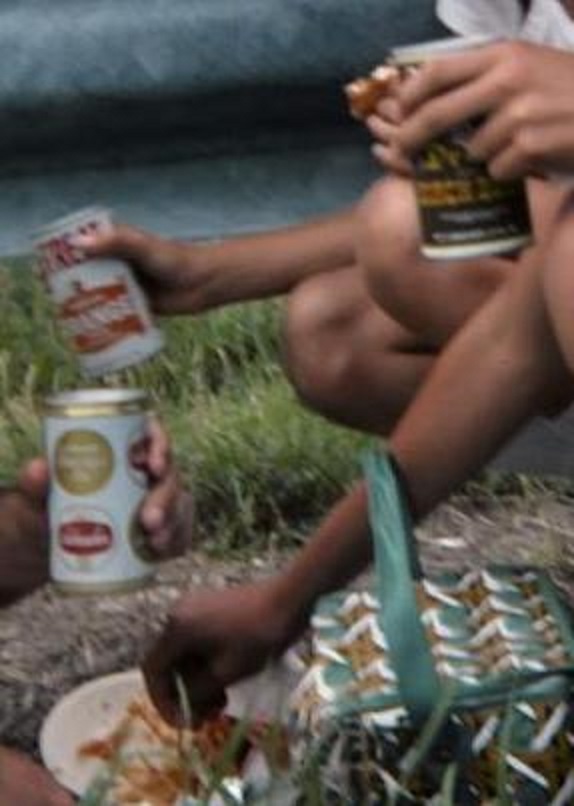
Actually, we brought our take-out fare from Leo’s to nearby Budd Lake and briefly picnicked on the side of the road. My father had packed his preferred brew, Schaefer Beer, in a cooler bag, so he needed no liquid refreshment from Leo’s. On the other hand, my brother and I washed down our tasty repasts with A-Treat brand sodas: orange and birch beer, respectively. I was intrigued back then—as youth are wont to be—by enticing products unfamiliar to me, like A-Treat Beverages, whose hanging signs were ubiquitous outside of country grocery stores. We didn’t have A-Treat sodas on grocery store shelves in New York. A-Treat was a local outfit. So, naturally, the opportunity to sample them in such faraway places as Northwest New Jersey and East Central Pennsylvania was heavenly.

After ninety-seven years in operation, I learned, A-Treat shuttered its plant in Allentown Pennsylvania in early 2015. However, the collective voice of a thirsty and nostalgic people clamored for its return. I can fully appreciate why—to those served by this regional institution—life just couldn’t go on without A-Treat. I’m happy to report that an entrepreneur brought the soda line—with original recipes—back to life.

Forty-one years ago while sitting on the banks of Budd Lake with an A-Treat soda pop in hand, I couldn’t in my wildest imagination portend the future. Calling attention to the A-Treat soda cans, I recently posted a picture on Facebook from that historic day in 1976.  And lo and behold, advertisements for A-Treat appeared in my Facebook feed shortly thereafter. Such is the insidious new world we now call home—but at least A-Treat is still in it.

(Photo one from the personal collection of Nicholas Nigro)

Monday, June 19, 2017

Sneaky Pete’s Dragon

A few days ago, I spied “No Parking” signs covering a several block radius in my neighborhood. Beginning at ten o’clock last night, remaining vehicles would be towed away. Upon closer inspection, the signs revealed the reason behind this local upheaval: location filming of Sneaky Pete, an Amazon original series. While the show has been recommended to me, I have thus far not seen it.

I recently wrote about a certain stroll down memory lane. That is, watching episodes of Kojak, my favorite TV detective of all-time. As previously noted, my contemporary complaint of this 1970s production is the cheesiness—the unevenness—of the filming. As a kid, the tough but compassionate New York City cop on the streets of New York, which more often than not were the streets of Los Angeles, didn’t faze me in the least. As I recall, it was quite costly in those days to film in New York versus Tinseltown. It still must cost a fair chunk of change, but today’s politicians clearly have the welcome mat out for such endeavors. Many more TV shows and movies are filmed here than in Kojak’s day. Blue Bloods, starring Tom Selleck, is exclusively shot on the streets of New York, including the outer boroughs of Brooklyn and Queens. While it looks really good—and real—I found the show somewhat heavy-handed and self-conscious. In other words, looks can be deceiving. So what if Kojak makes reference to a restaurant parking lot in midtown Manhattan, or that countless scenes include a stationary crowd of curious onlookers. 

While TV shows and movies are typically enhanced when filmed on location, the process is disruptive. In densely populated neighborhoods with limited parking spaces, residents are impacted. I can attest to the fact that road rage and parking rage, too, are not uncommon on the mean streets of the Bronx. It’s dog-eat-dog out there. Remove a couple of hundred spots and the competition—the cat fighting—gets taken to another level.

When I ventured out this dreadfully humid morning into the Sneaky Pete universe of trailers, lighting, and cameras, I saw that film preparations were underway at Tibbett Diner, an iconic neighborhood eatery that has lent its singular ambiance to filmmakers before. It was closed today for the shooting, which I’m sure caught a lot of loyal and hungry patrons by surprise. But sometimes sacrifices have to be made for the greater good. Immortalized on Sneaky Pete, Tibbett Diner—and the neighborhood it serves—will endure forever.

(Photos from the personal collection of Nicholas Nigro)

Saturday, June 17, 2017

I Made It Through the Rain

I appreciate that weather is an inexact science. I don’t, for instance, put much stock in two-week forecasts. When I first checked The Weather Channel’s (TWC) extended forecast for Saturday, July 1, scattered thunderstorms and a high of seventy-nine degrees were forecast for New York City. When I refreshed the page ten minutes later, the scattered thunderstorms were no longer in the picture. Never mind what the next ten minutes would bring—how about ten days?

On the other hand, hour-to-hour forecasts I expect to be more accurate than not. On this overcast morning, I placed my confidence in TWC’s predictions for the nine to one o’clock window of my intended journey. What I gleaned was cloudy at nine, cloudy at ten, cloudy at eleven, cloudy at twelve, and cloudy at one. Had rain been in the offing, I would have altered my plans. But moments before I left, TWC had given me the green light to venture out into the great outdoors without an umbrella or rain jacket, both of which are absolute last resorts for me. The official scuttlebutt was that it would be cloudy and dry until very late in the afternoon, when there was only the slightest chance of a passing shower.

It was a shade before noon when it began raining on me. I was in the vicinity of Rockefeller Center at the time and expected the shower to be fleeting in nature. I huddled in the doorway of some closed-on-the weekend office building for a spell, but it kept on raining and increasingly harder at that. As I was only a couple of blocks from my train station, I took the plunge and got wet. I figured by the time the Number 1 train exited the tunnel at 125th Street, the rain would have stopped. It hadn’t. It was back in the tunnel until Dyckman Street, closer to home, where I again anticipated more arid climes. The fact that I got soaked leaves me with precious little confidence in TWC’s Atlantic hurricane season predictions. How many named storms this year? 

Beyond the mercurial weather and inexact science of meteorology, I nonetheless got to see human beings in a variety of hues. The subway is a human nature laboratory. There are signs in various cars nowadays importuning riders to behave like good-mannered men and women. “Don’t Be A Pole Hog” and “Take Your Pack Off Your Back” were a couple of the admonitions I spotted this morning. It’s a shame so many people need to be educated on common courtesies. Of course, it remains to be seen if placards in the subway, instructing one and all to be civilized and considerate, reap any dividends. I suspect not. Today, I saw this woman with a baby stroller blocking an entire aisle of a crowded subway car. There was perhaps a foot to pass in either direction. She was on the train for quite a while, too, staring stoically into space with a puss on her face, as if daring someone to say something to her. On the brighter side, I witnessed a young fellow offer his seat to two different people, who both politely declined his generous offer.

Prior to getting rained on in the bright light of day, I walked the streets of Manhattan. At one point, I spied a guy sipping a cup of coffee in front of a swanky boutique. He looked like its owner to me, which made what he did next especially irritating. Finished with his brew, the lout tossed the empty cup into the street before sauntering back into his shop. No garbage can inside? Seriously, if I were running a chic retail establishment in a fashionable Manhattan neighborhood, I wouldn’t want garbage on the sidewalk or in the street in front of the place. And, by the way, it’s the weekend. The street isn’t going to be cleaned for a couple of days.

I didn’t stop for a bite to eat in my travels, because I would have to drink something with my repast. A plus B equals C, bathroom stopover. And wandering aimlessly around Manhattan is often a biffy-free zone. I’m sure Taste Good Chinese Restaurant had a toilet for its customers. But Frosted Flakes taste gr-r-reat, so I passed. I considered Num Pang sandwich shop, but—I don’t know—that's what I expect after taking a couple of Aleve. The name just didn’t ring appetizing. Of course, I could have stopped by John Doe Bar & Kitchen, the amnesia victims preferred watering hole. In the end, however, I got wet and made it through the rain.

(Photos from the personal collection of Nicholas Nigro)

Tuesday, June 13, 2017

By George, I Think I Fist Bumped

For a third day in a row the thermometer surpassed ninety degrees in New York City. We’ve now had six ninety-degrees—or higher—days this spring, which overall has been much colder than normal. And so in this curious spring, it’s only fitting that I experienced a peculiar first. There is a first time for everything, I guess, including a fist bump. In my limited circle of friends, relatives, and acquaintances, the old-fashioned handshake has always been sufficient. There’s not a fist bumper in the bunch. But the moral of this story is to expect the unexpected and never rule out anything in life, including a fist bump.

On this June “scorcher,” I bumped—pun intended—into a neighbor. I don’t know him well, but he’s a friendly fellow who likes to talk—loudly and sometimes a little too much. While his English isn’t especially good, he makes up for it with gushing enthusiasm. On multiple occasions now, the man has called me “George,” confusing me with another local with whom he has conversed. I don’t resemble or sound anything like George, but it would seem we’re all Georges to him.

Anyway, on this sultry morn, he was his bubbly self, shaking my hand in greeting and making small talk about the hot weather. “You are George, right?” he subsequently said. I hadn’t bothered correcting him up to that point—two corrections in previous encounters was my limit. Nevertheless, in response to the direction question, I replied, “No, I’m Nick.” It was this answer of mine that inspired the fist bump—the sweaty fist bump—that I couldn’t ignore. I really thought that I would get through life without giving or receiving one, but I was wrong.

I see where a scientific study concluded that the fist bump is actually more sanitary than a handshake and less apt to spread illness and disease. Speaking of scientific studies, I ran across another one this week that deemed the French fry bad for our health. Now, that is something I’ve heard before. Considering that they are typically fried in oil and often smothered in ketchup, why should we be surprised?
 
At my favorite diner last week, I ordered a side of French fries and thought about how many I must have consumed over the years. My father used to pick up a fifty-pound bag from a fruit-and-vegetable seller in the Arthur Avenue Market in “Little Italy in the Bronx.” With Manhattan’s Little Italy a mere shadow of its former self—gentrified beyond recognition—the Bronx’s is in truth the only Little Italy remaining in New York. That big bag of potatoes, by the way, didn’t last very long in a family of seven. Depending on what was the main course, the potatoes were baked, mashed, boiled, or fried. But French fries ruled on our dinner table in a time and place that knew no fist bumps.

(Photos from the personal collection of Nicholas Nigro)

Sunday, June 11, 2017

My “Mrs. Stern Moment”

After exiting a crowded subway car yesterday morning, I escaped from the land down under with a scratchy throat. Too many people in too small a place, tunnel dust, and the heat of June—which we’ve had very little of so far—were the culprits. While walking east on 18th Street in the sunlit morning air—through a hipster land of gluten-free pizza and Dim Sum—I coughed. As I covered my mouth, the cough sounded an awful lot like a sneeze. At least that’s what a passerby thought. He said, “God bless you, sir.” I replied, “Thank you.” I didn’t feel it necessary to explain to him that I had coughed and not sneezed. The man being a Latino awoke something me—a revelation of sorts. I had just experienced a “Mrs. Stern Moment.”

Some background on Mrs. Stern: She was a regular customer in a retail shop called Pet Nosh, where I toiled several decades ago. Mrs. Stern was a nice enough woman, but somewhat neurotic and in a constant state of high anxiety. She was a bona fide animal person who fed stray cats and contributed to others who adopted homeless pets. These noble acts nonetheless compounded her perpetual unease.

For years, the staff at Pet Nosh gave her bag loads of free samples from the various pet food manufacturers. “Do you have samples for the strays?” Mrs. Stern would always ask. “You know I feed them.” Yes, we know! As the years passed, however, fewer and fewer samples of pet foods came our way. Apparently, it had become apparent in the dog-eat-dog industry that free-flowing freebies weren’t paying dividends. Mrs. Stern’s strays enjoying their respective repasts wasn’t exactly what they had in mind when dispensing their sample products. She and other recipients of the free sample pet foods never accepted the fact that we no longer had a bottomless trove from which to tap. In the retail environs, we discovered, no good deed goes unpunished.

Actually, the “Mrs. Stern Moment” has nothing at all to do with her animal activism. It’s something much bigger and touches on universal harmony. One summer’s day approximately a quarter of a century ago, she came into Pet Nosh even more hyper than usual. Out of character, it was a gleeful strain of hyper. Mrs. Stern explained that her buoyant state of mind involved a sneeze—the genuine article—at a red light. Motionless with her driver’s side window down at the time, a motorist across from her at the light—with his windows down—heard the sneeze and loudly said, “God bless you.” What moved Mrs. Stern so much about this random act of kindness was that the driver was a black man. She read into this encounter something so much more than a ubiquitous societal courtesy. Mrs. Stern saw the big picture. How we’re all in this together—black, white, brown, yellow. After all, we all cough and we all sneeze. And so, now you know why I had a “Mrs. Stern Moment” yesterday.

A footnote: Mrs. Stern has since passed away. She was no youngster when she patronized Pet Nosh and regularly beseeched us for free samples. But—from where I sit—she’s left a legacy. Mrs. Stern’s been gone for fifteen years, but obviously not forgotten. A trivial cough on the not-so-mean streets of Manhattan set in motion a series of events that got me thinking about her. One little cough for man—one giant sneeze for mankind.

(Photos from the personal collection of Nicholas Nigro)

Sunday, June 4, 2017

Tommyrot on My Mind

I remember seeing a clip of former President Dwight Eisenhower with Barry Goldwater, the Republican nominee for president in 1964. They were at Eisenhower’s farm in Gettysburg, Pennsylvania filming a campaign infomercial. To make a long story short, Eisenhower said at one point—in reference to charges that Goldwater was a warmonger—“This is actual tommyrot.” Tommyrot was an expression unfamiliar to me, but I liked the sound of it. The word’s homespun informality had a certain appeal. Tommyrot means “nonsense”—or “rubbish” if you prefer—and has an appropriate nonsensical ring as well.

There’s this tightfisted money-worshiper in the old neighborhood who got me thinking about “tommyrot.” He’ll remain anonymous, but his forename shouldn’t be too difficult to figure out. Let’s call him Mr. T, a landlord many times over. The man buys up houses and rents the apartments therein at exorbitant prices, which sadly are the going rates for this time and place. The end-result of the practices of Mr. T and his ilk—and there are many like him—are revolving-door tenants, many of whom don’t give a whit about their transient residence and neighbors. As a favor to his son, a friend of mine looked at an apartment owned by the incomparable Mr. T. The rug in its living room was filthy, he told me, an incidental pointed out to the landlord during their tour. “That’s not my job!” Mr. T said in response. And he was asking over two grand for the two-bedroom apartment. A one-off cleaning lady was obviously not included in the price.

Courtesy of Mr. T and tommyrot, I had landlords on my mind yesterday as I walked up Ninth Avenue through a Manhattan neighborhood nicknamed “Hell’s Kitchen.” Once upon a time an Irish working-class stronghold—and quite gritty environs as you might imagine—it is no longer hospitable to folks of modest means. The Irish mob, the Westies, don’t even live there anymore. Suffice it to say: It’s not your grandfather’s Hell’s Kitchen. In the rough-and-tumble days gone by, there were mom-and-pop delicatessens, not “gourmet” delis with unintentionally ironic names. The locals from yesteryear didn’t know brunch from a smoothie. The sober-minded drank egg creams, which aren’t typically available in the contemporary gourmet establishments, and the others, libations with a little more edge. This was Hell’s Kitchen, after all.

According to Wikipedia’s description of Hell’s Kitchen now, it’s become home to a fair share of Wall Street financiers. My Mr. T could probably afford to live there. I see, too, that there are various accounts of how the neighborhood received its infamous moniker. The one I like best is attributed to a veteran policeman, “Dutch Fred,” who was partnered with a rookie. The newbie is reported to have said, “This place is hell itself.” Dutch Fred then set him straight in no uncertain terms: “Hell’s a mild climate. This is Hell’s Kitchen.” It’s not Dutch Fred’s Hell’s Kitchen anymore, either.

(Photos from the personal collection of Nicholas Nigro)

Friday, June 2, 2017

Clouds in My Coffee

I noticed a lot of picturesque cloud formations in the big blue skies of the last couple of days. Mother Nature’s pleasing visuals seemed apropos in light of what has been transpiring in the wide world of politics and beyond. Until this year, I was content on worrying about—and occasionally feeling embarrassed—at things said and done by a handful of loose cannons in my life circle. I never imagined that one day I would have to assume the burden of worrying about what my president might say or do in a tweet, during a commencement speech, or while conferring with a foreign leader. But, alas, it has come to that.

As a boy, I believed in the inviolability of “American exceptionalism.” I don’t remember that exact phrase being bandied about then, but I viewed my country as the “land of the free” and “home of the brave.” It was, after all, the geographical hot spot that attracted people from all over the world—men and women who wanted to make better lives for themselves and for their families. Most of us didn’t have to look very far to see that this “land of opportunity” was in fact the real thing and not some patriotic propaganda. My paternal grandparents emigrated from Italy, and my grandmother never, ever desired returning to the Italian mountain town she grew up in—even for a short visit.

I have in my possession a composition book, which belonged to my grandmother. It’s the one she compiled in preparation of her citizenship test. Learning the English language, American history, world geography, and civics was an integral part of the process. For me, one entry in particular jumps out: “Today is Wednsday [sic], July 15, 1942. Mayor LaGuardia lives in New York City. Gov. Lehman lives in Albany. Pres. Roosevelt lives in Washington, D.C. District of Columbia.” I don’t fault my grandmother for misspelling Wednesday, which is the most difficult day of the week to spell for native English speakers. But, really, what was she feeling on that summertime Wednesday three quarters of a century ago? The world was at war, including the United States of America, the country in which she would soon be a citizen. Basic food staples were rationed. Friends and neighbors were enlisting in the service and fighting in faraway places.

In those dark days, President Franklin Roosevelt delivered radio “fireside chats” from the White House, reassuringly referring to his fellow Americans as “My friends.” Mayor Fiorello LaGuardia read the comics, including Little Orphan Annie, over the radio during a newspaper deliverymen strike three years after my grandmother noted in her composition book his city of residence, which she shared. They were simpler, though far from easier, wholly different times. And these men weren't losers!

My grandmother and her new country overcame many obstacles in the decades to follow. America became a better place on countless fronts. But I wonder if we have we finally thrown the baby out with the bath water? I would very much like to believe that this too shall pass. However, the times no longer guarantee it. When I think of the number forty-five, I choose today to recall the late Tug McGraw and his screwball. Call it mind over matter.

(Photos from the personal collection of Nicholas Nigro)
Sunday, May 28, 2017

The Age of Shoddy II

One of my favorite miniseries of all-time is Ken Burns’s The Civil War. For some strange reason, a particular segment headlined “The Age of Shoddy” resonates with me today. When I initially saw the installment, I knew what the word “shoddy” meant, but in a contemporary context only. I was unaware that in the 1860s, “shoddy” referred to an uber-cheap fabric manufactured by unscrupulous wartime profiteers—men who sold poor-quality uniforms at inflated prices to the Union army. At the time, The New York Herald contrasted the Silver Age and Golden Age of the world’s past with the unseemly Age of Shoddy, which spawned a shoddy aristocracy of millionaires. These were human beings at their most greedy amassing fortunes at the expense of those fighting and dying on the battlefield.

A modern definition of shoddy in the Merriam-Webster dictionary is “a pretentious vulgarity.” And this, I believe, is a term befitting the current age. Last year, for example, New York City subway cars were festooned with reminders of what courteous and civilized people shouldn’t do in them. Advice on placards included covering one’s nose when sneezing, not clipping one’s fingernails, and holding off for a spell on malodorous repasts. After all, a subway car isn’t a dining car. Granted, there have always been inconsiderate, loutish boors out and about, but the sheer number of them nowadays is staggering. And technology isn’t helping the situation, either.

Yesterday, while riding the Number 1 train into Manhattan, I was reminded again of the times in which we live. The subway car I was in had gotten pretty crowded by the time two teenage girls, I’d guess—although they might have been a little older—appeared with their breakfast sandwiches in hand. Standing directly above me, they began unwrapping their fare. The wafting odors of the sandwiches remained both potent and entrenched in the congested setting.

One of girls loudly complained about her sandwich, but didn’t say, “Pardon my French.” The worst of the boorishness was yet to come when the conductor announced that from 72nd Street to Chambers Street, the train would be running on the express track and only stopping at express stations, which didn’t include the girls’ stop. They opted to ask a fellow straphanger about their unanticipated predicament. “Where should we get off now?” The rider fielding their question was a walking-and-talking stereotype, who didn’t appreciate the unsolicited brain work heaped upon him. He angrily replied, “What are you asking me for? The map’s right there!” Audibly perturbed, he pointed to a subway map, which was—in fact—directly in front of the girls and, unfortunately, right above my head as well.

“We just asked you a question,” the more combative of the two girls said in response. “What’s your problem?” The put-upon passenger out of central casting then walked over to the map and a comedic—were it a sitcom—back-and-forth ensued. He was still visibly angry that he had somehow been lured into helping these damsels in distress, but it was nonetheless his life mission now to sort out the girls’ conundrum.

At ten o’clock in the morning, a man with boozy breath and two girls munching on salami and egg heroes kibitzed over my head. I would have found the circumstances and dialogue quite amusing on Sanford and Son. But it wasn’t Sanford and Son and I heaved a huge sigh of relief when one and all exited at Times Square. The girls were looking for the A train, which was simple enough to connect with, but the guy with the foul morning breath was insistent that they absolutely needed to get on the R train to reach their destination. “We ain’t goin’ on no R,” I heard one of them say as a parting salvo.

When I returned home, I switched on the news and saw clips of my globetrotting president. The Age of Shoddy II, I thought, “a pretentious vulgarity” for sure. Whether I’m walking on the street, riding in a train, or tuning in the news, it’s an age like no other.

(Photos from the personal collection of Nicholas Nigro)

Wednesday, May 24, 2017

The Orphan Baseball

During my morning constitutional in nearby Van Cortlandt Park yesterday, I encountered an object in my path that—forty or so years ago—would have consumed me with delight. It was an orphan baseball that had found its way from a nearby field to the footpath. In my youth, this sort of find was akin to a gold strike. But in the here and now, I was absent any glee. I merely paused, recalled what once was, and moved on. Sure, I momentarily considered picking the ball up and taking it home with me. But that would have necessitated placing it in my pocket—a not inconsiderable task that, if successful, would have certainly attracted attention.

Were it 1977 with Jimmy Carter in the White House, I would have unquestionably added another baseball to my inventory. While we in the neighborhood sometimes played baseball on the crab grassy fields of Van Cortlandt Park—and a few other fields of green—concrete and asphalt surfaces were our primary playgrounds. And as hard as the “hard balls”—our moniker for baseballs, which distinguished them from the various other balls we played with—were, they took a beating on concrete and asphalt. I remember playing with baseballs that had lost their original cowhide covers. The cover substitutes consisted of several layers of electrical tape. Granted, electrical-taped baseballs were in their death spirals, but it was a frugal time. And like just about everything else back then, a baseball wasn’t taken for granted. It was a throwaway item only after it had accumulated sufficient mileage and died a proper death.

Speaking of baseball and electrical tape, I plugged in my old Schaefer Beer “Welcome” light-up sign for the first time yesterday. I've had it for a while now. Copious amounts of electrical tape on its cord had kept me from doing it before. But I finally threw caution to the wind and, I can report, no sparks flew. Four decades ago, Schaefer was the most popular beer in New York and the surrounding areas. It was my father’s preferred brew and he drank truckloads of the stuff before it went by the wayside in the 1980s. Schaefer Beer was at one time the official beer of the New York Yankees and then of my beloved New York Mets. But all good things come to an end. I passed up a perfectly good baseball. And Pabst Brewing Company now owns the Schaefer label and produces a pale imitation—crappy and cheap—of a former giant, which I will pass on, too.

(Photos from the personal collection of Nicholas Nigro)

Tuesday, May 9, 2017

Memories and Alternative Memories

There are memories and there are alternative memories—fiction. Since we live in an age of alternative facts, I consider alternative memories a natural offshoot. Not too long ago, I attended a gathering and chatted with a ghost from my past. He was an affable enough fellow, but he loved nothing more than to hold court and be the center of attention—the type of guy who is hard to stomach for any extended period of time. What annoyed me most of all was not so much that he was a blowhard, but that his recollections of the past frequently veered into fantasy.

I appreciate the fact that memory is a tricky thing—not an exact science. My recollections of the past don’t always jibe with others’. But there are certain memories—historical claims—that the aforementioned ghost from my past spewed that were patently false. They were downright slanderous to a couple of people from the old neighborhood who are long dead and buried. Unfortunately, in a small room sans an escape hatch other than a visit to the bathroom, listening to alternative memories was the price the rest of us on hand had to pay.

And now for something completely different: a memory rooted in reality plus a little science. For every action there is an equal and opposite reaction: Saw that my maternal grandparents’ old home on Miller Street in Bangor, Pennsylvania was for sale, which resurrected a traumatic experience. Arriving from the Bronx for a visit some forty-five years ago, I was carrying my Matchbox case full of cars to the house. In what was most unfortunate timing, the case snapped open in the street—directly above a sewer grating—and several cars from my impressive collection rolled out of the case into it. Visible to the eye, they remained for the entire world to see until the next heavy rain.

This painful memory, nevertheless, prompted me to search the Internet for vintage Matchbox cars and purchase a few, including a few of my all-time favorites: the Greyhound bus, station wagon ambulance, and Studebaker wagon. Back then, those of us with matchbox cars played with them until they were scratched and tattered. These die-cast gems were originally manufactured by an English toymaker—Lesney—with great attention to detail. The Studebaker wagon, for instance, had a retractable roof in its back. In a play moment with my younger brother—in the great outdoors of Bangor—it’s the car we deemed to belong to “Yia Yia.” Yia Yia, by the way, was our next-door neighbor in the Bronx—an elderly Greek woman and grandmother—who didn’t drive in real life. And that’s not an alternative memory. But as to who were the “owners” of my other matchbox vehicles in that playtime a long time ago, I don’t remember and won’t create an alternate reality. I’ll leave that kind of thing to that ghost from my past and his epigones in the alternative memory fraternity. 

(Photos from the personal collection of Nicholas Nigro)

Thursday, May 4, 2017

The Scarlet Pimple Face

While in the cozy confines of Van Cortlandt’s Tail—my box seat to the elevated tracks of the Number 1 train—I spied something unusual. It wasn’t Freddie flicking a sandwich bag full of crumbs to his frenzied feathered friends. There’s nothing unusual about that. Nor was it nearby track workers in fluorescent vests carrying flags on the El. That’s a common sight, too. Rather, it was a teenager with a pronounced case of acne.

Via Facebook, I’ve gotten to see a cross-section of my generation’s kids. While not a scientific survey, I have concluded that most of them amble through their teen years without seeing a pimple, squeezing a blackhead, or living with oily skin. When I was a teen, I suffered from periodic acne flare-ups, particularly during the grueling school months. Remarkably, when on summer hiatuses from the educational grind, my face totally cleared. Healthy doses of sun and fun worked wonders.

Back then, as I remember, many of my peers suffered with acne—some of us with worse cases than others. The most common remedies in treating the scourge were over-the-counter products like Oxy cleansing pads and Clearasil, which I don’t remember having much of an impact on our embarrassing pimple problems. There were a handful of kids with pretty ghastly cases of acne who visited dermatologists, but that sort of thing wasn’t on the radar for most families, including mine. Acne was considered part of growing up and that it, too, shall pass. And for most of us it did, leaving—in some instances—the telltale signs of what once was.

I know there are still plenty of kids with acne concerns, but it’s probably more of a class thing now. After all, Oxy cleansing pads and Clearasil are still around. But the suburban youth of today appear to have their zit troubles nipped in the bud. It would seem that modern medicine has done it again. I am, too, astonished that these same youth have Hollywood teeth—pearly white and straight as an arrow. How their parents pay for all these unblemished faces and perfect chompers—not to mention $50,000/year college tuitions—I can’t say.

There was a time when just hearing about or seeing a copy of The Scarlet Pimpernel in a bookstore or on a library shelf, would prompt me to think and maybe even say out loud, “The Scarlet Pimple Face.” And, once upon a time, teens from all walks of life could readily identify with The Scarlet Pimple Face. Not so anymore. But are kids who never know pimples better off in the long run? I don't know. However, I do know they’ll never appreciate the joy of getting rid of them. A little imperfection along the way sometimes has its benefits, because in life’s mirror are one zit after another.

(Photos from the personal collection of Nicholas Nigro)

Wednesday, May 3, 2017

What Would Washington Say?

I found myself in lower Manhattan this past Saturday—about as low as you can get on a warm and humid morning. I walked among the caverns of Wall Street—a labyrinthine maze of streets—and through the memorials for 9-11. Tourists from all parts of the United States and the world were everywhere. A big police presence, too. Prior to 9-11 the very same terra firma was—as I recall on weekends—relatively quiet. But that was then and this is now. It’s 2017. The next anniversary of 9-11 will be its sixteenth.

An old friend and I now refer to four-year spans as “Spellman cycles.” We both attended Cardinal Spellman High School in the Bronx from 1976-1980—four interminable years from our perspectives. I hadn’t yet turned eighteen on graduation day. So, four years in time amounted to almost twenty-five percent of my life in toto. Right now, four years represents just a shade over seven percent of my existence. I guess this explains why four years go by in a heartbeat nowadays, and how four Spellman cycles have just about passed since that awful day in 2001. And nine Spellman cycles have come and gone since my high school days!

Speaking of the passage of time, I chanced upon the historic Fraunces Tavern in my recent adventure. Located on the corner of Pearl and Broad Streets, it’s the hallowed spot where General George Washington, upon the British surrender and evacuation of New York, bid farewell to his officers. I most devoutly wish that your latter days may be as prosperous and happy as your former ones have been glorious and honorable,” he told the assembled. The date: December 4, 1783—fifty-eight-and-one-half Spellman Cycles ago.

If he could return today for a visit, I wonder how the Father of Our Country—the man on the dollar bill—would feel about things in the here and now. Esmerelda on Bewitched brought the man back to life for a spell, but that was in the colorful and contentious early 1970s. Armed Forces of Puerto Rican National Liberation  (FALN) detonated a deadly bomb in Fraunces Tavern several years later, But more than ten Spellman cycles have run their course since then. What I would like to know at this moment in time is what General Washington would make of the Subway franchise located right next to Fraunces Tavern in 2017? Seriously, is this what New York City has come to? When only a stingy-portions sandwich chain—apparently—can afford the astronomical rent in that historic part of town. The hair and nail salon above it likely gets a better deal. I don't know exactly what Washington would say about it all. Perhaps the hair and nail salon might intrigue him. A place he wished existed in the eighteenth century to powder a wig on a whim.

(Photos from the personal collection of Nicholas Nigro)