Friday, August 3, 2018

Talk Soup


It’s been a soupy summer thus far. And today is no exception. In appreciation of the present dog days, I will opine on this, that, and the other thing. For starters, I watched clips of the president ranting and raving at a pep rally yesterday. What came to mind—other than the incredibly obvious—was that more than a few people in attendance were offended when the Orange Man’s predecessor wore a tan suit at a press conference. He demeaned the presidency with this shocking sartorial selection, they—once upon a time—grumbled.

For some reason this same spectacle made me resurrect a waiter named Nestor and cat named Kyle. Nestor worked in a diner that I regularly patronized twenty-five years ago and Kyle was the place’s skulking mouser. On occasion the latter would wend his way up from the basement and saunter around the diner. Nestor warned my dinner companions and I to be leery of Kyle. “Cat not friend!” he said in his less-than-fluent English. Well, fast forward to the here and now and Nestor would be right in saying, “Russia not friend!”

A favorite short-order cook of mine in the very same establishment in which Nestor toiled was fond of saying—after his patented kitchen ramble of how so many things in society have gone awry—“It’s crazeeeee!” And indeed it is! The evidence is in and it’s overwhelming: We are unhinged—it would appear—and in a perpetual state of outrage. The unremitting frothing at the mouth knows no single political bent or particular demographic.

Facebook, for one, is a revealing laboratory. Nowadays, so many people are out to get scalps. “Shoot first and ask questions later” is their mantra. Mobs are lying in wait to annihilate those with whom they disagree politically. Nasty name-calling is the new norm. But mob outrage is hardly confined to partisan politics. Its wrath—to pick a couple of dissimilar instances—is cast upon adults who snare foul balls meant for little kids at the ballpark and, too, supercilious cheapskates who demean restaurant wait staff. With respect to the former, I’ve personally witnessed my fair share of Neanderthals at baseball games. Men and women who should have known better behaving like boors in usually futile attempts to procure orbs wrapped in cowhide. And while I found their behaviors annoying, even nauseating at times, I didn’t believe then or now that violence should come to them or their families. I didn’t believe then or now that their lives—and abilities to earn a living—should be disrupted in perpetuity. Apparently, that’s the posture of all-too–many angry Wizard of Oz-types on social media. Cloaked in the anonymity of their technological devices, it's disheartening to see them clamoring for the home addresses or pictures of those whom they believe deserve a taste of virtual justice. We're in a bad place right now...

Okay that’s enough of all that. It’s time to return to the more mundane—picayune annoyances and oddball observations. Recently, a woman across from me on the subway decided to paint her nails, taking most of the oxygen out of an already stuffy subway car. After exiting the train and the still lingering scent of nail polish, I spied Jolly Joe’s snack truck at Van Cortlandt Park. Free advice for Jolly Joe: If you can’t fit your name and the essence of who you are on one line, use a smaller font. The Scrabble board look is unbecoming of an ice cream man and makes a tacky first impression. Oh, and one last thing, I came upon a sneaker pawnshop in Manhattan. Yes, Virginia, the shop does purchase used sneakers, but probably not my Reeboks. I saw a pawned pair of sneakers selling for $850 on their website! These are strange times for sure.

(Photos from the personal collection of Nicholas Nigro)

Wednesday, July 25, 2018

The Pigeon Has Landed


It's been a clammy week of high humidity and fast-changing weather. The sun is shining one minute and there's a drenching downpour the next. In a momentary peep at blue skies yesterday, I spied the Red Baron flying over the Bronx. Seconds later the skies turned ominously gray and both the Red Baron and sunlight were gone. 

And now for something completely different in these soupy times: I recently came upon the name Nadia Comăneci, a five-time Olympic gold medallist in gymnastics, in a virtual news headline. The article referred to some accomplishment of the Romanian gymnast in the 1976 Summer Olympics in Montreal. What I most remember from that snapshot in time was being on vacation in the cozy hamlet of Mattituck, Long Island and not watching the Olympics—even for a moment. There was, however, a man named Jimmy on the scene, who had to be indoors—and glued to the telly—on those warm summer nights in July to watch Comăneci strut her stuff. And so I’ll never forget her.

That summer, by the way, was America’s bicentennial—her two hundredth birthday if you are counting. Looking back now, I see a more serene place to call home where the majority of Americans put their country above their party—above their petty, partisan politics—and could just chill out for one brief shining moment at least. Of course there was no social media in those days—no forums to vent 24/7 and spew bile under the cloak of anonymity or, worse still, in the bright light of day. There were no cable channels offering never-ending parades of blithering talking heads with uncanny knacks of riling up the faithful night after night after night.

1976 was a presidential election year, too, with incumbent Republican Gerald Ford—benign, prone to physical mishaps, and the epitome of dullness—fighting off a fierce primary challenge from a charismatic true believer named Ronald Reagan, who was deemed too old by pundits to ever seek the presidency again. Ford’s opponent in the general election was Jimmy Carter, a pious peanut farmer with a toothy smile. It was a bitterly fought campaign with Carter narrowly defeating Ford.

Magnanimously, Jimmy Carter began his inaugural address on January 20, 1977 with this: “For myself and for our Nation, I want to thank my predecessor for all he has done to heal our land.” The unelected Ford had assumed the office after Richard Nixon’s resignation amidst the Watergate scandal. And it was the beginning of a beautiful friendship. Ford even designated Carter to deliver his eulogy when the grim reaper determined that the 38th President had fallen down his last flight of stairs and would never ever again bang his head while exiting an earthly helicopter.

While on the subject of that bicentennial year, I vividly recall election eve when Jimmy Carter was declared the winner. Watching a network broadcast—the only alternative in those days—the ecstatic Carter relations in Plains, Georgia were called upon to comment on their good fortune. Stewed to the mickey, brother Billy Carter made the greatest impression on the viewing audience as he proclaimed that the Carter warehouse would be on holiday the following day. A paid one, he added with a bleary-eyed snicker. My father, a staunch Republican, expressed dismay at Billy’s behavior and thought it a sad day for America. He believed that the incoming First Family would be an embarrassment and stain on American dignity. Suffice it to say, the bar has been lowered—removed entirely, I think—on that front today.

When Nadia Comăneci was mesmerizing Jimmy and that other Jimmy’s family was making news, it was a different world entirely. I turned fourteen in 1976 and began high school without a cell phone, Facebook page, or a single app. Somehow I survived and America did, too. I’m just happy I’m not fourteen now. The pigeon has landed.

(Photos from the personal collection of Nicholas Nigro)

Sunday, July 15, 2018

The Fat Lady Sang


I think I go through life now on the outside looking in—or the inside looking out—whatever? So, when she entered the train with the assistance of a cane this morning, I couldn’t help but notice her considerable heft. The fat lady sat directly across from me, which caused me to internally cringe—and not because she was overweight with no discernible chin, but because I knew now that I had to be on special guard. It was a subway ride game-changer for me. You know: I wouldn’t want to be perceived as staring at her in any way, shape, or form. And then there’s my hobby of taking pictures and videos in the land down under. I wouldn’t want the woman to think I was attempting to photograph her on the sly. I wouldn’t want her to think I was making sport of her.

Now, here’s the real kicker vis-à-vis my fellow passenger. As the train approached her stop—Lincoln Center—she began the not inconsiderable task of gathering up her things and rising from her seat. The latter wasn’t a walk in the park, I detected, as I stared mostly at nothing in particular. When she finally made it to her feet, she tapped me on my knee—my prosthetic one—with her cane. Startled, I wondered if the woman sensed something unusual in the echoes of that tap. She asked: “Are you all right? You look…” I look what? 

“I’m fine,” I answered. “Take a few deep breaths,” the concerned lady added as a parting salvo. “Breathe in and breathe out.” And off she went into the wild gray yonder. Yes, it was that kind of morning. As I watched her pulling her travel bag on wheels to an exit, I realized that despite her girth, she was quite comfortable in her ample skin. The woman—whose hair, by the way, was dyed a light shade of blue—had a New Age-y feel about her.

So, I accepted her advice and took a few deep breaths, which isn’t always a good thing in a cramped subway car in summertime. On the very same trip, I encountered a female panhandler whom I’ve seen on multiple occasions. She’s got a piercingly loud voice and never deviates from her script and its three key selling points: HIV positive, empty refrigerator, and infant daughter. Oh, and that she doesn’t get her check for a couple of weeks, which she also proclaimed a week ago. When I dropped two dollars into her large mayonnaise bottle-sized receptacle, she said, “Thank you, honey.” I prefer these sizable containers for money drops and salute her for utilizing the proper prop.

Another fellow on the train had nothing at all but his hand for the money exchange. His pitch, though, was especially poignant. “Do not be afraid of me” and “Do not judge me.” I wasn’t and didn’t. Lastly, there was this individual whom I’ve previously spied working the subway cars. She’s clearly mentally ill and takes the handout notion to a very literal level. The woman goes from person to person and sticks her hand out each time in their respective faces. Let’s just say that she doesn’t respect people’s spaces, which is bad for business. There are a lot of sorry souls on the streets and in the subways, too, which is why being on the outside looking in—or is it the inside looking out—has its benefits.

(Photos from the personal collection of Nicholas Nigro)

Saturday, June 16, 2018

Sex and the City


When I spied a city bus with a billboard on its front side—directly under the driver—for the Museum of Sex, it struck me as odd. When the very same advertisement appeared on bus after bus after bus, it struck me as odder still. You see, there was no further information to be gleaned from the ads about this mysterious museum. Where exactly it was located and what exactly could be found there was left to our imaginations. Of course, this is the Information Age we live in and the answers to those questions are readily accessible with a smartphone or computer. By the way, if you’re interested in discovering what all the fuss is about, the place—also known as MoSex—is located at 233 Fifth Avenue on the corner of East 27th Street.

I had in fact encountered subway promos for one and the same on recent train trips. But then came the Museum of Sex bus blitzkrieg—seemingly out of nowhere—with the billboards prominently positioned and seen by millions in what amounted to a traveling road show. I was naturally curious as to MoSex’s money source for this comprehensive advertising campaign. It had to cost the museum a pretty penny. Perhaps the establishment receives endowments from the rich and famous—endowed or otherwise—I don’t know.

Also, I couldn’t help but wonder how the billboards were playing with the populace at large and, too, Metropolitan Transport Authority (MTA) employees. After all, bus drivers were compelled to lord over three words and three words only: Museum of Sex. Lo and behold, local news stations reported on and answered my questions this morning. There was indeed a billboard controversy. Complaints about them were coming in fast and furious from the aforementioned bus drivers. Female drivers griped about harassing hoots and hollers from riders. Male drivers weren’t too happy, either, being in the crossfire. Putting that three-letter word on the front bumpers of buses on busy routes was destined to stir the pot of boorishness, which is quite a large melting one in New York City, and it didn’t disappoint.

The MTA actually took to heart what their employees had to say vis-à-vis the Museum of Sex billboards and promised to slowly but surely remove them. I can attest that the removal—in my neck of woods at least—has been immediate. They were on practically all the buses yesterday and not on any of them today.

An unrelated footnote here is that the MTA now has a policy of “gender neutral” announcements. No more “Ladies and Gentlemen” and that sort of exclusive thing. You are more likely to hear: “Hello, Everyone.” When I first heard that intro echoing in the subway bowels, it sounded rather awkward to me. But I didn’t know then that a new policy—not to offend someone who is neither a lady nor a gentleman—was in place. Had the MTA consulted with me beforehand, I would have recommended: “Ladies, Gentlemen, and the rest” rather than “Hello, Everyone.” It would have simultaneously accomplished its inclusive mission and paid homage to the first season opening credits of Gilligan’s Island.

(Photos from the personal collection of Nicholas Nigro)

Saturday, June 9, 2018

Tail of One Park


It’s a U-shaped group of benches with a nicely shaped evergreen tree as its centerpiece—one that is decorated with lights at Christmastime by the New York City Department of Parks and Recreation. The place is an island unto itself—set apart from the sprawling Van Cortlandt Park proper by the heavily trafficked W240th Street, or Van Cortlandt Park South, as it is known east of the El. This slice of earth is, nonetheless, parkland and has been officially dubbed “Van Cortlandt’s Tail.”
                       
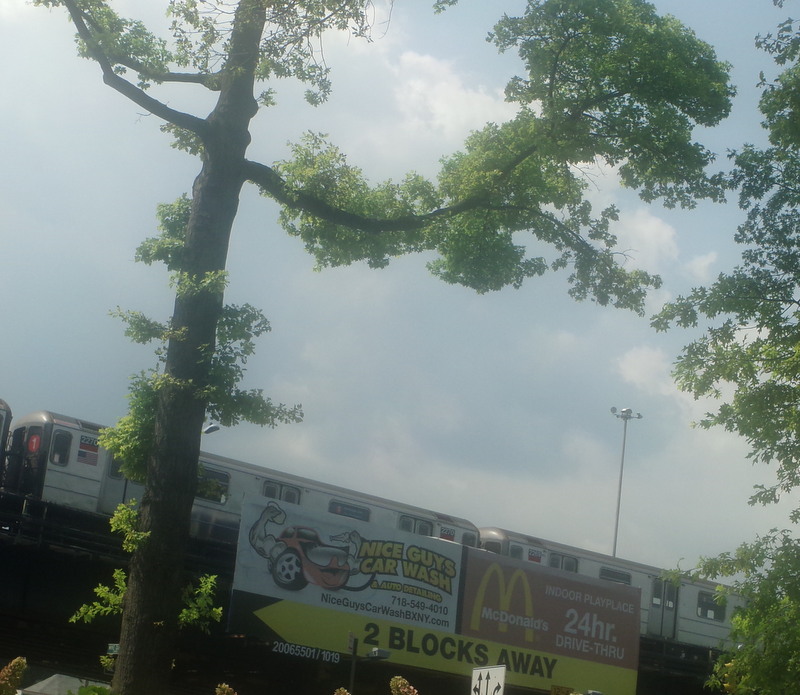
The reason why I snap so many pictures of the El on Broadway, subway track workers festooned in neon yellow and orange, and assorted passing vehicles is simple. It’s the view from the Tail, my catbird’s seat to occasionally interesting, but mostly non-interesting daily occurrences and recurrences. It wasn’t a planned thing, but the Tail has become a frequent stopover for me—an ideal resting spot and refuel location during my errand and exercise runs. 

Granted, I’d rather be sitting on a bench gazing out at the Atlantic Ocean, the Hudson River, or even Lake Welsh. There was nothing quite like vacationing as a boy in Manasquan, New Jersey and watching the fishing vessels navigate the Manasquan Inlet. But, believe it or not, observing Number 1 subway trains entering and exiting their ports has a certain calming effect—on me at least. The earsplitting horn blowing and screeching and scratching metal against metal isn’t exactly music to my ears, but it’s oddly reassuring. Never fail: The Tail supplies its visitors with an unceasing show of urban repetition with a special surprise every so often. And why not?

Life is full of surprises. On the western border of the Tail is Broadway traffic, which adds further color to the place’s singular ambience. Passing fire trucks and ambulances with sirens sounding are regular sightings. It’s a “Rainy Night in Georgia” kind of thing, only with a not-so-distant “moanin’ of a train.” Simply put: It’s a pretty noisy spot. And with Van Cortlandt Park a popular attraction—especially in the warm climes—there are typically ice cream and hot dog trucks in the vicinity.

While repeatedly playing the most maddening jingle—one that concludes with a particularly annoying “Hello!”—Jolly Joe’s sells everything from frankfurters to smoothies to chewing gum. Meanwhile, Mister Softee—a storied favorite in these parts—is happily still peddling his product in vintage trucks from forty and fifty years ago. That’s the way it looks to me! Mister Softee’s jingle is renowned in the five boroughs. In fact, franchisees playing the thing too loud and for far too long have inspired a city ordinance. The jingle must go silent while trucks are idle. Funny, but I had a Mister Softee truck right outside my door this past week for twenty whole minutes. The jingle played non-stop on a loop the entire time. I don’t know what’s worse: leaf blowers in autumn or the Mister Softee jingle in summer—played over and over and over. Nevertheless, it cannot be denied that the familiar jingle resonating through the ether attracted business that otherwise wouldn’t have known Mister Softee was on the scene. And—unbeknownst to many patrons—the jingle actually has accompanying lyrics beginning with “The creamiest, dreamiest soft ice cream, you get from Mister Softee.” Sights and sounds are all around.

(Photos from the personal collection of Nicholas Nigro)

Sunday, June 3, 2018

Embraced by the Light


I was “embraced by the light” at 18th Street yesterday morning in a Manhattan subway station. Soon after, I made my up to street level and the bright light of day. In the hazy sun and unpleasant heat and humidity of creation, I spied a “smoke shop” that gave me pause. “It’s not your grandfather’s cigar store anymore,” I said to no one in particular. “Vaporizer, Beer, Lotto, Cigars” are a far cry from my memory of “Optimo” in the old neighborhood. A rather large “Optimo Cigars” sign hung outside the place, which is why we locals—not so originally—called it Optimo. Really, though, it was just another “candy store” that—like its competitors—sold cigars as well. Nevertheless, the name distinguished it from Bill’s Friendly Spot (formerly Paula’s) and Joe’s (later Shital’s). Joe, by the way, was a notorious cheapskate who gave sour balls back to kids instead of change. Needless to say, Shital’s had an unfortunate moniker for a candy store on Main Street—or, in this instance, W231st Street in the Bronx.

Further wandering brought me past the “Merci Market,” which prompted me to say—again to no one in particular—“Lamb of God, You take away the sins of the world—have mercy on us!” I don’t exactly know why, but during Sunday Mass we would repeat that refrain followed by the grand finale: “Grant us peace!” And once the prayer was put to music, it became lodged in my brain for all eternity. A footnote: The “Lamb of God” entreaty was always appreciated because it signaled the end was near—of the Mass that is.

Finally in my travels, I resurrected the “Man-Lady”—and not for the first time. This decidedly unique personage owned and operated a neighborhood bicycle shop, “The Wheel,” in the 1960s and 1970s. Bicycle riding was commonplace back then—almost every kid in the old neighborhood had a bike. Suffice it to say, the Man-Lady was kept busy. The Wheel both sold and rented bicycles. In need of a repair—it was also the go-to place. I recall purchasing bicycle-tire tube patches there for my Stingray with its all-that-glitters-isn’t-gold banana seat.

Want a mental picture of the Man-Lady? Visualize a much more foreboding and considerably darker Pat. I hope you haven’t forgotten It’s Pat. New York City’s increasingly bicycle-friendly bells and whistles are what made me bring back to life this singular individual from my youth. Scattered all across the urban milieu now are bike racks. Lock up your bicycle with confidence, people. New York City is one of the safest big cities in the world!

A little background here: Upon The Wheel’s closure sometime in the late 1970s, I’d say, bicycle-specific shops were fast going the way of the woolly mammoth. But they’ve made a remarkable comeback in this era of snarling traffic congestion. I have little doubt the Man-Lady would be delighted at this turn of events—or, should I say, return of events.

(Photos from the personal collection of Nicholas Nigro)

Sunday, May 27, 2018

Spring Ahead, Fall Back

It’s Memorial Day weekend 2018.  Fifty years ago on Memorial Day weekend, I can say with certainty what I did. I was a mere lad—not yet six—and attended a barbecue in “The Garden”—as it was affectionately known—across the street from my house. For its lifetime, cookouts on the warm weather holidays were the rule. Prior to said festivities, my father would venture over to “Little Italy in the Bronx”—Arthur Avenue—and harvest the requisite fare: shell steaks, hamburger meat, and hot dogs. A keg of Schaefer beer was always on hand, too, along with assorted adult beverages.

After partying in this unique environment of sights, sounds, and smells, a fair share of the attendees exited the garden confines three sheets to the wind. Fortunately, many of the revelers walked home—if not exactly in a straight line—but some got behind the wheels of their cars and hit the highways and byways decidedly over the limit. The concept of a “designated driver” was pretty foreign back then.

Nowadays, it’s hard to imagine that a veritable farm existed—and a considerable one at that—on somebody else’s property in the Bronx. My grandfather and several others were originally given permission by a real estate agent to plant crops, dig a well, and erect a makeshift fence there. They had carte blanche to essentially play with fire and imbibe spirits in the space like there was no tomorrow. Sadly, though, tomorrow came. And the likes of the place will never be seen again. For more background on "Kingsbridge’s Last Victory Garden,”—as it was dubbed in the local weekly, The Riverdale Press—check out these past essays: Garden of ParadiseA Garden Grew in the Bronx, and Indisputably Simpler Times

This is a view from "the garden" of the newly built—and as yet occupied—Corlear Gardens. The year: 1968. The sunflowers tell us it was the dog days of summertime when this photo was taken.
Moving on to contemporary miscellany, I ran across this sign and wondered if a local ant population was responsible.
The first time I ordered food via GrubHub, it was pizza and delivered by a manic-eyed old geezer.
Pizza played a significant role in my youthful life and times. George, owner of Sam's Pizza, was a neighborhood icon. So what if he used the same mop on his floor as in his pizza oven. We were a heartier lot back then. This, by the way, is not Sam's Pizza.
The Metropolitan Transit Authority (MTA) is leaving no stone unturned these days. Now we positively know when we enter a subway car that we have three options: Turn right, turn left, or walk straight ahead.
New luxury apartments for lease with a choice view.
The Pigeon sisters.
Long sold by street vendors in New York City, Sabrett brand hot dogs are still readily available. Once upon a time, I loved these frankfurters. But that was then and this is now.
Vendor hot dogs typically give me agida, but I nonetheless crave Nathan's "famous" franks from time to time. Yesterday was such a time. Agida followed.
It's that tourist time of year again. Say cheese!
This ice cream truck parked at the southwest corner of Greenwich and Chambers Streets is just about where Lieutenant Kojak, in 1975, pulled into a sprawling Tribeca parking lot owned and operated by loan shark Joel Adrian (played by the incomparable Michael V. Gazzo). That parking lot in the environs of Wall Street is a distant memory now.
Kojak arriving at the aforementioned parking lot. Take my word for it: The area doesn't look remotely like this anymore.
A last nursing home food photo. How does one make a hamburger look this unappetizing?
Springtime in the Bronx.
Ebony and ivory live together in perfect harmony here in Van Cortlandt Park's Tail.
Decades ago this very man was seen—in his words—"walking it off" in the vicinity of Van Cortlandt Park. It's good to know that somethings never change.
The MTA is endeavoring to make the New York City subway system more efficient, customer-friendly, and civil. Yesterday, a train conductor made an announcement: "If you see someone who is pregnant, disabled, or elderly, stand up and give that person your seat. By doing so, you will be standing up for what's right." Wouldn't it be nice if people didn't have to be told that?

(Photos from the personal collection of Nicholas Nigro)

Wednesday, May 16, 2018

All Roads Lead Home


For too many people to count, all roads lead home—to a nursing home. As a frequent visitor to one particular institution in the Bronx, I am reminded of this harsh reality bite on a regular basis and in living color. It’s not quite Cinema 180, but sights and sounds are all around, including mysterious culinary concoctions, distant wailing, and television sets with the volumes on maximum. Considering the price tag of residing in the place—either temporarily or on a permanent basis—one would hope that both the service and amenities would be worth the hefty price of admission.

My nursing home model costs about $15,000 a month, which includes rehabilitation. I appreciate the fact that one is quite expensive to operate and a heavily regulated nightmare as well. However, if profit is the bottom line, patients are going to get the short end of the stick. With a minimalist staff catering to predominantly elderly and—in many instances—very ill patients, how could it be otherwise?

A couple of days ago, I thought I was witnessing the last gasps of my relation’s roommate. When I first entered the room she was calmly sitting in a wheelchair with a table on wheels in front of her—not uncommon sights in a nursing home milieu. I was pleased when she put her head down on the table—naptime, I surmised, and better than the alternative, which was staring at me from across the room.

The woman was alive and well. Well…not so well...really. I don’t know what her myriad medical issues are, but she painfully grunts and groans as a rule. Apparently, the nursing home powers-that-be took away her emergency pull string because she had a penchant for summoning help morning, noon, and night. The lady may have cried wolf one too many times, but there’s always a first for everything.

Anyway, to get back to this tale of woe: When a nurse making her rounds came in to take the woman’s blood sugar reading—it’s always in the vicinity of three hundred (so much for medical privacy)—and administer meds, she was having quite a time waking up her patient. After several shouts of the woman’s name and assorted shakes, the nurse darted off to her mobile station for a stethoscope, thermometer, and blood-pressure sleeve. Diagnosis: The lady’s heart still beat, her temperature was normal, and blood pressure in the range of the living. So, she didn’t breathe her last in my presence. Still, the poor soul seemed pretty out of it after the scare. I don’t blame the nurse for moving on. She did what she could and had a whole floor of patients in which to tend. But it seemed to me that the place should be better staffed to keep watchful eyes on men and women teetering on the brink between life and death.

While on the subject of bang for your buck, I recently surfed on over to a favorite childhood summer vacation spot of mine. It was Manasquan, New Jersey and I was interested in a certain street named after a certain fish. Once upon a time my family rented a classic railroad-style cottage there and never paid more than two hundred dollars for a week’s stay. What a difference four decades make! Most of the old, inexpensive cottages from the past are two-story homes now. And this transformation began long before Superstorm Sandy did a number on the area in 2012. The going rate for rentals—a couple of blocks from both the ocean and Manasquan Inlet—is $5,500 a week in 2018. I’ll happily take three weeks in Manasquan—the price of a month in a nursing home with its singular room service—and let that be the end of it. 

(Photos from the personal collection of Nicholas Nigro)

Sunday, May 6, 2018

“A” Day in the Life


Yesterday, I rode the A…the Brooklyn-bound A express train. This is not—and has never been—my preferred mode of transportation. Occasionally, though, when the Number 1 isn’t operating in my neck of the woods—due to ubiquitous construction—the A’s the best alternative in getting into lower Manhattan. The Metropolitan Transportation Authority (MTA) supplies “free” shuttle bus service to the A train along the Number 1 line and an invaluable life lesson, too: Nothing in life is free!

The proof was certainly in the pudding Saturday afternoon. With the Number 1 train in service as far north as City College—in the neighborhood where my paternal grandparents originally settled in New York City—I thought I’d give the shuttle bus route a try. After all, how bad could it be? Silly question. The bus trip took me from 137th Street to 168th Street. It didn’t cost me a penny but I soon discovered that it wasn’t free by any stretch of the imagination.

For me to complete my homeward journey, I would have to take four different shuttle buses—on, off, on, off, on, off, on, and off. That’s way too much shuttling for me. Riding New York City buses on heavily trafficked roads—with relentless stops at traffic lights—is a rather unpleasant experience in and of itself. And having a prosthetic knee is a further complication. The city has many kneeling buses, but sometimes exiting requires a drop off of two feet onto an uneven street pavement. On the other hand, the subway has a certain perverse charm to it—even the subterranean A—with more predictable starts, stops, entering, and exiting.

Interestingly, the A line has some really antiquated trains still on the job. I was surprised to see the dangling Emergency Brake that I remember so well from my youth on the Number 1 train. I presumed they had all been retired a long, long time ago. The thing just hangs there, easily accessible bait for the untold nut-job passengers that ride the New York City subway. In the newer trains, the Emergency Brake is behind a plate of glass. Accessing it is a process that includes a sounding alarm and contact with the train’s conductor.

While on my joyride on this throwback train, I spied someone standing in the vicinity of the aforementioned brake. No, the guy didn’t pull it. He was holding something unusual: a book. But even more unusual was his choice of reading: Machiavelli’s The Prince. Niccolò, I have no doubt, would have a lot to say about the current state of affairs in the land of the free and home of the brave.

Anyway, the icing on the cake of my journey into the unknown was that—after disembarking the shuttle bus—I took a car service home. The driver checked his traffic app and told me that the typical fifteen-minute ride from where we were to where I wanted to be would take at least seventy minutes. Courtesy of subway work, there was heavy traffic at the Broadway Bridge. And the Cross Bronx Expressway to the Major Deegan Expressway—option two—was a nightmare as well. The last best hope—option three—was the Henry Hudson Parkway with its toll. I gave the driver the green light to take the app’s good advice. In the big picture, the free shuttle bus cost me ten subway fares. It must be true: Nothing in life is free.

(Photos from the personal collection of Nicholas Nigro)