Sunday, September 5, 2021

Eighteen Pictures Is Worth 800 Words

While riding New York City subways and busses, masks are required for the vaccinated and unvaccinated alike. I’m okay with that and so are—from my observations at least—most riders. In fact, in my subway excursions yesterday—from the Bronx to Manhattan and back—I counted a mere handful of folks without a mask. One unmasked passenger—a young woman—was confronted by a masked older woman and dead ringer for an aunt of mine. The latter wanted to know where the former’s mask was. The unmasked accused said that she was vaccinated. “That’s meaningless,” replied the masked enforcer. “I work in a hospital!”

Meaningless? Well, I wouldn’t go that far. Personally, I’d be very leery of confronting unmasked riders in the New York City transit system. My view is that I’m vaccinated, masked, and not sitting on top of a fellow straphanger, which is protection enough for me. The mask patrol was fortunate that the unmasked person in question just said, “Okay…okay…okay” after the chiding and let it lay. The truth be told: Some people are itching for a fight—verbal and even physical. What follows are assorted snapshots and thoughts concerning this, that, and the other thing in these very strange and tense times.

After the remnants of Hurricane Ida struck with a vengeance Wednesday night, the unrelenting heat and humidity of days past vanished. While riding the rails this weekend, I felt cold in the subway cars. Wearing a mask in the underground recesses was certainly more tolerable under these conditions. 

I’m certainly looking forward to the post-de Blasio New York City. Sadly, though, the big oaf is contemplating running for governor next year. He just can’t enough of running, I guess.

A year ago, when COVID-19 first reared its ugly head and dealt a considerable blow to the city’s coffers, organic garbage recycling was suspended until June 2021. Hello…it’s September 2021, and I’m still tossing my chicken bones, carrot peels, and soiled paper towels in with the regular garbage.

From unprecedented rainfall and flooding to a picture postcard…

Tourists are certainly back. The Lady Liberty tour boats were packed to the rafters. Hope there were no mask scuffles on board.

It would be nice if Americans remembered what the Statue of Liberty and Ellis Island signify. We seem to be willingly forfeiting our liberties in a headlong dash toward insanity. If kids going to college—of all places—are literally afraid to express an opinion that goes against the woke grain, that’s a slippery slope leading to a bad place.

Happily, there’s at least some pushback against the nuttiness in primary and secondary education, calling out crackpot educators who put a premium on political indoctrination over reading, writing, and arithmetic. In the end, liberty will prevail, he says, fingers crossed…

The New York City bird—the pigeon—is more relaxed now that many tourists have returned, not to mention the metropolis’s hipsters getting out and about again in greater numbers and leaving their Pret a Manger crumbs in their wakes.

It very definitely takes a village…
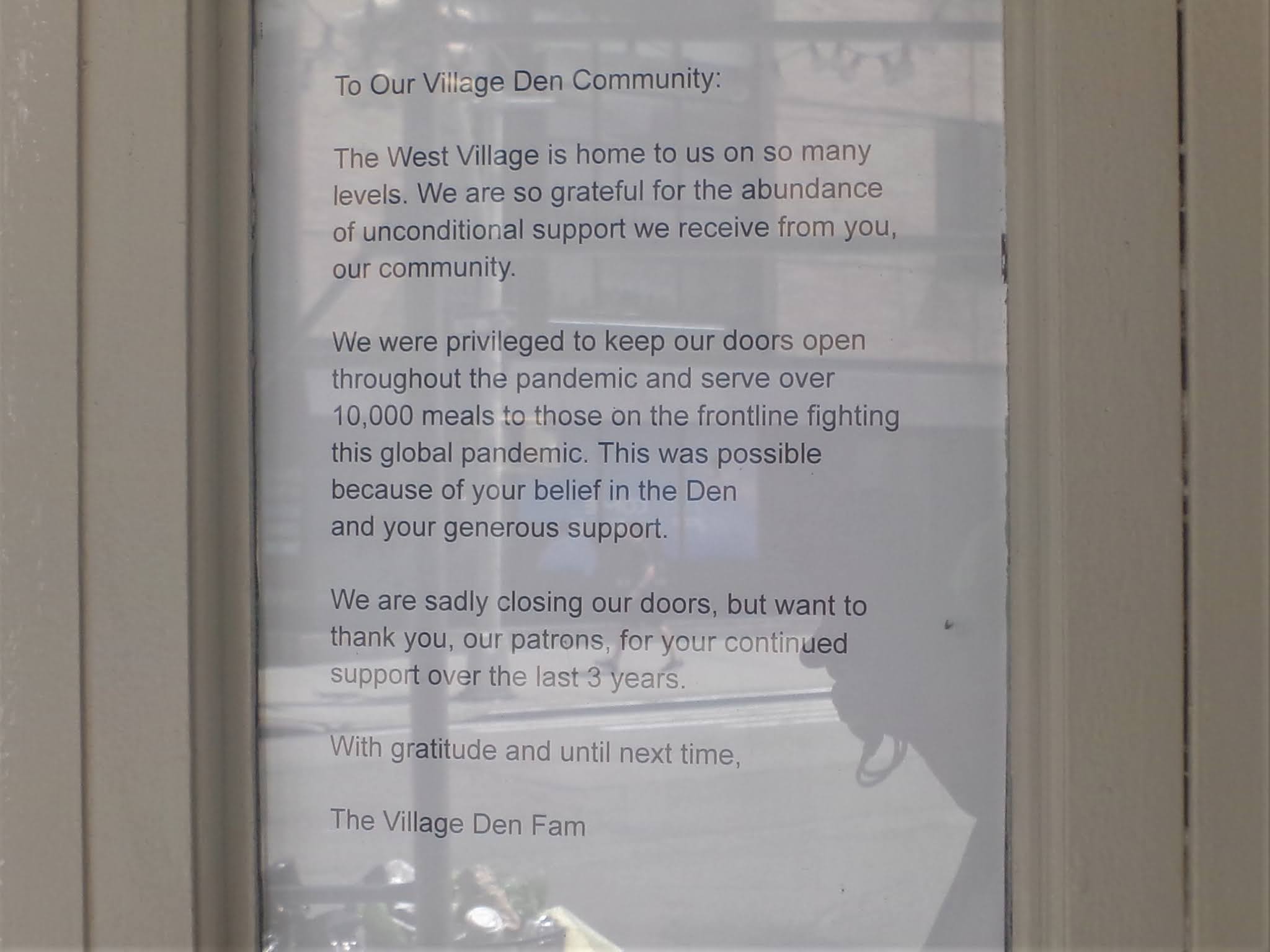
But sadly, the pandemic has taken a big hit on it.

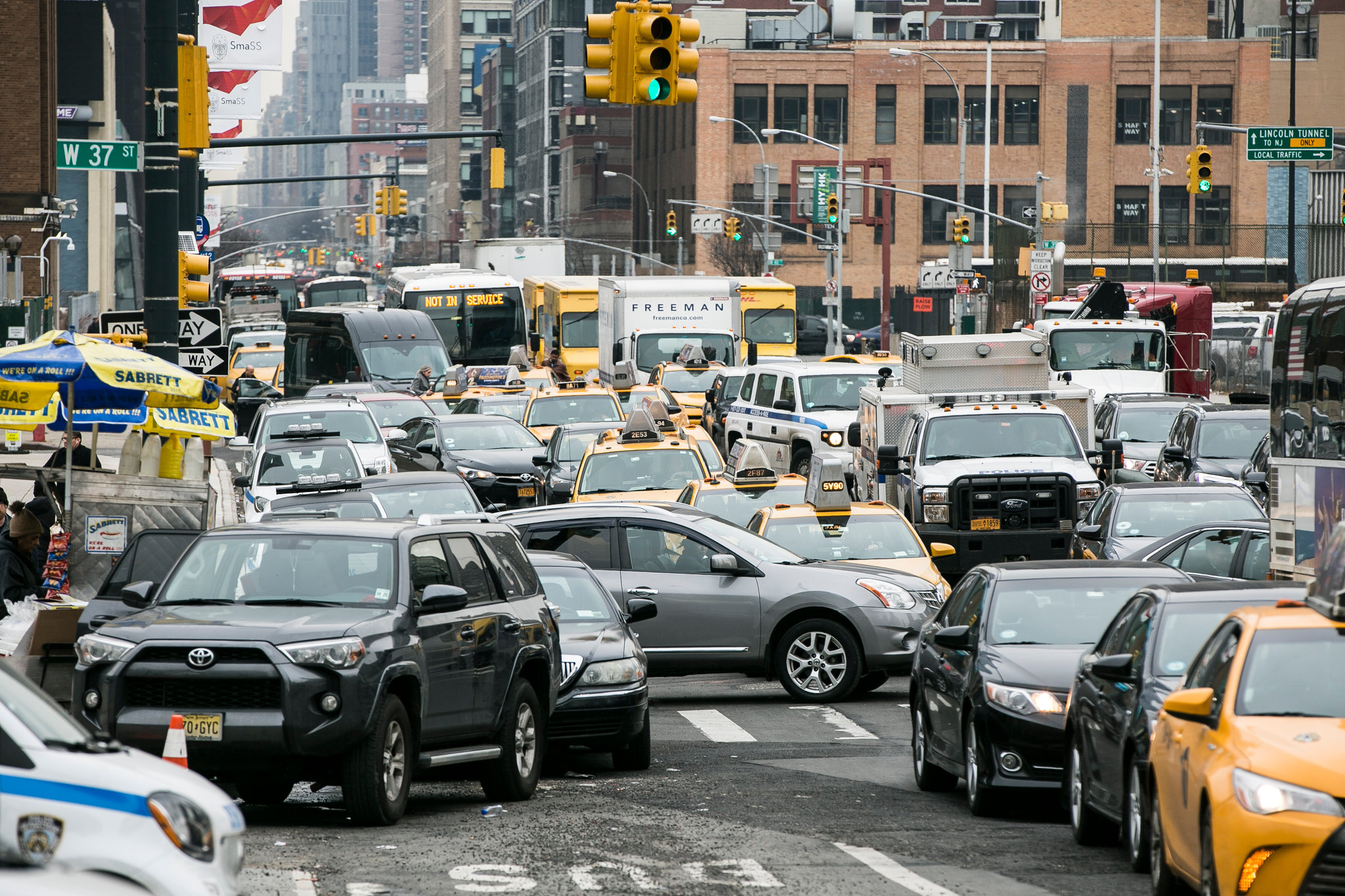
Outdoor dining structures remain on the city’s byways in considerable numbers, which doesn’t please everyone. Cross streets are inundated with them, which makes driving in the typical traffic mess even messier. Oh, and did I mention there a fewer parking spaces in a city with limited parking spaces. And some of the edifices are bona fide eyesores as well.

An unfriendly call followed by a visit from Luca Brasi?

Impatiens in Battery Park City, a world unto itself built on landfill from the excavation of the Twin Towers. Once upon a time, I’d be standing in the Hudson River at this spot or, perhaps, on an old and rotting wooden pier. 

Yes, my Luv Gov is no more. His recent “farewell address” was painful to watch—and with no apologies. I suspect we haven’t heard the last of Andy Boy because old politicians never die or fade away.

Considering that the subway system was a total mess after the Ida soaking, my weekend excursion was problem free with absolutely no vestiges of the flooding of several days ago. 

Have Corona beer sales suffered during the Corona virus? Just wondering...

During his lengthy service at the James A. Farley post office—the city’s main post office on Eighth Avenue—my father exited at the 28th Street station on the Number 1 line. On Wednesday evening, this very spot resembled a prime white water rafting locale.

I presume this Department of Transportation sign is cautioning us to be aware of the increasingly ubiquitous bicyclists in the city. In my experience, it’s likewise good advice vis-à-vis high school principals.

(Photos from the personal collection of Nicholas Nigro)


Wednesday, August 25, 2021

The Final Chapter

Nowadays, the obituaries are chock full of so many personalities who were—once upon a time—young. It’s downright unsettling. Men and women who were in their prime when I was a boy are passing away. I wasn’t a hockey fan, but I knew of Rod Gilbert, who died this week at the age of eighty. I knew he was a future Hall of Famer and distinctly remember his hockey card with the bright green backdrop.

During my youth, my favorite pastime was the American pastime at the time: baseball. It seems like a day doesn’t go by without a former baseball player—an athlete whom I rooted for or against—dying or getting diagnosed with Alzheimer’s. Recently, I read where J.R. Richard, Rennie Stennett, and Dick Tidrow passed away. James Rodney Richard struck out over three hundred batters in 1978 and 1979 and had a major stroke the next year at the age of thirty, which prematurely ended his career. Rennie Stennett went seven for seven in a game, a record that still stands. And when Dick Tidrow pitched for the Yankees in the mid- to late-70s, my older brother imitated his distinctive windup and mannerisms while playing stickball. These little snippets of memory were so fresh because—honestly—it seemed like only yesterday when Richard, Stennett, and Tidrow were professional baseball players plying their trades.

Several weeks ago, an aunt of mine passed away two months shy of her 101st birthday. From the Spanish flu to COVID-19, her life began in a picturesque mountain town in Italy, Castelmezzano, before she emigrated to the shores of America in 1926 at the age of six. She lived through the Great Depression and then World War II. The "the war to end all wars,” World War I, didn’t quite live up to its billing. Eventually, my aunt labored as a seamstress in New York City’s thriving Garment District for decades until her retirement in 1985. She collected a Social Security check for thirty-five years, an impressive feat in and of itself.

My aunt’s hobbies included walking, cooking, and baking. She made homemade pasta, meatballs, and tomato sauce called “gravy”—an Italian thing. The woman produced cakes and pastries that were uniquely hers like Graham cracker crust chocolate pudding pie, cream puffs filled with vanilla pudding, and oatmeal cake with two cups of sugar—one white and one brown. Strange, though, when people pass away, their lifetime of accumulations don’t go with them. Upon her death, my aunt’s spice closet was brimming with every imaginable spice, including multiple bottles of the same ones. Some bottles were unopened. As her cooking acumen took a hit in her final years —it stands to reason—so did her spice use. Many of those spice bottles had lapsed expiration dates going back twenty years.

Cleaning out her spice cabinet struck me as emblematic of what’s in store for me and, yes, just about everybody else. I have all kinds of things that have meaning to me but won’t have meaning to anybody else. I won't have a presidential-like museum in which to donate my photos, bric-a-brac, and papers, including old test papers from St. John’s grammar school, Cardinal Spellman High School, and Manhattan College.

I know my aunt had every intention of using the three bottles of bay leaves in her spice closet. But the finite end—in store for all of us—had other plans. So, from this day forward, I am gradually divesting myself of many of my material possessions and assorted ephemera. I like the thought of me getting rid of me. There is more dignity involved in this do-it-yourself exercise. After all, in writing the final chapter, who better than I to recycle my high school trigonometry tests?

(Photos from the personal collection of Nicholas Nigro)

Monday, August 23, 2021

It Is Goodbye


(Originally published 8/31/18)

Recently, I thought of an essay that was published in my Manhattan College Commencement program. Its anonymous author, a 1929 graduate, eloquently expressed the melancholy of the achievement and what it augured. He ended his piece as follows: “The moon grows pale and drops down and down. The shadows encroach further and further. The breeze sighs mournfully. A subway train rattles away into the distance. I sit alone on the Chapel steps. It is goodbye.”

Last week an old friend, neighbor, and fellow Jasper passed away. Mere words cannot do the man justice. Suffice it to say, Richie was a one-of-a-kind personage—a true original—whose likes will never be seen again. When I was growing up in the Bronx’s Kingsbridge, he was a ubiquitous and enigmatic presence on the block. He had the X-factor.

Riche was considerably older than those who hung on his every word and relished time spent with him. But his inimitable personality and audacious spirit added layers of color to the childhoods of those who experienced him up close and personal. You just had to be there.

Richie was the guy who taped oak-tag signs to his father’s dark brown Ford LTD that read “Guy Lombardo and the Royal Canadians” and “Bob Hope in Car.” He would then drive around the neighborhood with his youthful entourage. We would watch people stare, often gasp, and occasionally laugh. On a whim, Richie might ask, “Do you want to give the fist?” I don’t exactly know the origins of this peculiar pastime, but it involved shaking fists from the moving car’s windows at unsuspecting passersby on the street. It was harmless fun that—on the very same thoroughfares today—would probably put one’s life at risk.

Forty-one years ago this month, Richie, my older brother Joe, and I traveled to Boston to see the Red Sox in Fenway Park. Believe it or not, this was a monumental adventure for a fourteen-year-old boy and for our fearless leader—eleven years my senior—as well. We scrupulously planned the trip in an age before the Internet as if we were going around the world in eighty days. Money was pretty tight. By the end of the two-day journey, our coffers were nearly depleted. In fact, Richie loaned me five dollars along the way, which I agreed to work off at a future date by washing and waxing his car.

During those two days in Beantown, we ascended the Bunker Hill Monument, trod the grounds of Harvard University, and toured Old Ironsides. We also saw a game at Fenway alongside a grandfather affectionately known as “Pops,” who was quite shaky on his feet, and his doting grandson. Sitting next to me, Pops was concerned that I might be a “California rooter” and antagonistic towards his beloved Sox. I assured him that I was a Met fan from New York who wouldn’t be rooting for the Angels.

Two short weeks later—with the same cast of three—Richie plotted a fun-filled encore to the summer of 1977: a jam-packed day trip that commenced at the Brigantine Castle on the Jersey Shore. This haunted amusement was incessantly advertised on local television back then and Richie wanted to see what all the fuss was about. It turned out to be much ado about nothing and we promptly headed south to nearby Atlantic City—in its pre-casino days—and finally to Philadelphia. There we checked out Liberty Hall and that cracked bell. Our nightcap—the icing on the cake—was a game at Veterans Stadium. The Phillies versus the Braves in that cookie-cutter monstrosity lasted fourteen innings and ended near midnight.

Upon our return to the Bronx, Richie was noticeably drowsy behind the wheel of his beloved Mustang. We had, after all, left home at six o’clock in the morning. To give him a much needed break, seventeen-year-old Joe, who had just gotten his driver’s license, offered to take over for a spell. Allowing an inexperienced driver such an opportunity in the middle of the night—and in the middle of what seemed like nowhere—was hardly a slam-dunk decision, but an exhausted Richie ultimately relented. He would turn over the reins for fifteen minutes, he said, and take a brief catnap. After a two-hour snooze, Richie arose from his slumber and we were ever so close to home.

These memories are just snippets from decades of them. But they are reminders that life is fleeting and, really, about moments. And when time draws to a close, the moments to remember are the freest ones—simple, innocent, and absent of drama. Richie…it is goodbye.

(Photos from the personal collection of Nicholas Nigro)

Saturday, August 14, 2021

What $1.30 Used to Buy

(Originally published on August 14, 2013)

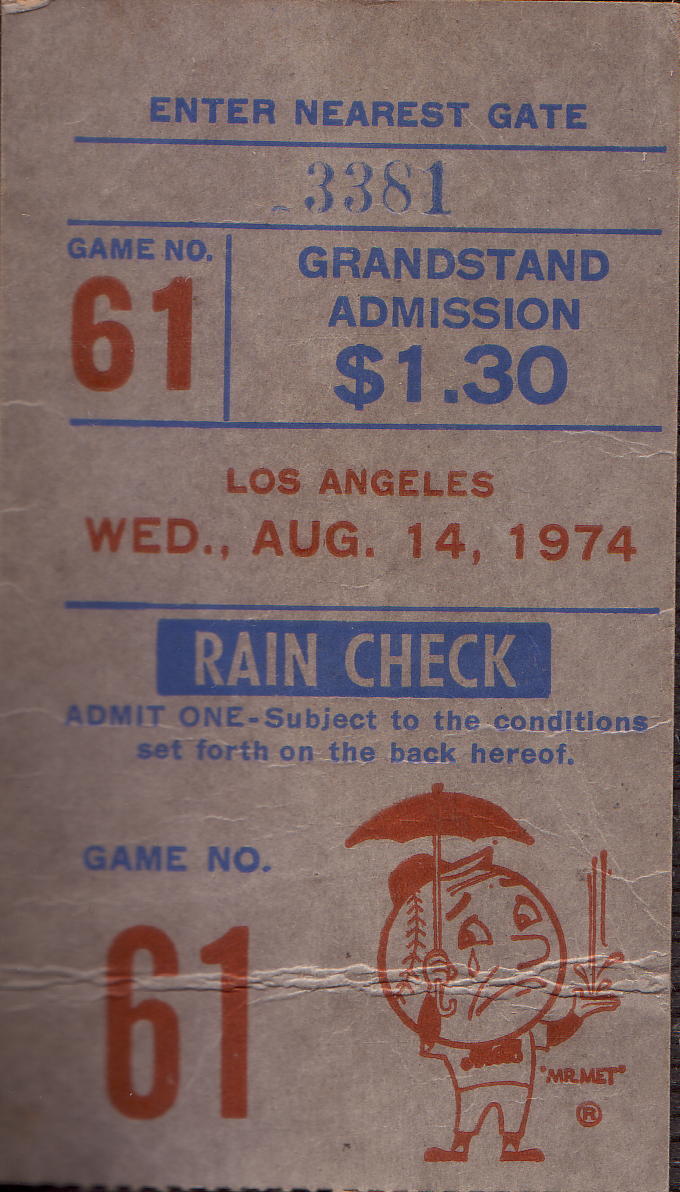
Exactly thirty-nine years have passed since my father took my two brothers, a friend, and me to Shea Stadium. It was the afternoon of August 14, 1974, five days after Richard Nixon resigned the presidency. But I’d hazard a guess the Watergate scandal and the historic changing of the guard in Washington were not on my radar. Baseball—and only baseball—was.

The Mets were saddled with all kinds of injuries in 1974, including star pitcher Tom Seaver’s ongoing battle with nagging sciatica in his left hip. He was uncharacteristically struggling and, when all was said and done, my revered idol went 11-11 on the year and my favorite team, an unimpressive 71-91. (The Mets had won the National League Pennant the year before.) Still, it was an exciting afternoon as we plopped ourselves down wherever we darned pleased in the far reaches of the upper deck—grandstand seats for $1.30 a pop and closer than anyone else in the ballpark to the airborne planes taking off and landing at nearby LaGuardia Airport. As a boy, I always loved those loud, periodic interruptions, particularly the spitting sounds of the planes’ engines that drowned out the stadium din for a fleeting moment. It was part of the unique and unrivaled ambiance of attending a game at the “Big Shea”—and even added spice to listening to home games on the radio and watching them on TV.

Courtesy of today’s ready access to information, I discovered that the Mets beat the Los Angeles Dodgers three to two on that day, scoring two runs in the bottom of the ninth inning to pull it out. Normally, I remember details like this, but I have no recollection of the game itself or that Tom Seaver was the starting pitcher. Tug McGraw got the win in relief. I have this faint memory, though, of my father insisting we leave an inning earlier to avoid the post-game parking lot’s traffic snarl. Attendance was 33,125. It was one of his hang-ups, which I can appreciate now having inherited his “I really and truly don’t like driving and excessively fret about things like traffic” gene. Nevertheless, this early departure meant that we missed a thrilling, come-from-behind, bottom-of-the-ninth inning victory. (Thrilling for me, I should add, and not my die-hard Yankee fan and Met hating father.) I imagine we were listening to the game on the car radio as we headed back home. I’d wager, too, that I was simultaneously ecstatic at the win and disgusted at having missed it live and in person.

Suffice it to say that 1974 was a vastly different time for the world in general and baseball in particular. We traveled from the Bronx to Shea Stadium in Queens on the game day—a twenty-five or so minute ride—and purchased tickets at a ticket booth for $1.30 each. An in-law of mine recently ventured to the new Yankee Stadium—the House that Ruth Didn’t Build. He spent $75 for tickets that were far from the best seats in the house and spoke of the stadium runways being more like shopping malls than the hot dog and beer-smelling passageways—with the sticky concrete floors from copious concession spillages—that we both recalled so fondly. (I’d add to these evocative olfactory memories the urine and urine-masking deodorants from the stadium’s bathrooms.) A trip to the ballpark used to be foremost about the game of baseball and rooting for the home team, not going on an expensive shopping spree and dining on Penne a la Vodka and exotic-flavored rice pilaf during the game in an upscale eatery.

The game has been remade by an uber-corporate mentality that has completely refashioned the baseball brand to suit the times and the ever-waning attention spans of its customer base. It’s hardly the affordable family game that it once was, and it’s not the American pastime anymore. What is? Major League Baseball is marketed as an event—a happening. The game on the field is secondary to all the glitzy, technological distractions and the unrelenting clamor. And, to add insult to injury, there are the A-Rods who make mega-millions of dollars and cheat on top of that, rendering records suspect at best and often meaningless.

The simple pleasure of attending a baseball game at Shea Stadium and sitting in the upper deck in the summer of 1974—even if my impatient father ruined the denouement for me—is gone with the winds of time. There will never be another outfield featuring the likes of Cleon Jones, Don Hahn, and Rusty Staub. I’m happy, though, to have been a youthful fan in an era when the bottoms of my PRO-Keds sneakers got all sticky as I exited the ballpark, and I when didn’t have to pass by the Hard Rock Café and Wholly Guacomole on the way out.

(Photo from the personal collection of Nicholas Nigro)

Thursday, August 12, 2021

Benchwarmers


While sitting in sliver of parkland known as Van Cortlandt’s Tail yesterday morning, I bore witness to something rather unpleasant. I’ve reported from this sprawling sea of benches before, this noisy location overlooking busy Broadway and the Number 1 elevated subway line. Not too far south from this Shangri-la is another slice of park—crescent shaped and much smaller—with benches that abut the heavily trafficked Major Deegan Expressway, I-87. In my youth in the 1970s and 1980s, the place was affectionately known as the “Bum Park.” In other words, it was oft populated with unsavory sorts with an excessive thirst for the grape or some such thing. Just to keep the local geography in order, the Tail is the “Bum Park North.” I appreciate that these monikers are not politically correct nowadays, but we are entitled to a little black humor every now and then—to laugh to keep from crying—without getting chastised or cancelled by some holier-than-thou snitch or triggered crybaby with too much time on his or her hands
.

Okay, back to my sighting. There’s this fellow that I see around a lot, a skinny dude about forty or so, I’d guess, but he could be younger or older. I feel genuinely sorry for this man who regularly rummages through garbage cans for discarded cigarette butts with enough puff left in them. He’s always smoking, perspiring, and bleary-eyed. I’ve long wondered what his tale of woe is. Mental illness? Drug abuse? Both? Is the guy homeless? In any event, he’s a veritable pinball, stopping to sit on benches on Broadway, in the Tail, and in nearby Van Cortlandt Park proper. Stop and go is his modus operandi as this peripatetic wanderer abruptly moves on to pillage the nearest garbage cans for cigarette remains before venturing to his next sit-down. It’s a recurring cycle that I've witnessed over and over. He never speaks with anyone, which is fine by me, but does an awful lot of nervous flitting. And although his attire looks relatively respectable from afar, the guy’s not very sanitary. Now, more than ever, when I plop down on an area park bench, I contemplate all who came before me.

From where I sat yesterday morning, this growing concern of mine assumed Code Red significance. For I saw this mystery man drop his pants and defecate on the sidewalk. He then wiped himself clean with a plastic bag. Well, today, I returned to the scene of the crime, as it were, and cut short my stay. It was hot, humid, and uncomfortable, but the impetus of my early exit from the Bum Park North was an approaching benchwarmer. No, it wasn’t yesterday’s Man of the Hour, but a woman whom I’ve previously encountered there. I hadn’t seen her in a while and, honestly, didn’t want to see her this morning or any other morning for that matter. She’s a disturbed individual who says strange things in an unwarranted and unwelcome hostile manner. Whether this lady is just making batty small talk or looking to pick a fight is often hard to decipher.

As I was
making like a tree and leaving the Tail before this character was in earshot and could engage me in conversation, she took note of my sudden departure. My plan was to vanish before this paranoid woman deduced that I was leaving because of her. When she glared my way, though, I knew she had put two-and-two together, that I was, in fact, calling it a day because of her—and she internally fumed! It’s always amazed me that certain types of people feel entitled to rant and rave to anybody and everybody—and nobody has the right to move on until their show of shows is over.

Fortunately for me, there was this senior citizen in the Tail—who often stops there on the last leg of her journey to her apartment building—whom the crazy lady appeared to know. She had found an audience of one and the distraction worked in my favor. So, that’s a little taste of life in the big city on a dog day of summer 2021. It isn’t always pretty and is frequently quite sad. But sometimes it helps to be on the outside looking in—to detach from the reality of the reality. Everyone’s got a story and many don’t have happy endings or beginnings and middles in many instances.

(Photos from the personal collection of Nicholas Nigro)

Thursday, August 5, 2021

The “Clem Nouri Rule of Polite Society”

(Originally published on 10/28/15)

Some three decades ago I had a professor in college named Clement Nouri. I remember thinking what a great name that was. It was kind of like the Old West meets the Old World or some such thing. Anyway, the course he taught was rather excitingly called “Business Policy,” and a considerable portion of our grade was based on class participation. Still, the very same people—class after class after class—did the lion’s share of the participating. Really, this was the case, I found, in primary, secondary, and higher education alike. Many of the eager participators in these class discussions did so because they were intellectually curious and desired learning from their more scholarly teachers and professors. But there was also a fair share of said participators who, I fear, liked the sound of their voices above all else, especially in college.

Anyway, in this “Business Policy” course, Dr. Nouri insisted that one and all participate in the class discussions. An oft-repeated catch phrase of his, which has stuck in my brain all these years later, was: “How ‘bout others?” In other words, Dr. Nouri was importuning the “Silent Majority” in the classroom to be heard—come on: anybody other than the usual suspects. I didn’t know it then, but I know it now: My old professor’s three-word question has real legs and can be applied in all kinds of venues and situations outside of the classroom. In fact, I silently ask, “How ‘bout others?” time and again as I go about my daily business. Just yesterday, what I have dubbed the “Clem Nouri Rule of Polite Society” danced like sugarplums in my head.

It came to the fore while I was in a neighborhood drug store—Rite Aid, formerly Genovese, and I hear soon-to-be Walgreen’s—and waiting on a long line, the handiwork of an oblivious woman with out-of-date coupons for starters, questions about the current chain’s flier, and—in general—treating the cashier like she was in a private audience with the Pope. “How ‘bout others?” I internally intoned as the line grew longer and longer and longer. And, at long last, when she actually purchased something and received her change, it took another seeming eternity for her to gather herself together, which, of course, she did at the checkout.

Later in the day, I was in a Chinese take-out establishment with a very small counter to put it mildly in which to place an order. When I entered the eatery, a woman was in the process of placing hers. Straightaway, I could tell she was a pain in the butt but nonetheless patiently waited my turn as I always do. But, alas, after placing her official order—with every “I” dotted and “T” crossed—she didn’t budge. Apparently, she was intent on watching her food being prepared—and asking further questions and making assorted demands—throughout the process. How ‘bout others? I had to at long last shout out my order over this inconsiderate boob, whose elbows were resting on the countertop and spread out a la Charlie Brown ruing his lot in life on the backyard brick wall.

Finally, have you ever been at a party or social event where some blowhard holds court the whole time? Of course you have. And no matter what the topic of conversation, he or she invariably hijacks it. On these occasions, it is high time that all of us vocally and unapologetically enunciate the simple but oh-so-just “Clem Nouri Rule of Polite Society”: “How ‘bout others?” No more suffering in silence.

(Photos from the personal collection of Nicholas Nigro)

Wednesday, August 4, 2021

August Company

Considering what other parts of the country have endured this summer, New York City’s weather has been rather benign with no extended heat waves and only an occasional monsoonal rain. I’m noticing, too, more and more locals wearing masks outside again. Yes, the Delta variant has turned back the clock somewhat. But despite the media’s sky-is-falling hype, the preponderance of evidence suggests that the vaccinated are pretty much good-to-go. Mayor Bill de Blasio, though, recommends that we wear masks indoors when around another person, even if we are both vaccinated. That’s going to encourage people to get a shot.

Oh, and the mayor has announced that we will soon have to show proof of a vaccination for indoor activities like restaurant dining, sitting at a bar, and exercising in a gym. How exactly is that going to play out? Seems to me that it will put unnecessary pressures on embattled small businesses, which is the last thing they need right now.

On Saturday, I patronized a pizzeria on a shadowy side street in the Financial District. The slices were $3.25 each and wouldn't pass muster for a children’s menu. They were served up by a personality-challenged counterman who uttered not a syllable during our transaction. Sadly, the slice of pizza price is finally outpacing the cost of a bus or subway ride, another indicator of the city’s decline. How, I wonder, will Mr. Personality in the pizza parlor enforce the future vaccination order for Wall Streeters and tourists desiring to sit inside with their microscopic slices?

I’d like very much not to think about politicians, let alone write about them, but I would be remiss if I didn’t mention my governor: the Luv Guv. The mighty have certainly fallen. Andrew Cuomo’s defense after the scathing attorney general’s report on his serial harassing was absurd. He presented a pictorial montage of his affectionate acts in public—hugging and kissing men and women alike. Just another demonstrative Italian guy. I can’t help but think about his father, Mario, right now. While the Tappan Zee Bridge shouldn’t bear his name, he was an honorable man without a whiff of scandal about him. What will Andy Boy do going forward? The knives are sure out, but Cuomo is so shameless, it’s anybody’s guess. De Blasio is absolutely relishing his nemesis’s demise and predicts he will resign and hopes, too, that he faces criminal charges.

A final note: After my recent weight watchers’ pizza lunch, I passed by Federal Hall in lower Manhattan. As always, the grand statue of George Washington proudly stood in front. Unfortunately, though, the historic locale was festooned with woke banners, including one with a “Womxm,” an intersectional term. Ridiculous, I thought, as I continued on my merry way. But then we are living in ridiculous times. I see where some professors at major medical schools apologized for using the terms “male” and “female.” And publishers are refusing to publish fiction writers who create characters outside their race, ethnicity, and gender. Novelists create, no? It’s an artform and the talented therein were—once upon a time—respected for going wherever their muses took them. I can create a narcissistic male politician with a penchant for harassing women character without having been one. Can’t I?

(Photos from the personal collection of Nicholas Nigro)

Sunday, August 1, 2021

That '70s Summer


(Originally published 7/19/20)

It’s extremely hot today. The temperature is expected to near one hundred degrees Fahrenheit—a New York City scorcher in the midst of a bona fide heat wave. Once upon a time in the Bronx, I was undeterred come hell or high water. What now constitutes a long time ago, neighborhood kids went about the business of summer regardless of what the thermometer read or where the relative humidity stood. We played stickball on steamy asphalt without a cooler of bottled water on hand. In fact, there was no such thing as individual plastic bottles of water back then.

The contemporary Big Apple is being compared unfavorably to its 1970s forebear. In the mid-1970s the city was in the throes of a fiscal crisis—with bankruptcy a very real possibility—and rampant crime on top of that. I was a boy in those days and fondly remember that colorful snapshot in time, even if it was on the dirty and unsafe side. It still resembled old New York—the city my paternal grandparents settled in—with its mom-and-pop shops, Garment District, and the last of the automats.

Summer nights brought out stoop sitters en masse, who shared the increasing darkness with copious lightning bugs. I’ve spotted a smattering of those incandescent insects around this year, but nothing like the numbers in their heyday. Even the fortunate folks with air conditioners emerged on the warmest nights to spit the breeze. We youth played a game called “flashlight,” a.k.a. “flashlight tag,” immediately after sunset. No part of our days were wasted. I grew up in an outdoor world absent any uber-technological devices to endlessly stare into. So much was left to our imaginations.

When the heat was on, our local utility—Con Edison—often scaled back the power during the nighttime hours. Lights would flicker and ice cubes would partially melt and then refreeze. A cold drink was sometimes hard to come by and the poor excuses for ice cubes tasted foul. No air conditioning and sub-par ice cubes, though, were par for the course during the dog days. I called home an upstairs apartment. Seven of us lived in it with a solitary bathroom. I’m not complaining because The Brady Bunch had it even worse with nine people sharing one. They never appeared bothered by the heat, so I assume the Brady clan had some form of air conditioning.

As a kid, the heat of the summer was to be expected, endured, and celebrated as a welcome respite from the interminable school years. There were no air conditioners in my classrooms from kindergarten through college. I recall some days—particularly in the month of September—baking like a couch potato while learning my ABCs. But at least that was taught back in the day. There were few things more horrifying than hazy, hot, and humid weather in the fledgling days of a new school year.

My father always said that feeling the heat was in our heads. He wasn’t bothered by the melted, peculiar-tasting ice cubes, which he found no use for in his preferred brew. The old-school Italians grinned and bore it. Dinnertime in the dead of summer was not all that different than dinnertime in the dead of winter. In the hottest of hot weather, some adjustments were made vis-à-vis turning on the oven, but the frying pan continued to fry with the post office motto the wind beneath its wings.

That was then and this is now. I like having an air conditioner on days like today. And I’d rather not cook baked chicken and French fries this evening. Still, I miss the great outdoors in the heat of the night and heat of the day, too. Forty and fifty years ago, there were no safe spaces for us to hide in during the summer months and the recurring brownouts didn’t trigger any meltdowns either. So, please, let’s not compare the 1970s to 2020.

(Photos from the personal collection of Nicholas Nigro)

Saturday, July 17, 2021

The Goose Is Flying High

Recently, Major League Baseball commissioner Rob Manfred intimated that the COVID-19 changes to the game—seven-inning doubleheader games and the placement of a man on second base in extra-inning games—will not be permanent. That’s a start, I guess, but it’s not about to resurrect professional baseball to its former glory as America’s pastime. Unfortunately, the sport has gone the way of so many things today—down the tubes with no turning back. Played by mega-millionaires in ballparks that double as shopping malls and arcades, the game almost seems secondary. With owners who eagerly embrace partisan politics on top of all that, it’s quite easy to breakaway and never look back. I once believed that my bond with baseball was inviolable—until death do us part. I couldn’t conceive of life without it. That was then and this is now.

The first ballgames that I experienced in the flesh were at the old Yankee Stadium, the House that Ruth Built with its wooden seats painted blue and concrete poles holding the place together and, too, obstructing views. I recall intensely feeling the history there with its three monuments out in dead center field—in play approximately 461 feet away from home plate—memorializing the team’s deceased greats: Babe Ruth, Lou Gehrig, and diminutive manager of “Murderer’s Row” Miller Huggins. From my little kid’s perspective, Yankee Stadium maintained a downright ghostly feel. During the must-see Old Timer’s games—which don’t exist anymore due to the decreasing attention spans of the fan base—the on-field master of ceremonies introduced the widows of Lou Gehrig and Babe Ruth, which further added to the spectral ambiance.

Shortly after my introduction to baseball at the only game in town in the Bronx, I chose the Mets as my team for better or for worse for a quarter of a century. Although growing up in a sprawling sea of Yankee fans, with a father who lived and died with the Yankees for over seventy years, their cross-town rivals in Queens were a better fit for me. While I loved the game’s storied past—and peculiarly appreciated getting spooked by the widows of Ruth and Gehrig—the Mets were fresh and on TV a whole lot more than the Yankees in those days.

Cheesiness notwithstanding, I considered Shea Stadium a baseball palace. I see the hot dog price at Citi Field, where the Mets now play their crazy game, is $6.75. Parking is $25 and cash is not accepted. Once upon a time, downing two, three, or four hot dogs was par for the course at a ballgame. And the beer sold at the ballpark was exclusively the team’s beer company sponsor’s product. Nowadays, Citi Field has an extensive selection of “Big Apple Brews,” including Goose Island Honker’s Ale, Johnny Appleseed Hard Cider, and Shock Top Lemon Shandy. You can still sample a Budweiser on tap, but also Bud Light Straw-Ber-Rita and Bud Light Platinum. It’ll cost you $9.50 for the watered-down privilege of any of the above. Ballpark peanuts and sunflower seeds, which were not something I ever purchased at games, will set you back $5.00/bag. This can add up to an expensive night out for the family.

Oh, the memories: peanut shells everywhere, spilled beer and soda on the concrete grounds, and the wafting aromas of suds and frankfurters. Not having attended a baseball game in more than twenty years, I can’t say with certainty if the residue of spilled craft beers sticks like the flat Budweiser of my youth did. Ditto: I don’t know if the hot dog bouquets still permeate the stands and runways of contemporary ballparks. There’s just so much food competition there for the pricey wieners, including restaurant rows—something for everyone—on the premises.

So, I say: Play ball—all nine innings. And who’s on second? The guy who earns his way there. Not that it really matters anymore…and that’s profoundly sad.

Sunday, July 11, 2021

No Can Do

I just came across a rather sobering statistic concerning America’s former pastime. In baseball’s heyday in the 1970s and 1980s, the World Series commanded a total audience of almost twenty percent of the population. Conversely, the 2020 World Series garnered three percent. For it’s one, two, three strikes, you’re out...at the old ballgame. Actually, it’s mind boggling that this once mighty sport has fallen so far and so fast—yet the franchises still rake in the big bucks. One hundred and sixty-two regular season games that last on average over three hours a pop is—even with the diminished interest—a major money maker. Today, the average age of the devoted baseball fan is fifty-seven. The Millennials and the previous generation just aren’t interested in the once storied game.

Exhibit A: I see this young kid walking his dog every single day. And every single time—for the whole time—he is staring intently into his phone. I don’t suspect baseball is on his GPS. But, come on, it’s the summer for crying out loud! Check it out! You might like what you see. Or maybe not. It is 2021 after all.

While on the subject of 2021: The New York City mayoral race to succeed Bill de Blasio is finally set in stone. Honestly, if it’s going to take weeks to I declare a winner—as it did in the recent Democratic primary—perhaps ranked-choice voting isn’t all that it’s cracked up to be. Exactly three years ago, for what it's worth, I received this repeated Facebook message: “Tag Mayor de Blasio in your post so they’ll be more likely to see it.” I didn’t know then why I was seeing that, and I was baffled by they’ll when, I thought, it should have been he’ll. In 2018, ignorant me was blissfully unaware that it was intentional—the jettisoning of he and she so as not to offend who? I Don’t Know…third base!

Anyway, I’ll be happy to see the back of them—Mayor de Blasio—come January. Democratic nominee Eric Adams is likely to be the next mayor. Someone described him as a “bomb thrower.” He was, nevertheless, among my four choices. Alas, if Andrew Yang had done a little homework in preparation for “the second toughest job in America,” he could have made us proud. Or they could have made us proud.

Meanwhile, Curtis Sliwa, the Republican nominee for mayor, is a New York City character and radio talk show personality from way back. Nowadays, not too many New Yorkers sound like the loquacious Sliwa, who is prone to malaprop. It would be the upset of the century if he pulled it off, but I suspect he’ll get a considerably larger share of the vote than the last two Republican candidates who ran against them. I like Curtis. I can’t help but like him despite his somewhat buffoonish, blowhard personality. His Guardian Angels with their trademark red berets and red satin jackets have been around for decades. I remember feeling a little less anxious when riding with Guardian Angels in the same subway car during anxious times, which, by the way, have returned with a vengeance in 2021. In 1992, John Gotti Jr.—son of Gambino crime family boss John Gotti—put a hit out on Sliwa, who was shot at point-blank range and seriously wounded in an attempted kidnapping. And the guy rescues feral cats. That’s an interesting blend of strange New York pedigree. At the end of the day, we will be better off when the 6’5” they man has packed his bags and vacated Gracie Mansion.

So, should I feel optimistic about the future? It’s not so easy to with all the record-breaking temperatures, wildfires, and droughts, Major League Baseball’s meltdown, and diversity trainers preaching—among countless nutty utterances—that the can-do spirit is a white supremacist thing. More madness: Brandeis University cautioning teachers and students to avoid using words and phrases that “link to violence” like “rule of thumb,” “picnic,” “policeman,” and even “trigger warning,” a woke creation. Roy Rogers had a horse named Trigger. And despite it sometimes having a metallic green hue to it, I liked the man's roast beef. They were simpler times for sure when the rule of thumb was to enjoy the great outdoors and employ the can-do spirit in building a go-cart with the wheels of your mother’s—or, should I say, birthing person’s—shopping cart. I certainly was optimistic then and had reason to be—not so much anymore.

Wednesday, June 30, 2021

The Heat Is On

In the prior reprise—a blast from the past—I recount navigating my way home from high school after a final exam. Perhaps even the final final—a New York State Regents Algebra exam—of my freshman year. I remembered it was a hazy, hot, and humid mid-June afternoon. The air quality was extremely poor and the sky a greenish-yellow overcast. On the last leg of my journey, I spied a flash of heat lightningno thunder accompaniment  lightningon the distant horizon beyond the High Pumping Station off Jerome Avenue. As Bronx architecture goes, this building is rather distinct. Built at the turn of the twentieth century—as an appendage of the Jerome Park Reservoir system—it is listed on, of all places, the National Register of Historic Places. With its red bricks and precipitously steep and slate-covered gable roof, which is not too common in the area, the High Pumping Station has always been an eye-catcher. Anyway, that was a memory blip from a June day forty-four years ago. In that momentary snapshot in time the heat lightning served as a welcome beacon, a portent of better things to come—for a couple of months at least.

Fast forward to the present and the heat is on once more. However, I’m not banking on any of Mother Nature’s natural phenomena—signs from the heavens—lighting the way for the coming summer season. Instead, New York City voters, including yours truly, cast ballots in the first consequential election with ranked-choice voting. I had forgotten that we the people said yay to ranked-choice voting by a margin of three-to-one in 2019. Honestly, I don’t think very many of us considered the potential consequences of this new way of electing office holders. While it makes sense in a lot of ways, leave it to the city’s Board of Elections to royally screw things up. With so many men and women on both the left and right believing our elections are corrupted nowadays, this is awfully bad timing. Apparently, the Board of Elections counted 135,000 test ballots in the first round of ranked-choice tabulations, which skewed the results. The bureaucratic tangle of an agency has since announced a do-over.

Riddle me this: If frontrunner Eric Adams, who was up by ten points in the actual tally on election night, somehow loses this substantial lead in the ranked-choice tabulations, will it be accepted as absolutely aboveboard? Adams got a plurality of votes in four of the city’s five boroughs. Only Manhattan demurred, giving “Defund the Police” Maya Wiley the most votes. Her core support was in the more upscale white neighborhoods. From voters who love to talk the woke talk from their door-manned buildings, their vacation homes in the Hamptons, and while consuming lobster gazpacho, chicken tikka basmati rice, and nori seaweed tots in trendy, hipster restaurants. Just sayin’.

While on the subject of just sayin’: There are more cars on the streets than ever before. Traffic time never takes a holiday. It’s not just the rush hours and the Friday evening exoduses anymore. Add to this mayhem countless variations of motor bikes, mopeds, and illegal ATVs. Traversing the highways and byways is a nightmare night and day. Crime is also spiraling out of control and it’s hot as hell on top of that. Looking on the bright side: It’s not as toasty as in the Pacific Northwest with its heat dome plus climate change one-two punch wreaking havoc on the animate and inanimate alike.

So, yes, while the talk the talkers will throw their full support behind things like the Green New Deal—without fretting over the fine print or even reading the fine print—are they willing to make any personal sacrifices, adjustments to their lifestyles? Sitting amidst an all-too-typical traffic jam—with my taxi driver alerting me that his outdoor thermometer reading is one hundred degrees—I think I know the answer to that question.


Summer Daze

(Originally published on June 23, 2017)

Once upon a time, I relished summer days and nights. The heat and humidity one-two punch didn’t faze me. No temperature or relative clamminess was too high to prevent a stickball game. In fact, playing on searing asphalt during a scorcher—sans water—was par for the course. There was no such thing as individual bottled water in the 1970s! Sure, the gang could have brought along a cooler, thermos, or canteen to games, but it just wasn’t on our radars. Looking back, we sometimes played doubleheaders in ninety-five-degree heat without liquid pick-me-ups. After game two, we were a parched lot in a mad-dash search for a non-contaminated watering hole—tap water from the kitchen sink or powdered iced tea. What American TV western didn’t feature its protagonists short of water and in a do-or-die hunt for it in super-dry desert climes?

Ah, but summer days just aren’t what they once were to me. It's more like summer daze. This week, the calendar officially said that it was summer with the longest days of the year upon us. As a youth in the third week of June, I was uber-active in the great outdoors until the last sliver of daylight disappeared. Now, I spend well-lit summer evenings inside and do all that I can to circumvent the infamous New York City heat and humidity. Air conditioning certainly has its place. For me, there is no more stoop sitting and chewing the fat with neighbors on poor Air Quality Index (AQI) days and nights. I don't recall whether or not the AQI was calculated in the good old days. However, I can say that the air quality in the 1970s was considerably worse than it is today.

Bad air notwithstanding, the summers of my youth found the Good Humor man turning up every night at around the same time. Good Humor’s cola-flavored Italian ice—a favorite of mine—was a rock-solid frozen block. In attempting to sliver off pieces of the ice with the tongue-depressor spoon supplied, its paper cup would get punctured beyond recognition. Actually, the only cola taste—if you could call it that—of their watery Italian ices was found at the bottom of the paper cups, which by then would be sorry casualties of war. But what did we expect for twenty cents? They were worth every penny.

Summertime also meant a vacation on the seashore of New Jersey or Long Island. It meant day trips to the happening hot spots incessantly advertised on the New York City metropolitan area airwaves, like the Brigantine Castle—a haunted fortress on the Atlantic in Brigantine, New Jersey. A three-hour drive trip from the Bronx to the Brigantine Castle was a memorable summertime adventure. The equivalent for my peers’ kids today—on the satisfaction front, I'd say—would be two weeks in the South of France or Swiss Alps.

A final summertime footnote and memory from forty years ago. It’s the solitary snapshot kind not associated with anything monumental. I had completed a high school final exam during my freshman year. It was an afternoon in mid-June 1977. I was alone and on my way home via mass transit—from the East Bronx to the West Bronx. Standing at a bus stop on Jerome Avenue across the street from two of the ugliest-looking buildings in the borough—Tracey Towers—I patiently waited for the BX1, which would take me on the last leg of my journey home. It was overcast, dreadfully humid, and I remember seeing lightning on the distant horizon—heat lightning, I think. This far-away hot flash nonetheless signified so much to me—school’s end, summer, and a couple of months of incredible bliss.

(Photos from the personal collection of Nicholas Nigro)

Monday, June 21, 2021

A Shore Thing

With this being the first full day of summer, I thought I’d revisit the family vacations of my youth. Many of them were spent on the Jersey Shore as it was and is affectionately known. For countless working-class New York City families in those days gone by, this considerable slice of shoreline was heaven. Initially, my family stayed in small cottages in the town of Manasquan on streets named after fish, like Whiting, Pike, and Trout. In the late-1960s and early-1970s, weekly rentals set the folks back $75 to $100, bargains considering they were a few blocks away from both the Atlantic Ocean and the Manasquan Inlet, a busy boating thoroughfare that provided never-ending entertainment for kids, like me. It was a huge deal walking over to the inlet in the morning, where we would watch the fishing fleet from Point Pleasant—on the opposite shore—head out to sea. They would subsequently return with their catches, sometimes showing them off to land-bound spectators, including spellbound boys and girls. The flocks of seagulls inevitably trailing their crafts were likewise mesmerized.

In that colorful snapshot in time, cottages in a particular part of town were occupied by hard-partying hippies. Ever a source of fascination to little me, there was something so summery about the wafting smell of Mary Jane commingling with the ubiquitous sea breeze. Manasquan, too, had an extensive boardwalk, which was mostly asphalt as I recall. The houses along it were out of my folks’ price range, but I always wished we could stay in one of them. In the aftermath of Superstorm Sandy’s destruction in 2012, those very homes’ front porches now have a bird’s-eye view of tall sand dunes, not the mercurial Atlantic.

At some point in the mid-1970s, there were no rentals available in Manasquan for the weeks of my father’s vacation. We ended up venturing a little south to a place called Lavallette, a cozy vacation spot on a barrier island with the ocean to the east and Barnegat Bay to the west. Granted, the Manasquan Inlet was a big loss, but Lavallette’s boardwalk was a boardwalk from beginning to end. There also was this great bakery in town, Kay’s, which supplied us with breakfast donuts galore. Eating four glazed donuts was a piece of cake in those days. Lavallette also had a takeout pizza restaurant, The Oven, which produced a tasty pie. Not too far away was The Pizza Parlor, where the wait for pies at dinnertime was hours. It served superb thin pizza and was worth the wait. On one occasion we had visitors at our summer rental and The Pizza Parlor supplied the fare, including a pie with anchovies—my father’s idea. As expected—by me at least—the plain pies were consumed with alacrity while one too many anchovy slices languished in a box. And I could have eaten another slice or two, I remember. Upon learning this and that I was not a fan of anchovies, a visitor—a burly Italian patriarch—rather curtly told me, “Just take them off!” No can do! Anchovies leave their mark.

In the waning years of vacations on the Jersey Shore, we landed in the town of Ortley Beach, just south of Lavallette, which was totally decimated by Superstorm Sandy, I learned. The house we rented there a couple of times would get flooded during a summer thunderstorm. Ortley Beach also bordered Seaside Heights with its boardwalk of more than just boards. It was a nice place to visit with its amusements, entertainment, and foods, but I wouldn’t want to live there. The one and only time I ever was on a log flume was on the Seaside Heights boardwalk. A relative of mine once sniffed at her time spent on Cape Cod, calling it “boring” compared to the Jersey Shore with its electrifyingly exciting boardwalks. I thought that odd. But maybe not for a person with an Attention Deficit Disorder. Whatever, I remember fondly my time spent on the Jersey Shore with its boardwalks, where no two were the same.

(Photos from the personal collection of Nicholas Nigro)