Thursday, March 28, 2013

A Cautionary Tale: MoneyPak Can't Buy Happiness


Engaged in my now standard morning routine of drinking coffee, perusing various online news stories, and navigating Facebook bromides, I was violently assaulted a couple of days ago. Without fair warning, my computer—access to any and all of its components—was snatched away from me.

While leisurely reading an article from a local newspaper, the words suddenly disappeared. They were replaced on my screen with a bloodcurdling notice from the U.S. Department of Justice, or so it said, informing me that my computer had been locked pending further investigation of criminal activities. However, I could unlock it for $300—payable via MoneyPak only—and perhaps stave off further investigation of what were some pretty serious crimes my computer and I were alleged to be involved in.

The U.S. Department of Justice was quite thorough here, I thought, in its decidedly chilling message. I was informed where I could purchase MoneyPaks—Rite Aid, Walgreens, CVS, 7-Eleven, et al. However, something rang a wee bit unethical to me that the feds could be bought off so easily. But then, this government entity made no iron-clad promises they wouldn’t proceed in the investigation after it got its $300 via MoneyPak. Giving me three days to pay this extortion to the U.S. Department of Justice may have seemed fair, but not when the due date was March 1st and I received the notice on March 26th.

Needless to say, I didn’t run down to Rite Aid, a nearby retailer that sold the U.S. Department of Justice’s preferred form—actually only form—of payment: MoneyPak. Instead, I shut down my computer, hoping against hope that all would be well when I turned it back on. It wasn’t, which didn’t surprise me. That hideous notice appeared before I could even put my computer into Safe Mode and try any number of things. For a non-computer savvy person, like me, I feared I might have to exercise the nuclear option—System Recovery—and begin anew. And, with my very old computer, that meant returning to prehistoric virtual times. It had happened to me once before and it wasn’t pretty.

The insidiousness of acts like this—anonymous, computer wrecking, and extortion of monies from the frightened and gullible—are downright sickening and more than a bit scary. The fact that these attacks come out of the blue—when we are blissfully going about our business—is a cautionary tale from the age we live in. What will tomorrow bring? God only knows. And, as for the persons behind these viruses—this particular one has been dubbed Ransomware—you deserve nothing less than being boiled in heart-healthy, hot Canola oil.

Wednesday, March 13, 2013

Note to Self

While thumbing through a box of grammar school ephemera recently, I encountered an uneven scrap of notebook paper with some scribbling on it. Turns out that it was a bona fide “Note to Self” and dated 2/26/80, which places its author—me—in my senior year of high school.

What can I say for certain about this day in February 1980? It was a Tuesday and a leap year, so there was a Friday, February 29th. I took a sick day from school, but I can’t say for sure whether I was physically under the weather or not. I’d hazard a guess that I wasn't. I was, though, experiencing some measure of teenage angst—the “I dread returning to that sickening place” is a dead giveaway.

Funny, but I have no recollection of writing this “Note to Self” and headlining it “Feelings Tonight.” I don’t recall what exactly was troubling me thirty-three years ago on that winter’s eve. Suffice it to say, I didn’t enjoy my high school experience all that much, which was more about me than the institution of fine learning I attended, which really was better than most in the Bronx. As I recall, I found my senior year the least unpleasant and objectionable of the four. So, the timing of this “Note to Self” surprised me a little.

As far as I'm concerned, the most intriguing note within this particular “Note to Self” is: “To be taken out on June 27.” This was the scheduled day I picked up my high school diploma, I believe, and the last day I would ever again set foot—by necessity—in that “sickening place.” Strange, but I do remember penning occasional notes with the “To be taken out on” tag and date—when enumerated troubles, which seemed so all consuming and even insurmountable, would be no more. It was my crude teenage way of convincing myself that “this too shall pass.” Oh, I believe in tomorrow.

There was, however, a serious glitch in this particular “Note to Self” and all the others, too. The words I penned ended up not being read—“taken out” as it were—on the prescribed days. And this was integral to the "Note to Self" concept. Still, it's probably a positive thing in the big picture—proof that so many of my problems were indeed fleeting.

On June 27, 1980, I was supposed to exclaim, “Hey, that awful angst that I wrote about in my 'Note to Self' is no more—gone with the winds of time.” Well, having missed that key date, I have finally gotten around to reading it thirty-three years later. And, yes, whatever was the overwhelming burden that confounded me on that February night a long time ago has been lifted from my shoulders. As for other “Notes to Self” that exist in the miscellaneous ephemera that I have yet to uncover, I’m certain, too, those assorted tribulations have also dissipated.

I do, though, have a few brand new “Notes to Self” that need to be written—notes befitting my life in the new millennium. To be taken out on when—now that’s the big question. Perhaps I'll publish them in thirty-three years and let everybody know how they turned out.

(Photo from the personal collection of Nicholas Nigro)

Wednesday, February 20, 2013

Even the Garbage Was More Special

Why, yes, the 1970s were a simpler snapshot in time…for me, and probably for a few others, too. Midway through the decade, 1975, had some extra-special resonance. Gerald Ford was the president of the United States, having succeeded Richard Nixon, who had resigned the previous year amidst the Watergate scandal. I had originally written “in disgrace,” but I thought it a bit cliché to do so.

Actually, Gerald Ford was a pioneer in the annals of American history—a truly unelected president—appointed by Nixon after his elected vice president, Spiro Agnew, resigned in disgrace in October of 1973. By his own admission, he was a “Ford, not a Lincoln,” but startlingly benign in contrast with his dubious predecessor. He asked Americans to wear “WIN” buttons back then, an acronym for “Whip Inflation Now,” in what were inflationary times.

But I turned thirteen that year, and inflation didn’t mean all that much to me. In fact, I don’t recall ever wanting for anything because of skyrocketing prices. Now, the government’s inflation statistics suggest that everything is hunky-dory—under control—in this pricey arena. It’s funny, but while I may have been a callow youth back in 1975, I don’t recall prices rising as fast and as frequent as they do today. And it’s not just the rising prices but also the sizes of everything that are shrinking.

While I don’t do political blogs—and this isn’t one—I can’t help but conclude that those inflationary times, in the 1970s, were better times, particularly for individuals on fixed incomes and families. They weren’t, then, buying shrinking rolls of toilet paper and half gallons of orange juice that were fifty-nine ounces. The pound of coffee from 1975 is a distant memory. The thirteen-ounce coffee is even a thing of the past.

This blog, however, is really about the 1970s in general—and 1975 in particular—when even neighbors’ garbage seemed more interesting. My father was wont to pluck from area garbage heaps unusual items. In the spring of 1975, just in time for my younger brother’s Confirmation party, he brought home a rather large wooden advertising placard for, of all things, Kentucky Fried Chicken. "Let Us Do Your Catering" it read. Where exactly he found it—and why it was there in the first place—I’ve since forgotten. Nevertheless, he propped it up in the dining room for the party and it was conversation piece. Many of us posed for pictures in front of it during the festivities. Wearing flowery dress shirts were also kind of cool, as I recall, when Gerald Ford was president and KFC was still Kentucky Fried Chicken.

Ironically, for those of us in Catholic grammar school, the 1970s color infusion, which seemed a bit over the top and even somewhat strange on occasion, supplanted some of the most ridiculous-looking, downright creepy outfits imaginable for the Holy Sacraments. (Compare with prior Communion and Confirmation attire.) A little color went a long way, I'd say. Now, if we could only Whip Inflation Now.

(Photo from the personal collection of Nicholas Nigro)

Thursday, January 31, 2013

Premature Senior Moment

Recently, while on a daily errand run on the heavily trafficked Broadway, I spied a young fellow with a clipboard in hand. I generally try to avoid clipboard-wielding men and women for a variety of reasons. Foremost, I’m not typically interested in their particular causes or their winning business opportunities. And—even in the rare instances when I am on their wavelengths—I can’t help but be leery and on guard for some sort a scam. These are the times we live in…and I live in the Bronx.

Try as I did, though, I just couldn’t bypass this chap. He said, “Hello,” and since I didn’t say, “Goodbye,” he began his spiel, which I politely listened to while not breaking stride. Strange, but I thought I heard him say he was pitching a program for “young people” like me. So, I listened further to what was tumbling out of this poor guy's mouth. Under the circumstances, I couldn’t help it. Is he actually pitching a senior daycare plan to me—with door-to-door pickup, Medicare, arts and crafts, etc.—I wondered? And indeed he was. The flier he handed me told me as much and listed the countless benefits and the many exciting things I could do at this geriatric daycare center. Why there were gentle exercises and mental stimulation games to be enjoyed. Really, what more could a person ask for? Actually, the “Relaxation Room” didn't sound half bad.

Despite being cane and able, perhaps my walking along with such an aid added fifteen or twenty years to my chronological age, I don’t know. But from this young man’s perspective, I was a geezer who just might enjoy playing a game of checkers with a fellow geezer. I take small solace here—very small in fact—from a friend from high school, who when asked to hazard a guess of the age of our high school chemistry teacher, answered, “Sixty.” Well, thirty plus years later and she’s still teaching the same subject at the same place—and she’s not ninety-three. She was probably in her late twenties—maybe early thirties—when we had her as a teacher. Nevertheless, AARP solicitations aren’t very far off, I know. And to paraphrase a favorite author of mine, I’m more cognizant than ever before that every day amounts to “more and more subtracted from less and less.”

Sunday, January 20, 2013

The Ralph Factor

Thirty-two years ago this January, I met Ralph—a salesman and bona fide peddler who represented a small pet accessories company that sold assorted wares to mom-and-pop retailers in the environs of New York City. Still in high school at the time, and working in one such store in Queens, Ralph fascinated me.

When he strolled through our shop’s back door—called Pet Nosh, by the way—for the first time on that cold winter’s morning when Jimmy Carter was the president; Ed Koch, the mayor; and Hugh Carey, the governor, Ralph wasn’t exactly dressed to the nines. Rather, he looked like a real nerd—the genuine article—when I first laid eyes on him festooned in earmuffs and an old Muscovite man’s winter hat. As something of a nerd myself, perhaps I’m being quick to judge here, I recall thinking as I watched Ralph remove his multiple layers of winter garments, including galoshes, which seemed to me like overkill considering the day was sunny, dry as dust, and the grounds snow free.

No, Ralph was a full-blooded nerd all right with his completely buttoned up white dress shirt and 1960s—maybe even 1950s—old tweed sports jacket. Yet, there was something mesmerizing about Ralph—special—as I eyed him lifting up his suitcase full of wares onto our front counter. Actually, it was more of a chest than a suitcase. Ralph was a happy-faced, upbeat version of Willy Loman. While his kind still plied their trade in 1980, their days were definitely numbered. Ralph, however, was as enthusiastic as ever—the eternal optimist—and viewed the impending pet care trade’s boon as a godsend.

In 1980, the industry was on the cusp of becoming a really big deal, and Ralph and his employer were right in the thick of this awakening, peddling a hodgepodge of merchandise that we all thought was pretty unique and quite cool for its time: attention-grabbing cat and dog toys, every imaginable kind of treat, and state-of-the-art accessory items like the Step ‘N’ Dine. Incredible, but this thing could actually keep pet foods fresh with its plastic covering—one that would only open up when a cat or a small dog approached it and stepped onto its welcome mat mechanism that, in turn, raised the plastic cover. The only problem—and it was a considerable one in retrospect—was that the plastic cover slammed shut every time the cat or dog stepped back off the welcome mat, which was often, to chew and digest their dinners. Suffice it to say, not a very pleasant dining experience. The consensus: Step ‘N’ Dine scared the dickens out of felines and canines alike who would—so pet parents complained—starve themselves before ever again approaching this invention from hell.

Fortunately, though, Ralph had a treasure trove of goodies in his suitcase-chest that pets of all stripes could appreciate. He wrote his orders by hand on scrap paper. I actually gave him scrap paper on more than one occasion, which he greatly appreciated. It was like gold to him because he used so much of it due to a Korean War injury that affected his handwriting. (Ralph wrote in very big strokes. A single order sometimes took up twenty or more pages.) There were no modern-style computers back then and the Ralph Way of doing business was not unusual. “The catch is you gotta buy a dozen,” Ralph often said. In his eighties now, the man is still at it. He has somehow survived all the growth and changes in the business. It can be explained only by the Ralph Factor.

Friday, January 11, 2013

Really...It Ain't Over 'Til It's Over

Funny, but I can recall as a kid doing the math with a friend of mine. We calculated how old we would be in the year 2000, which seemed so very, very far away—a science fiction-y sort of benchmark. Actually, we envisioned ourselves being downright ancient by then—in our late thirties—but reasoned, I suppose, that it would take so long a time in coming that it just might never come to pass. Well, it did—2000 has come to pass and then some. It’s 2013 now and counting. And time is accelerating, too.

Recently, the sports writers who elect members of the Major League Baseball Hall of Fame failed to select a single one for induction in 2013, despite several marquee names with Hall of Fame numbers on the ballot, including Barry Bonds and Roger Clemens. Their more than suspected use of performance-enhancing drugs torpedoed their chances—this go-around anyway.

2013 also marks the fortieth anniversary of the 1973 Mets, and my then favorite team’s last place to first place August-September metamorphosis. Champions of the National League Eastern division, the Mets promptly defeated the heavily favored Big Red Machine in the play-offs—three games to two—but came up a game short in the World Series against the heavily favored Oakland A’s. It was a World Series that my beloved Mets really should have won—they were up three games to two after all. It would have been the icing atop the cake of what was—for me at least—a mystical snapshot in time that, I know, can never be replicated.

I wasn’t quite eleven years old that September when the baseball gods intervened and healed so many injured players, while simultaneously adding a little extra oomph to their on-the-field performances. The coupling of youthful, unjaded exuberance with bona fide baseball fanaticism proved a potent mix, particularly back in this vastly different, much more innocent epoch to be a kid. If I had a month to live over in perpetuity—a Groundhog Month as it were—September 1973 might very well be my choice. It was an epic run for Met fans, and most especially appreciated by the younger set, like me, who lived and died on every call made by Lindsey Nelson, Bob Murphy, and Ralph Kiner. Up to that point in time, these three guys were the only broadcasters the Mets had ever employed. They painted the word picture with class and aplomb in stark contrast with the overbearing critical eyes of so many of today’s announcers.

My all-time favorite player was pitching great and future Hall of Famer Tom Seaver—the “Franchise” as he was known in these parts. Yogi Berra managed the 1973 club and, as far as I'm concerned, will always be a Met. God, Willie Mays was on the team’s roster—back home in New York where he rightly belonged—for his final season in what had been a long and illustrious career. When the organization hosted a “Willie Mays Night” in the thick of a pennant race before a capacity Shea Stadium crowd, I remember watching the festivities on the family’s black-and-white TV set in our living room. Witnessing the Say Hey Kid “say goodbye to America” was simultaneously thrilling and poignant. It was a simpler snapshot in time, for sure, with both affordable tickets on sale at the box office and Jane Jarvis tickling the organ ivories in the ballpark. Forty years ago, 24/7 all-sports-talk radio stations didn't exist. Dissecting and criticizing players, managers, and management were largely confined to newspaper columns and miscellaneous bloviating among friends and acquaintances on the neighborhood streets, in the schoolyards, and—for the adult crowd—in the saloons.

Growing up in the Northwest Bronx—in both a Yankees-centric neighborhood and family—kicked up the pressures a notch or two for this sixth-grader Met fan. Despite it being my family living room, I nonetheless accepted the reality I’d be watching the 1973 World Series in enemy territory. High anxiety. My father—a Yankee fan extraordinaire—hated the Mets with a passion. Committed New York fans loved and loathed in those days—to the marrow of their bones. And I hated the Yankees right back with equal fervor. Real fans just didn’t play both sides of the street and, if they did, they weren’t considered real fans.

Anyway, on October 14, 1973—game two of the World Series in Oakland—scrappy shortstop Bud Harrelson scored the go-ahead run in the tenth inning on a Felix Millan sacrifice fly. But hold your horses here, veteran umpire Augie Donatelli missed the call. He anticipated Harrelson sliding—which he didn’t do—and positioned himself smack dab on the ground for a bird's eye view. The great Willie Mays—in the on deck circle at the time—couldn’t believe the out call and fell down on his knees in despair, gazing toward the heavens for some succor, which he didn't get. An apoplectic Yogi Berra cried out in both disgust and resignation, “You missed the damn thing!” Harrelson, who was tossed out of the game for something he apparently uttered to the overly sensitive Donatelli, moaned, “You can’t kick me out for your inadequacies!”

As one might suspect, I was crestfallen at the blown call and, too, the harsh ribbing I received from the Yankee fans on the premises—my father in particular. I ran off to the security of my bedroom to shed a tear or two—definitely internally and maybe even externally. I don't recall the teary details. Chagrined at having gone too far, I suspect, my dad came back to console me. He said something to the effect: “The game isn’t over. The Mets could still win it. Come back to the living room.” I did and, in fact, the Mets won the game in fourteen innings. Although I knew he wished they had lost—super-Met fan young son notwithstanding—Pop was right on the money.

There is a life lesson here—from all those years ago in 1973—I surmise. “It ain’t over ‘til it’s over,” perhaps, or “Ya gotta believe?" I can't say. However, I do know that forty years have passed and a fair share of folks from that time—and that team—are no longer among the living. And that's kind of sad. But really, life is about moments—high points—and the 1973 pennant chase and post-season were, for me, high points that will never, ever be forgotten.

Tuesday, December 18, 2012

The Con Man Cometh...Again

Today, unhappily, I discovered that an indefatigable local con man is still plying his trade in the neighborhood. A few Thanksgiving mornings ago, he tried to put the bite on me, and apparently his shtick hasn’t changed all that much. When he initially approached my brother and me, he posed the seemingly innocuous question, “You don’t remember me?” In an attempt to convince me that we had indeed crossed paths on life’s long and winding road a while back—and on multiple occasions, too—the con man followed this query of his with an amiable back and forth guessing game.

Kibitzing for far too long with this guy, whom I didn’t in fact recognize, I was in hindsight a wee bit too dense for engaging this phony baloney for even a moment. As it turned out, the con man game that I got swept up him, found him, at long last, admitting to being the brother of a fellow whom I once worked alongside. Yes, I had finally guessed right with “John Smith”—really, that was his name. Funny, though, but I never knew he had a brother. In fact, I didn’t recall ever meeting a single Smith relation at the workplace.

So, to me, my con man was thus Billy, Eddie, or Adam Smith for a brief spell—very brief. The guessing game had gone on almost a full block before we had settled on the Smith Brothers’ connection. But by then, the cloud of dimness that had enveloped me had completely dissipated and I was more than suspicious. I wished with all my heart that Billy, Eddie, or Adam Smith would vanish into thin air, never to be heard from again. I knew, though, having given him entirely too much airtime made it inevitable that I was going to have to play along to the inevitable conclusion. He was, of course, going to ask me for money at the climax of some cock and bull story. Yada…yada…yada...he locked his keys in his car and had to pay the locksmith to get them out. Poor guy—he couldn’t get home without his car. And that, of course, is where his checkbook was.

Anyway, I finally had to decline his plaintive request for $42. I felt a hint of guilt for having strung the con man along for more than a block, when I knew full well he was not John Smith’s brother. Still, when I said, “Sorry…no…I can’t,” the agile con man didn’t miss a beat and went on his merry way to pull the scam on another unsuspecting patsy. And, it should be noted, I wouldn’t have given John Smith’s blood brother $42, either.

Fast forward three years and I hear a familiar voice from behind me this morning: “You don’t recognize me?” When I pivoted, it was, lo and behold, John Smith's brother. Ironically, I did indeed recognize him, but he didn't recognize me. “No,” I said without missing a stride. “You still don’t recognize me,” he said as he trailed me for several steps. “No!” I repeated more emphatically. While this neighborhood con man quickly gave up on yours truly this go-around, he nonetheless supplied a final verbal volley. “I’m your Saturday mailman,” he said. Oh, no you’re not. I know my Saturday mailman and he’s definitely not you. You’re John Smith’s brother, no? That was then and this is now.

Sunday, December 9, 2012

The Power of Negative Thinking and Sunday Karma

In the world of prostheses and health insurance approval, patience is without question a virtue. I’ve been getting around on a malfunctioning C-Leg in its safety mode—a stiff leg, if you will—for four months now. I delicately navigated from point A to point B by adopting a paralyzed right side kind of gait and dragging the right leg along. I got more than a few “poor fellow” looks from locals, who, most probably, assumed I had suffered a stroke or some such setback.

So, this past Friday when I dragged myself to a scheduled appointment at the prosthetic clinic, I knew at least the pendulum was shifting in the direction of progress—of brighter tomorrows. I nonetheless employed the power of negative thinking—never for a moment believing I’d walk out of there with a bend in my knee and a spring in my step, which is what happened. It was both unexpected and exciting—an early Christmas present if ever there was one—even if my new knee was only a “loaner.” I anticipate becoming a full-fledged owner in the near future.

With my new lease on life today, I ventured into lower Manhattan for the first time in a long time—since late July as a matter of fact. While the day was chilly, damp, and gloomy all around, being back in the saddle was all that mattered to me. But good things come with a hefty price attached, I suppose. When a mother, father, and their two little girls took over the subway car I was in for five long miles of my journey, I should have just internally rejoiced as the kids twirled around subway poles and generally ran rampant in the aisles. I didn’t, however, and neither did countless exasperated straphangers, who were compelled to continually dodge the girls’ awkward ballerina moves and incessant jabbering. Ma and Pa nevertheless gushed the entire time. Predictably, too, the subway car morphed into a classroom—a common occurrence—as the smugly doting parents taught their youngsters all kinds of life lessons, except the one that I believe is most important in a New York City subway car: Take a seat, shut your mouth, and mind your own business.

The rancid icing on the cake here was when I heard Dad tell one of his children that we have “twelve more stops to go,” then “eleven,” “ten,” “nine,” etc. Hoping against hope this bunch would exit after several stops just wasn’t in the Tarot cards. When their stop count got down to eight, I took it upon myself to do a little arithmetic of my own. Egad, they were getting off at 18th Street, the tranquil station I sometimes exit when tranquil is what I desire above all else.  Now just where did all this bad karma come from?

Happily, the Brady Bunch wasn't in my subway car on my return trip home to the Bronx, but a well-educated and highly informed lunatic was. Among many things, he put in a good word for Jesus, noted the passing of Larry Hagman, and informed one and all that he couldn’t rightly defend Kobe Bryant for his actions, nor the woman, who he felt was equally culpable. Fortunately, this man of many opinions and insights exited after only a couple of miles and several stops. I must admit to being impressed with his parting salvo—something akin to Val Bisoglio’s words and jaunty manner after robbing the patrons of Kelsey’s Bar in an All in the Family episode. “Bye, bye, everybody,” he said as he headed off to Lincoln Center. He knew who he was and endeavored to be the very best lunatic that he could, which I find very admirable.

Wednesday, December 5, 2012

Our Woo Woo Song

When Kingsbridge’s “Stickball Boys of Summer” gathered together this past week for a long overdue reunion, I unearthed a treasure trove of the mostly crude scorecards that chronicled our exploits. One that I came upon was dated June 18, 1978. What was most intriguing to me about this day and game was not the seventy degrees temperature or the final score, but rather Commissioner Meatball’s admonition to us to “WATCH THE OLD LADIES.” Our game’s quasi-imaginary commissioner was referencing a prior incident.

Occasionally when we arrived at John F. Kennedy High School all gung-ho for a stickball game, we would be unpleasantly surprised to discover that our field was occupied by someone else, or that the school was hosting an after-hours or weekend event of some kind. The latter entailed cars pulling into a parking area—a key part of our playing field—and people getting out of them and walking through tennis ball fallout territory. Playing under these conditions was pretty uncomfortable, as I recall, but—come hell or high water—we almost always did. The game meant that much to us.

Anyway, a few days prior to June 18th, the high school hosted a pre-graduation gathering, which seriously complicated our early evening stickball game. Automobiles en masse filled the parking lot at an unnerving clip. We kept playing, though, as folks of all ages paraded in between pitcher and fielder. Chasing after fly balls in our designated double and triple zones were now hazardous undertakings. So, when the senior member of our stickball contingent ripped a hard line drive, which had double written all over it, into a senior citizen’s mid-section, our game unceremoniously ended.

The old lady cried out “Woo…woo!” when the airborne tennis ball struck her. We uttered a “so sorry” or two to the woman and her companion—probably her daughter—as they contemplated their next move. The victim didn’t appear worse for wear— a bit startled, perhaps—as she at long last started walking in the direction of the school’s entrance. However, she kept stopping, pivoting, and casting us dirty looks.

Observing this stop-and-go, our fearless leader, nicknamed “Cheese,” said without missing a beat, “Follow me,” as he made a beeline to the back of the school and away from his nearby parked car. “Where are we going?” I asked. You see, Cheese was the far-thinking Head Cheese. He was making absolutely certain that the old lady and her escort didn’t see us getting into his car—with his license plate.

This is precisely why Commissioner Meatball advised us on that mid-June day to keep our eyes peeled for old ladies when playing our favorite summer game on Bronx asphalt. The scorecard from this day in 1978 identifies our foursome by our nicknames: Cheese, Met, Geek, and Fish. Fast forward a year to 1979 when I, evidently, determined that our scoring ways and statistic-keeping merited a little more professionalism and class. We were thereafter referred to by first name initials and surnames. Commissioner Meatball, nonetheless, was back and continued to offer us sage and practical advice on playing the game like fine gentlemen, good neighbors, and patriotic Americans.

(Photo from the personal collection of Nicholas Nigro)

Saturday, December 1, 2012

Revisiting Nostalgic Bullies of Yesteryear

Not too long ago in the scheme of things, people from the old neighborhood and classmates had, by and large, dropped off the radar. Then along came the Internet and a thing called social networking to upend so many of the “Whatever became of?” mysteries. Folks whom we had largely forgotten—or only thought about when we perused a school yearbook or came upon an old photo—materialized in the virtual ether.

Always a curious sort, I was especially interested in what the bullies from the past were up to in the twenty-first century. Outside of the occasional incident, I wasn’t, thankfully, bullied in any kind of systematic way. But there were a lot of bullies, and bully cliques—they don't merit being called gangs—in the neighborhood while I was growing up. One particular motley crew from a couple of blocks to the east of where I called home were—what I would deem—textbook bullies.

Like me, they’ve grown up now and are leading adult lives—chronologically at least. Courtesy of Facebook, I’ve discovered the whereabouts of a few of these former Bronx bully boys. They are rather respectable citizens—pillars of the community—in nearby suburban communities like Hastings-on-Hudson, Pearl River, and Woodbridge, New Jersey. Funny, though, while they are not gut punching kids in the stomach anymore and stealing their basketballs and spare change, they are nonetheless nostalgic about all those good times they had. Evidently, breaking into area mom-and-pop businesses in the wee hours of the morning, and robbing them blind, was a real hoot in Kingsbridge, and remembered with great fondness by these law-abiding adults. I get the impression they would like to do that in Hastings-on-Hudson, Pearl River, and Woodbridge, too, but just don’t have the nerve anymore.

I have come up short on a couple of my favorite local bullies from the past. Apparently, they aren’t computer literate and into social networking—or maybe they’re no longer of this world, who knows? And perhaps this is for the best. One missing-in-action bully was the quintessential sadist. Forgive me for wondering what became of a kid who derived pleasure in blowing up pigeons with firecrackers. The other fellow who piques my curiosity was the Incredible Hulk’s evil doppelganger—a truly scary, callous leviathan. As I recall, though, he had a soft spot for cats, so I guess there's a little bit of good in everyone.

In my innocent youth in the simper times of the 1970s, I could never fully comprehend what made these bullies the awful oafs they were. And while I welcome them into adulthood and can forgive their youthful cruelties and boorish behaviors, I just wish they weren’t so nostalgic for all those fun times from their pasts. I'd hate to think their bullying days were their heydays.

(Photo from the personal collection of Nicholas Nigro)

Saturday, November 24, 2012

Thinking Outside of the Box


It’s the little contributions to one’s own neighborhood that really matter. If everybody tended to his or her little piece of earth, the uplifting multiplier effect of this would redound to a happier and healthier planet and existence.

This is wishful thinking on my part, I know, as all too many folks do a rather poor job at tending to what is theirs and give very little thought, or no thought at all, to their neighbors and the community at large. In my neck of woods, it never ceases to amaze me how some people plunk down a half-million dollars and more for homes, do a couple of hundred thousand dollars worth of interior improvements, but allow their exterior properties to become woeful eyesores. Imagine 1313 Mockingbird Lane here, but with inhabitants decidedly less warm and fuzzy.

Playing stickball at John F. Kennedy High School a few blocks from home—in the simpler times of my youth—our athletic ensemble sometimes drew home plate “H” boxes with chalk. Other practitioners of the stickball art spray-painted the very same boxes, which were transient and perpetually painted over by the city fathers. A little ingenuity—and compromise—was in order. Stickball in the Bronx was, after all, a storied tradition. However, we didn’t have to perform a cheesy act of vandalism to keep the game alive. Our chalk boxes could be scrubbed away rather effortlessly. A couple of heavy rains would also do the trick. But why not a removable masking-taped home plate box? Ultimate ingenuity and one small step for humankind—a tiny one but with a broader message: a neighborhood without needless graffiti and fewer slob homeowners and selfish landlords is always a better place to live in. Before it was fashionable, we were literally thinking outside of the box.

(Photo from the personal collection of Nicholas Nigro)

Monday, November 19, 2012

Twinkie, Twinkie, Little Cake...

In the simpler times of the 1970s, I have little doubt a pithy rhyme of some kind would be floating around the old neighborhood regarding the Hostess Twinkie on life support. It would have gone something like this: “Twinkie, Twinkie, little cake. How I thought you tasted fake. On that grocery store shelf so high. I think I’ll reach for a sugary fruit pie.” Happily, though, I see there’s more than a glimmer of hope for the Hostess brand’s survival, which, of course, includes Archie Bunker’s favorite dessert—the Twinkie.

I liked Twinkies once upon a time, but Drake’s line of products—Devil Dogs, for instance—were vastly superior in my opinion. Hostess’s airy, ultra-sugary Twinkie tended to melt in your mouth, but not always in a pleasant way. As a boy in Cardinal Spellman High School—when Jimmy Carter was the president—I consumed more than a few Hostess Suzy Q's, with a half-pint of milk chaser, in the esteemed institution of learning’s cafeteria. Thirty years later, I sampled a Suzy Q and wasn’t nearly impressed with what I once deemed a confectionery masterpiece. So, either Hostess altered its recipe, or I just could no longer stomach the Suzy Q’s super-sweet and rather extensive mélange of ingredients. Think about it: No at-home baker could produce a Twinkie or Suzy Q, no matter how hard he or she tried. There’s obviously a perverse magic in the baking process of these store brands, which, I suppose, we are better off knowing as little as possible about.

While I won’t fork over a $100 for a box of Twinkies on eBay today, I do look forward to sampling this distinctive cream-filled cake sometime in the future, preferably in a two-pack. I always found these comfort foods tasted better when they were conjoined rather than individually wrapped. I pine for the days when a local mom-and-pop grocery store—like Pat Mitchell’s Irish Food Center on W231st Street in the Bronx's Kingsbridge—had a full rack of Hostess and Drake cakes for sale and not a single gourmet pound cake on the premises. Simpler times indeed.


Wednesday, November 7, 2012

Election 2012: Goodbye, Farewell, and Amen...


Once upon a time old Saint Nick brought me a Parker Brothers board game called “Landslide.” It was Christmas Eve 1973, I believe. And, as I recall, Landslide was a truly exhilarating game—second only to Monopoly in strategy, suspense, and the sheer joy of victory. The game’s goal was to amass 270 electoral votes and win the presidency—the whole enchilada. It was a board game with civic lessons intertwined with the rolling of the dice and myriad rules in amassing votes and winning states.

In the early 1970s, California was the premier booty with forty-five electoral votes followed by my home state of New York, coming in a close second at forty-one. Pennsylvania’s twenty-seven was number three, while—interestingly enough—Florida’s electoral heft stood at a mere seventeen. Yes, the times have certainly changed. While California is still the top prize—by an even larger margin with fifty-five electoral votes—New York, alas, has fallen behind Texas, which controls thirty-eight, and Florida is now tied with the Empire State at twenty-nine. I don't know, but New York no better than the Sunshine State just doesn’t seem right. When I was playing Landslide, Florida was nothing more than Flipper to me.

I still have the Landslide playing board in my possession, but not the complete game. Since I don’t have anyone to play with anymore, it’s not a big deal. Recently, I checked out eBay and noticed that a winning bid on the board game—heavily used—came in at $22. It’s worth a whole lot more than that, I thought. For Landslide was a genuinely smart game—American to its core—from a more intelligent, thoughtful, and genteel time, before blowhards (of all political bents) ruled the roost on 24/7 cable, social media, and the Internet. Really, before I was eligible to vote, the Electoral College and electoral process seemed almost cool and even classy. Now, all these years later, voting here in old New York is more often than not akin to casting a ballot in the old Soviet Union—there's rarely any competitive races. The idealist in me nonetheless continues to exercise my civic duty as if I resided in Florida, where so many New Yorkers have ended up. Thank God it’s over...but then it never really is anymore.

Saturday, October 20, 2012

How I Became a Made Man in the Bronx

The most corporate franchise in sports history isn’t going to the World Series this year. Hooray! Yes, I’m happy about that. Not quite ecstatic, like I would have been a quarter of a century ago, but more than mildly pleased. Why? To borrow a phrase from Facebook, “It’s complicated.” After all, Major League Baseball has become downright sacrilege to me, and I make every effort not to follow, or lose any sleep over, the antics of multi-millionaire muscle heads and crybabies (see my previous blog and others for more on that). But perhaps Charles Bukowski (Henry Chinaski as played by Mickey Rourke in Barfly) was on to something when he said, “Hatred, it’s the only thing that lasts.” Because, I still hate the Yankees. I don’t follow the game anymore, or have any vested interest in the cross-town rivalry like I did once upon a time. Still, I root against the whole pinstriped lot of them by osmosis. And I don’t burn sassafras root at Derek Jeter’s altar, either.

My father was the quintessential Yankee fan from way back until, almost literally, the day he died. The very first baseball games I attended were in the late-1960s alongside him—in the actual “House that Ruth Built” with the wooden seats and concrete poles that made unobstructed views of the game well nigh impossible. I seem to recall going to a “bat day” promotion against the Seattle Pilots. That had to be 1969 then—the expansion team’s only year in existence and chronicled in Jim Bouton’s then-controversial tell-all memoir Ball Four, one of my all-time favorite sports books. So, I was a not-as-yet seven-year-old boy when I received my “Jake Gibbs” inscribed bat on the way into the stadium—a quality piece of lumber. We used "bat day" bats with bona fide “hardballs”in the old neighborhood and they were up to the task.

Something, though, tells me that particular game against the Pilots got rained out, but we at least got to keep the bat. I believe, too, there was some bat mischief that "bat day" as well. Handing out thousands of rock-solid wooden bats to folks in the Bronx entering a crowded stadium was asking for trouble, I suppose, particularly when one added an extended rain delay and free-flowing beer to the soupy mix. I was on hand for yet another “bat day” a year or two later, when I took home a “Gene Michael” Louisville Slugger. This was the game that a serious mustard-packet splatter on the back of the seat in front of me held me spellbound for nine innings. Anyway, I was groomed to be a Yankee fan—why would I be anything else?

So, I can't really explain what happened. The 1969 “Miracle Mets,” maybe? Rebelling against an authority figure in the family and daring to be different? Tough to say. If I was rebelling, I was quasi-unaware I was doing it. Sure, I wholeheartedly embraced the Mets in 1970. My father even brought me a home the 1970 Mets’ yearbook—from Yankee Stadium no less. I’d like to think I was merely a wide-eyed seven-year-old boy switching on the black-and-white television at home and watching my favorite team—the Mets televised three-quarters of their games; the Yankees only a quarter back then. Still, I didn’t feel I had to root against the Yankees after declaring myself a Met fan—not in the least.

Very quickly, though, it became evident to little me that I couldn’t like the Mets—love them in fact—and still wish that other New York team well. I thus became a made man at the age of nine or ten. My chop-busting father and the majority of my peers in the old Bronx neighborhood I called home, who rooted for those damn Yankees, considered Met fans—and particularly “Mr. Met”—persona non grata. There was no two-timing permitted on this playing field—no mealy-mouthed bipartisan stuff. It was one or the other. You're either with us or against us. Against then. At the tender age of nine or ten, I became a full-fledged Yankee hater. I had no choice. Perhaps there’s a lesson here, I don’t know. I’ll leave that sort of thing to the New Age folks. But I can honestly say that for me: Hatred, it's is the only thing that lasts—at least so far as the Yankees are concerned. Ah, yes, made to hate on the streets of the Bronx a long time ago.

Monday, October 8, 2012

Look Who's Number One

I know where I was and what I was doing on this day thirty-nine years ago. It, too, was a Monday and a holiday. As per family tradition, my mother hosted a birthday party for my younger brother on that crisp autumn Columbus Day. Various friends from the neighborhood were invited over to our house to sing “Happy Birthday” and eat Duncan Hines chocolate box cake, ice cream, and assorted munchies. And, last but not least, no kid party of ours was complete without fun games like “Pin the Tail on the Donkey” and “Dunking for Apples”—McIntosh Red from Sloan’s supermarket down the street.

But it also was a very special day for New York Met fans of all ages. Back in October 1973—a month shy of my eleventh birthday—I proudly wore the nickname of “Mr. Met.” On my block, I was a rare fan of the team from Queens. After all, I called home the Bronx, where that American League franchise played in a big stadium several miles to the south. My unbending fealty to their cross-town rivals set me apart.

Shortened to just “Met” in most instances, my nickname has endured. Over the last four decades, a handful of folks—who misheard “Met” in the ether—have called me “Matt.” But, sadly, my allegiance to the team has not endured. Once upon a time my Met fanaticism was whole and pure—loyal through good times and bad for a quarter of a century. Society, the world, and Major League Baseball, though, gradually changed—for the worst in many instances—as did my interest in what once was a wonderful game. Big money, multi-media hot air, and snowballing technologies have dramatically altered the playing field. The game’s unique and special ambiance has taken a colossal hit—fatal from my perspective. An average game takes close to three hours now, and a half hour longer than that during the post season. Between excessive commercials and on-the-field dilly-dallying, the games just never end. I won’t bother mentioning the pampered millionaires who play the game today, steroids, over-expansion, interleague play, uneven and unfair scheduling, and ticket prices beyond the pale of decency. Player loyalty? Fuggedaboutit. This used to be the little guy’s game.

And so I return to that Columbus Day birthday party from yesteryear, which found my New York Mets playing Cincinnati’s heavily favored "Big Red Machine" that same afternoon in a play-off game. Yes, we called them the “play-offs” then—not the “LCS.” It was televised on both WOR, Channel Nine—the Mets’ local station—and nationally on NBC. Imagine that. Naturally, I remained loyal to the play-by-play of the home team’s dulcet announcers: Lindsey Nelson, Ralph Kiner, and Bob Murphy. And on this festive fall day, Jerry Koosman pitched a complete game and Rusty Staub hit two home runs in a 9-2 rout. The Mets went on to beat the Reds in a best of five series with a team ERA of 1.33. The staff also completed three of the five games played. Imagine that.

Only a week earlier, the Mets clinched the Eastern Division title with a win against the Chicago Cubs at Wrigley Field. Realizing that many of her students were more interested in watching the game than having her read aloud from The Big Wave, sixth-grade Language Arts teacher Sister Joanne wheeled in a big black-and-white television set, resting atop a tall stand, and plugged it into the non-educational, commercial TV slot on the wall. Fortunately, it wasn’t a year earlier when I had old and crabby Sister Camillus for the same subject. She wouldn’t have been so obliging, I suspect.

On August, 31, 1973, the Mets sported a 62-71 record. Manager and guru Yogi Berra told skeptical reporters around that time, “It ain’t over till it’s over.” After a year of debilitating injuries to so many team regulars, good health had returned for the month of September. Admittedly, it helped that the Eastern Division of the National League was pretty lame that year, but Yogi was nonetheless prescient. On the last weekend of the season, five of the six teams had a mathematical chance of winning the division. The Mets actually assumed first place with a 76-76 record on September 21st. After they beat the Pirates 10-2 that night, I'll never forget a WOR-TV post-game camera shot of Shea Stadium’s "state-of-the-art" electronic scoreboard. It read “Look Who’s Number One,” with the division’s standings listed below it. That old scoreboard often looked like contemporary Facebook posts from iPhones—error laden, incoherent, and unintentionally hilarious—but this particular message was absolutely correct in letter and number.

When one combines my almost-eleven-year-old enthusiasm and wide-eyed innocence with my favorite team going from last place to first place during the first few weeks of September, it’s little wonder that one of the most exciting sentences I’ve ever laid eyes on was: “Look Who’s Number One.” Perhaps I’ll encounter another such sentence in the future—with such heft—but that’s highly unlikely.

(Photo from the personal collection of Nicholas Nigro)

Saturday, September 15, 2012

A Friend Indeed...

My Facebook homepage recently alerted me of people that I “may know” out in the virtual ether. Despite the word “people” being plural (meaning two or more persons), I received the name of only one soul who might or might not be familiar to me. And a day or so later this very same person was suggested to me as a potential Facebook friend.

Admittedly, I was intrigued with this person’s peculiar name: “Mosholu Parkway.” The surname was certainly unfamiliar to me. I don’t remember any Parkway family living in the old neighborhood, or a kid by that name in my high school class. I, too, just cannot recall anybody named Parkway that I worked alongside. No, I never had an editor named Parkway parsing my words, either.

Hey, wait just a minute here. Mosholu Parkway isn’t a person after all. It’s a leafy Bronx thoroughfare that I’ve driven on countless times. In fact, it’s where a flesh-and-blood person drove up an entrance incline to the parkway (near the New York Botanical Garden in the Bronx) in the wrong lane. Having just purchased a spiffy new set of wheels, he wanted to avoid at all costs a small pothole—“the bump” as it was dubbed—in the wrong but all too literal right lane.

As we inched up the hill on our way home from a Mets' game at Shea Stadium, the car’s two passengers were for—one brief shining moment at least—terrified. Good fortune, though—fate’s huge and generous hand—intervened. We weren’t met at the hilltop by a fellow driver in the left—when we really should have been in the right—lane. Courtesy of a long night game and the lateness of the hour, we were spared a head-on collision on the typically busy Mosholu Parkway—not an actual person, I know, but a friend indeed.

Sunday, August 26, 2012

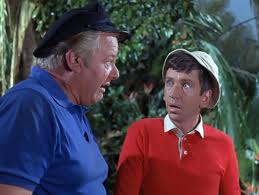
"Uplifting Platitude Central" Meet Gilligan...

Perhaps it was the tufted titmouse I spotted in a local sycamore tree that reminded me of something incredibly uplifting. No, wait just a moment here. I didn’t see a tufted titmouse today, or yesterday for that matter. I don’t even know if the species inhabit this slice of geography. And even had I spotted one, this little bird is too small to resurrect the image that bedazzled my mind and body alike. I could understand had I laid eyes on an eagle, hawk, or even a vulture, but I didn’t see any of them, either. So, it was something else entirely that resurrected the scene of an angelic and well-meaning Gilligan attempting to fly in an episode of Gilligan’s Island entitled, “Will the Real Mr. Howell Please Stand Up?”

Via a radio broadcast, Mr. Howell had discovered that an impostor was back in civilization and spending his money like there was no tomorrow. He thus offered a not inconsiderable sum to the one castaway who could get him off the island and safely back to the mainland. This monetary incentive inspired many clever inventions, including a pontoon boat built by the professor, which is what Howell ultimately settled upon as his last best hope.

Gilligan, on the other hand, had crafted a pair of super-sized bird wings in anticipation of taking flight. For a test run he scaled a very tall tree. But when the Skipper spotted him up above, he told a flapping Gilligan, who was indeed suspended in air and ipso facto flying, “Gilligan, you can’t fly!” “I can’t?” Gilligan asked. “No!” And down Gilligan went—fast and hard to the ground. The laugh track howled heartily at his misfortune.

Since Facebook, aka "Uplifting Platitude Central," is awash in both New Age and Old Religion bromides, I thought I would contribute to the surfeit my very own from Gilligan’s Island, and one with a compelling moral message. That is: “If you believe you can fly, you can. And don’t let anyone tell you otherwise!” On the other hand, perhaps the Skipper was on to something and we really can’t fly—with feathers anyway. Food for thought.

A footnote: The professor’s guaranteed seaworthy pontoon boat sunk immediately upon launch into the murky waters of the lagoon. One more: the Howell imposter, inebriated from an excess of expensive champagne, fell off a Howell-owned yacht into the ocean waters somewhere and washed up—alive and well—on the island. Coincidence, you say? There are no coincidences in life. At least that’s what I have gleaned in Uplifting Platitude Central.

Saturday, August 25, 2012

The "Back-of-the Head" Image Series


Sometime in the late-1970s, my younger brother and I borrowed my father’s cheesy camera with the 110 film and embarked on a monumental photographic undertaking. We endeavored to snap photos of a cross-section of our neighbors—the ones we deemed memorable characters and, too, whom we deduced wouldn’t be around forever. We were remarkably prescient on this last count.

And thus began our not quite award-winning “Back-of-the Head” image series. We weren't the gutsiest of photographers. Getting caught in the act of taking pictures of individuals we really didn’t know concerned us. After all, our prey might have actually questioned why we were doing what we were doing. Some people are camera shy as well. Almost invariably, a case could have been made that something wasn’t quite kosher with our actions.

Looking back all these years later, it would have been best to just tell them the unvarnished truth. Explain that we were in the process of compiling a neighborhood yearbook—a picture book to remember one and all by. Who wouldn’t have wanted to be part of that?

But the yearbook per se never materialized, and so I am left with a hodgepodge of back-of-the-head images of an eclectic cast of characters, including Howie G and his mother, who went for a walk each and every evening at the exact same time. Without fail, they ran their daily errands while chewing over the day’s events. Mother and son were always in intimate conversation, which was kind of special. Oh, I did manage to snap an occasional profile picture and even a few aerial shots from a second-floor window. These photographs will have to suffice in remembering Howie G and company from that very colorful snapshot in time—when city neighborhoods had both character and characters…lots of them in fact.

(Photos from the personal collection of Nicholas Nigro)

Friday, August 24, 2012

The Noble Experiment

For a couple of years in the early 1980s, the family car was a Champagne-colored Chevy Chevette. It looked more like “Army green” to me. During that snapshot in time, an increasing number of folks in the old neighborhood were giving fuel-efficient cars a fair look for the first time in their lives. On the heels of recent gas shortages and unwelcome price spikes, it made sense to drive vehicles without voracious fuel appetites. And, too, reducing energy consumption is always a good idea—for a whole host of reasons—isn't it?

My father owned a light blue 1959 Chevrolet Biscayne for fourteen years. In 1973, he bought a used 1968 Buick Skylark from a neighbor on the next block. It kind of sat on the road—you could almost walk into it. Eight years later, he was coaxed into purchasing the car that was—evidently—driving people happy. It was a noble experiment indeed to buy one with a manual transmission, no air conditioning, and back windows that would only roll down half way—a good gas mileage trifecta. Trouble was that Dad wasn’t exactly “Mr. Smooth” with the stick shift and the pool of alternative drivers was slim. So, when one added the lack of air conditioning and the back window thing to a never-ending series of shaky starts, summertime rides could get pretty hellish. The Chevy Chevette was retired after only a couple of years.

As I gaze upon the city streets three decades later, I see bigger than ever vehicles spewing more and more carbon dioxide into the air and taking up a whole lot of parking space, too. And all of this in an era of high gas prices and the general cost of living off the charts. Occasionally, though, I am heartened when I see a Smart Car whiz by me, but I worry its driver will one day be cast asunder by a runaway SUV or pickup truck. Perhaps it's noble experiment time again.

(Photo from the personal collection of Nicholas Nigro)

Sunday, August 19, 2012

Mad Max 2

Time flies these days—even, it seems, when one is not having fun. It’s closing in on a year now since a very special diner, and a secular holy place, served up its last grilled hamburger and bacon, eggs, and home fries breakfast platter. And the really sad thing is that we won’t see its likes again around these parts. Changing tastes, astronomical rents, high-operating costs, and a business-unfriendly bureaucracy have seen to that. The owner of this gritty eatery was there seven days a week—on the physical premises all the time with the exception of several hours on Sunday afternoon—and did virtually all the cooking himself. While he was plying his culinary trade, it was the norm to both greet and bid farewell to this classic diner impresario. I miss the thunderous “Hi!” greetings and equally booming “Take care!” farewells from grill side.

I was reminded of both this personal and societal loss when I bumped into the diner’s number two man for many years. Fortunately, he has found work in the area. While I chatted with him, an old blowhard got out of a car and yelled over, “Hey, Pete!” I asked, “Wasn’t he a diner customer?” Pete replied, “A long time ago.” I, of course, knew that Max was indeed a patron. He was unforgettable.

Almost invariably, Max would double park his huge boat of a car and have arguments with people on the street before entering the diner. He ordered the same thing all the time—like so many of us did—and executed his usual pre-meal ritual. Before eating his ham and egg sandwich, he swallowed a medley of meds and then swigged from a bottle of Pepto-Bismal, which he pulled out of his jacket pocket. Max was always loud and loutish.

What surprised me about seeing Max in the flesh today was that I presumed he was long dead. The man was old, obese, and red-skinned many, many years ago. He appeared then to be among the living courtesy of those pockets full of pills and bottles of Pepto-Bismal. But there Max was—all these years later and in living color—double parked in a heavily trafficked thoroughfare and heading off to purchase lottery tickets, which was where Pete was going, too. Somehow, though, seeing Mad Max alive and well—albeit still old, obese, and red-skinned—made my day.