Thursday, February 12, 2015

The Life of Brian

Like so many people in the here and now, I no longer watch a network newscast. I grew up with the likes of Walter Cronkite, John Chancellor, and Harry Reasoner as news anchors. It seemed for a long spell in the 1980s, 1990s, and into the new millennium that network news meant Dan Rather, Tom Brokaw, Peter Jennings, and nobody else. Whether it was real or imaginary, these network news anchors of the past had a certain gravitas that is sorely lacking now.

My oldest memory vis-à-vis the network news is watching the Huntley-Brinkley Report in my grandmother’s living room. She lived only a flight of stairs away, directly below me, and had a color television set when most people still had black-and-white TVs. It took a while to warm up, and you actually had to get up from the chair or sofa to change channels, which then amounted to about a dozen in total, but it was colorful indeed.

My brothers and I would “go downstairs” every night to watch television and especially enjoy whatever was presented in “living color,” It was a familiar and comforting ritual and I recall, on occasion, gearing up for an evening of prime-time TV watching while NBC’s Huntley-Brinkley Report neared its conclusion. Of course, the Chet Huntley-David Brinkley sign off had not only taken on a life of its own but become the stuff of legend: “Good night, Chet…Good night, David…and Goodnight from NBC News.” Huntley was stationed in New York and Brinkley, in Washington, D.C., and rarely saw one another in the flesh. They weren’t best buddies, either.

As a little boy, Huntley, Brinkley, et al—and the news they reported—seemed so much larger and so far, far removed from me. Of course, when I was six years old, the summer of 1968 meant playing with a spaldeen by day and catching lightning bugs by night. Can’t say I gave much thought to the Vietnam War, political assassinations, and rioting in streets, even when reported by Cronkite, Huntley, and Brinkley.

Times have certainly changed. For starters, I’m not six years old anymore. The network news and its anchors no longer mesmerize me. In fact, I rarely watched Brian Williams on his show. I probably saw more of him giving interviews to others. It boggles my mind that I guy in his position could tell such an overt lie to bolster his image as an intrepid reporter who is ever willing to put himself in harm’s way and, of course, to inflate the ratings of NBC Nightly News in what is now a dog-eat-dog business.

To disseminate such a tall tale—when so many people who were there knew it wasn’t true—doesn’t seem like such a smart move, either. Sooner or later you are going to be ratted out. And I’m not one who enjoys seeing people’s careers go down the tube for a verbal faux pas or one mistake in judgment. I believe we should all be judged by the totality of what we’ve been and what we’ve done. Political correctness is running amok and more insidious than ever. However, considering Brian Williams’ anchor position, I don’t see how he could ever get past this big fib—and it might even be a pattern—to be trusted and believed again. But I’m sure Brian will land some other position in the news business where he won’t have to worry about coming down with dysentery. He might, though, have to take a cut in pay. 

Saturday, January 24, 2015

What's Fare Is Fare

So, the fare for a New York City bus or subway ride is going up to $2.75 this March. And it appears, too, that the going rate for another popular fare in these parts—a slice of pizza—is that very sum or close to it. For some inexplicable reason these two decidedly unrelated things—one a service and the other a favorite fast-food staple—have been inextricably linked for a long time.

Recently, I unearthed a newspaper article in my overflowing archives—dated 1992—from The Riverdale Press, a local Bronx newspaper. I saved this slice of ephemera—a review of the area’s pizzerias—for a reason, probably because I was a renowned pizza aficionado who had sampled all of the neighborhood shops but had a special attachment to one in particular. Naturally, I was surprised at my preferred pizzeria’s somewhat poor rating of just two slices (out of five maximum), although by the 1990s its quality was—I will concede—somewhat inconsistent. I was curious, nonetheless, to ascertain whether or not the price of a transit ride corresponded with the going rate of slice of pizza that year. I wanted to know if this pizza connection of mine had historical legs. Not too long ago, an individual on Facebook remembered when the price of a New York City slice of pizza was .15, which, coincidentally, was the cost of a bus or subway ride at the time. Now, I can recall pizza as low as .35 a slice—in the early to mid-1970s—that, interestingly enough, corresponded to the day’s bus and subway fare.

Anyway, this neighborhood newspaper pizza review noted the cost of a slice in the various places surveyed as anywhere between $1.30 and $1.40. The 1992 bus and subway fare were $1.25—close enough to establish the fare and fare conjoining though time.

It should be noted that while New York City bus and subway service has gotten measurably better through the years—particularly the latter—the pizza slice has gotten considerably slighter. That is, courtesy of the costs of cheese and tomato sauce—and every other foodstuff for that matter coupled with criminally high cost of doing business—the ubiquitous slice of pizza’s mass has suffered. If not in taste then definitely in size, the slice of pizza isn’t what it used to be around here. And size matters.

When Luigi—who bore a striking resemblance to Lurch—of Luigi’s Pizzeria tossed his dough into the heavens, one definitely got more for his or her money. And, when push came to shove, Luigi no doubt made more dough, too. It was the end of an era for sure—the 1990s—when Italian immigrants from Italy still owned a New York City pizzeria or two. But then, a Greek man, who made a full-bodied and tasty pizza slice whose likes will never be sampled again—certainly not at a price that shadows the transit fare—owned and operated my pizza place of record. The slice of the past: Rest in Pizza.

(Photos from the personal collection of Nicholas Nigro)

Saturday, January 17, 2015

Nothing and Something

As a gift for her seventy-fifth birthday, I presented my maternal grandmother with “The Nothing Book.” In 1980, this hardcover tome, with its dust jacket and multi-colored interior pages, was a real novelty. Actually, it was little more than a blank journal. What would ultimately make it a “gift to remember” were the words eventually written in it.

I came across that very “Nothing Book” recently—it’s in my possession again—and perused my grandmother’s scribbling therein. She was a positive person—thoughtful and empathetic always—and her writings reflect that. My grandmother wasn’t about to use a diary, as it were, to trash anybody, even if some were deserving of trashing. Rather, she chronicled events, reflected an awful lot on the passage of time, and expressed gratitude for her family and friends in what were the last years of her life.

There was one notable exception to her mostly upbeat and often philosophical musings on her life and times. It involved a certain landlord. When this individual appeared in my grandmother's life, she had been living in the same house in Bangor, Pennsylvania for thirty-six years. She first moved into the place when there wasn’t a functioning indoor toilet, but just an outhouse in the backyard, which my mother remembers not especially fondly. 

It was, in fact, the only residence of hers that I ever knew, although it had a workable bathroom by then (but only a tub and no shower). This cozy abode on Miller Street with its grassy backyard, and dirty black walnut tree hovering above it, had a slate tiles pathway leading to its back porch. I must concede that her Bronx-born grandsons periodically tore up the yard in the summertime with our wiffle ball games. I distinctly remember slicing off one of my grandmother’s potted geranium flowers with a searing line drive and hoping that she wouldn’t notice. We even pitched a pup tent in the backyard and killed off some of her grass in the process. Actually, without exception, my grandmother tolerated our passion of youth when visiting—from our ultra-urban perspective—the country. Notwithstanding the Bangor summers’ ubiquitous and infuriating gnats, it was a Shangri-La. For a spell as a boy, I even envisioned living there in my adulthood. The Bronx versus Bangor....

Anyway, something that both the urban and rural had in common—much to my grandmother’s surprise and despair—were awful landlords. She notes in the aforementioned “Nothing Book,” a particular “unsavory character”—one that she subsequently dubbed a “horrible character.” Said character bought the house she lived in—and leased—for thirty-six years, most of the time with my grandfather, who had died a couple of years earlier. 

The house was owned by a kindly gentleman—whose mother, in fact, lived just across the street—and he kept the rent stable and affordable for decades. In other words, he wasn’t in it for the money, although he no doubt made a small profit. But then along came this particular fellow—this character—who purchased the place upon the previous owner’s passing. He—who shall remain nameless—viewed real estate as a moneymaker and moneymaker only. Real life people be damned. Yes, even in bucolic Bangor in the state’s leafy Slate Belt, where the folks always seemed a bit kinder and gentler to me—generally speaking—than their counterparts in the Bronx, there were bad apples. And some three decades later, I see that my late-grandmother’s former landlord is still making waves—and lots of enemies—in the town he still calls home.

(Photos from the personal collection of Nicholas Nigro)

Sunday, December 7, 2014

RIP Sleepy Eyes' Sister

I just learned that an old woman from the old neighborhood passed away. I was told she had lived with her family in the Bronx’s Kingsbridge for almost three-quarters of a century. At one time both a mother and father lorded over a brood of five children. Seeing as the decedent was just shy of ninety years of age—and the youngest among her siblings—you can imagine there aren’t too many of them left. Only one sister, in fact, remains on this earthly plane, and she is in a nursing home.

Such is the march of time—out with the old and in with the new. However, this large family of three boys and two girls avoided tying the knot altogether. Not a single one of them married and had children of their own. I’m certain there were layered reasons for this life course, particularly in a time when dysfunctional families were more prone to live under the same roofs come hell or high water; when men went off to war, too, returned home, and sometimes had to permanently anesthetize themselves to forget the horrors they experienced.

I really don’t recall anything about this particular family, who lived only a couple of blocks away from me while I was growing up, so I don’t have a clue what their particular life situation was, and why they chose to live the lives they did. I didn’t even know their last name until a couple of days ago. From my perspective at least, it is an unusual one that begins with the letter Z and is synonymous with the words “acne” and “pimple.” Actually, I feel a certain loss that I wasn’t aware of their surname in my spry and enthusiastic youth, because I’m certain it would have entertained me on some higher level. It would have been a perfect last name to affix to a character in a work of fiction.

In light of this woman’s passing, I was asked if I remembered one of her brothers, who was known in some neighborhood circles by the moniker “Sleepy Eyes.” There was a surfeit of oddball characters in the old neighborhood. Many of them were assigned clandestine nicknames—for identification purposes only. However, I didn’t recollect "Sleepy Eyes." His branding must have occurred before my time, I concluded. I heard, too, that old “Sleepy Eyes” liked his drink, and was often seen venturing to, or coming from, one of the neighborhood’s many watering holes.

Light bulb above the head moment: I recalled a fellow who frequently walked by my house when I was a boy—a man whom I also remember lived in the vicinity of where this family called home for the better part of a century. While I didn’t know him as “Sleepy Eyes,” his unique visage gave him a certain star appeal in the pantheon of intriguing neighborhood characters. He had a rather large head, distinctive bulbous nose, and assorted zits of the permanent variety. And—if this man was indeed “Sleepy Eyes”—this latter affliction was very apropos considering his curious last name.

When I described this craggy sort—and equally craggy memory—to someone in the know, it was confirmed he was one and the same: “Sleepy Eyes.” With a little Internet detective work on my part, I discovered his name was George and that he passed away in 1980, which would have been just about right. While he was a guy that roamed the neighborhood for many years before my time, getting noticed as a genuine character by the star-struck me was definitely a 1970s thing. I never knew he died because I didn’t know who he was. Just like that, “Sleepy Eyes” never walked by my house again, which is life in a nutshell. In trying to paint a mental picture of him in my mind all these years later, I’d say he resembled character actor Kenneth Tobey, minus, of course, the orange Irishness. The end of an era for sure. RIP "Sleepy Eyes'" sister and "Sleepy Eyes" thirty-four years after the fact.

Wednesday, November 19, 2014

If Tom Seaver Is Seventy...

A couple of days ago, Tom Seaver celebrated his seventieth birthday. And, really, if he’s turned the big 7-0—and become a septuagenarian—I, too, must be getting a little long in the tooth. As a wide-eyed Met fan in the 1970s, “Tom Terrific,” as he was affectionately known, was my favorite player bar none. Games where he took the mound assumed a little extra meaning to me, because I constantly fretted over his won and loss record and earned run average. I remember a boyhood friend—and fellow Seaver aficionado—and I commiserating over a tough loss in which our idol gave up four whole runs. “Do you know what that’s going to do to his E.R.A.?” he asked with genuine concern in his voice. Yes, back in those days, four runs scored against our ace pitcher—and future Hall of Famer—was a very bad outing indeed and quite rare.

As a boy, I didn’t give much thought to how much Tom Seaver meant to me. Although he was larger than life from my youthful perspective, I didn’t christen him my “hero” or any such “official” thing. I didn’t conclude that I wanted to grow up and be a Major League Baseball pitcher like him. And although I would have loved to have been his next-door neighbor, I didn’t dream of living in Greenwich, Connecticut—the tony town he called home—either.

Nevertheless, I proudly wore his number “41” on the back of my “Property of the New York Mets” gray T-shirt, and I felt genuine disgust when a pal of mine—who didn’t even follow baseball, let alone revere Tom Seaver—donned a similar shirt. As the neighborhood’s most dedicated Tom Seaver disciple—it was by and large a Bronx neighborhood full of Yankee fans—I didn’t appreciate my uniqueness being challenged. And challenged by a non-believer making a fashion statement no less! (Major League Baseball merchandising was pretty primitive back then. “Property of” tees were the rage and, as I recall, that was the long and short of it.)

Anyway, Tom Seaver is seventy and there is no turning back the clock. Three thousand miles away from where he once so magnificently plied his trade, Shea Stadium—which is, alas, no more—the baseball great grows grapes for his own wine label. No too long ago, Tom Seaver was pretty sick and diagnosed with Lyme disease. Its symptoms led some to suspect  the man they called “The Franchise” might be in the early throes of dementia. Now that was a scary thought! Happily, he’s of sound mind. When all is said and done, though, I suspect he really was my hero—and the only one I ever had.

I realize that Tom Seaver has something of a reputation for being haughty and a bit full of himself. He doesn’t always appreciate his loyal fans, which isn’t an admirable quality. But then again, he’s got ample reasons to be impressed with his accomplishments in baseball. The man was the consummate professional in an era when one could respect, above all else, on-the-field performances and not be hopelessly distracted by the endless sideshows that accompany contemporary sports and sports figures. Today, athletes are very often multi-millionaire celebrities—spoiled and overexposed. When Tom Seaver and I were younger, the world we simultaneously cohabited was a whole lot different place than the current one. Great pitching mechanics and a fastball with movement and snap, crackle, pop were the stuff of heroes. The man, by the way, pitched 231 complete games in his career. Imagine that.


Tuesday, October 21, 2014

A Day in the Life

I called on the New York State Department of Motor Vehicles (DMV) today to renew a driver’s license. Based on both past experiences and the bureaucracy’s somewhat notorious reputation, I understandably was not looking forward to the adventure. Where I call home afforded me a variety of choices as to where to complete this task. I could have ventured up to the DMV in Yonkers, just past the New York City line, and closer to my hometown Bronx’s alternative on Fordham Road, which I could have also accessed via a twenty-minute bus ride—give or take a few minutes.

I journeyed instead into Manhattan, calling upon the License Express on 30th Street near Fifth Avenue. So, even if it took me a little more time—via a subway ride and a several block walk—it was a wise move on my part. Who ever heard of getting one’s business sorted out in a DMV office in under a half hour? The times are a-changin’ and this is an instance of changin’ for the better.

In my travels this morning en route to the DMV, I encountered an elderly man—a face, really, that somehow got into mine for a split second. Our eyes met. “I know that guy,” I said to myself. “Sure, that’s Joe Franklin…I think…a New York City radio institution.” To verify my sighting, I Googled him as soon as I got home and, happily, discovered he’s still among the living at the ripe old age of eighty-eight.

On my subway ride home—with just about everyone in the car preoccupied with his or her iPhone—a religious zealot touted the importance of reading the Bible and preparing for eternal life in either Heaven or Hell. He phonetically spelled out the word Bible, too—B-I-B-L-E—so that there would be no misunderstanding. He, though, wasn’t asking for any money and just wanted to save subway straphangers’ souls. A little while later, somebody who was asking for spare change materialized. He said he’d just gotten out of Riker’s Island, a well-known jail complex in these parts, and was valiantly trying to get his new life in order, starting with getting his clothes cleaned. I would have given him something, but it was too difficult for me to access the change in my pocket while seated uncomfortably and scrunched beside a heavyset fellow with both an umbrella and halitosis. This troubled young man came up empty, which made me feel kind of bad because maybe he was telling the truth. My unsolicited advice to him in future subway appearances is to work with some sort of money receptacle, because handing over cash and coins to the actual hands of those with a hand out, as it were, is an extra and unnecessary hurdle to maximizing the bottom line.

Friday, October 10, 2014

Forty-One Years Ago

Forty-one years ago today, October 10, 1973, the New York Mets defeated Cincinnati's "Big Red Machine" in the National League playoffs at Shea Stadium. My beloved Mets were the underdogs to put it mildly—and the team that sent Pete Rose and company home for the winter. What I wouldn’t give to relive that day in, of course, my eleven-year-old body taking directives from my eleven-year-old psyche. The passion of youth made that day oh-so-special with my boyhood idol, Tom Seaver, on the mound and getting the win, and “Ya Gotta Believe” Tug McGraw coming in the ninth inning to douse the fire and record the save.

Sitting in the living room and watching the game on my family’s sole black-and-white TV, I won’t soon forget legendary Mets’ announcer Lindsey Nelson’s call of the game’s final out, and how he animatedly repeated three times: “The New York Mets have won the pennant…The New York Mets have won the pennant…The New York Mets have won the pennant.” He then described the “wild scene at Shea Stadium” as fans stormed onto the field in what was an era—to say the least—of lax crowd control. The wild bunch ripped the field to shreds and frightened Mets’ and Reds’ players alike, who hurried as fast as they could off the field. Fortunately, stadium groundskeepers had a full week to get it back in shape for the World Series.

With the convoluted and uber-expensive television rights that define today’s professional sports, it’s worth noting that the playoff games were carried in New York by the Mets’ local station, WOR-TV, Channel 9, as well as the network, NBC. Such a generous arrangement would be unthinkable in this day and age. I was thus able to listen to Lindsey Nelson, Bob Murphy, and Ralph Kiner do the play-by-play for the entire series. The Mets televised a lot of games on free TV back then. Lindsey, Bob, and Ralph became family. It was right and proper then that I got to hear Lindsey Nelson—family—put the icing on the cake of an improbable pennant in an October to remember. Baseball like it was once upon a time...and life like it really ought to be.


Thursday, October 9, 2014

When Life Gives You Lemons...Watch Hogan's Heroes

Through the years when feeling blue, I’ve been wont to hark back to—yes, drum roll, please—simpler times. From my perspective at least, many of the television programs I enjoyed as a youth serve as a very welcome pick-me-up in the here and now. In need of a lift recently, I opted to put Hogan’s Heroes in my Netflix queue. I soon after discovered that every episode—seasons one through six—was on YouTube (for the time being at least).

Over the past few weeks, I’ve been plowing through the series with glee. While Hogan’s Heroes is steeped in some controversy, it nonetheless holds up extremely well in my opinion. Werner Klemperer as the ineffectual, vainglorious Colonel Wilhelm Klink and John Banner as the endearing but bumbling Sergeant Schultz never grow old from where I sit.

Originally, I watched the show—for the most part—after it exited the prime-time stage in 1971. It went into syndication right away and played on, as I remember, local station Channel 5 every night at 7:30. In the colder climes when we were under house arrest, watching these shows over and over—be it The Munsters, The Andy Griffith Show, I Love Lucy, Gilligan’s Island, or Batman—was therapeutic They were comforting back then when the stresses of growing up reared their ugly heads. There was just nothing quite like sitting in front of television set and watching the familiar antics of Herman, Barney, Lucy, Gilligan, and Chief O’Hara.

TV Guide included Hogan’s Heroes on its list of the worst television shows of all-time. This selection was contemporary PC at work, with the show taking a hit forty years after it went off the air for making light of a time and a place that wasn’t very funny—World War II and a German POW camp. Nazi characters appeared regularly, too, on the sitcom, and constant references to their beloved leader were made. However, Colonel Robert Hogan and his trusted subordinates always thwarted them.

Hogan’s Heroes was good satire. During the war itself the Nazis were regularly mocked in comedy fare, including in Three Stooges’ shorts. Make the most heinous folks on the world stage appear foolish and asinine—why not? It’s a healing route that says we are somehow all in this together. We’re going to laugh at the insanity. Robert Clary, who played diminutive Corporal Louie LeBeau, survived a concentration camp and has a tattoo on his arm as a lifelong reminder of the experience. John Banner escaped from his native Austria but lost many family members in the Holocaust. Werner Klemperer and Leon Askin, who played General Burkhalter, likewise fled persecution. If these men were willing to assume prominent roles on Hogan’s Heroes, surely the judge and jury of TV Guide could find it in their hearts to cut the show some slack and give it its due as a timeless classic.

Saturday, September 20, 2014

Don't Smoke on Me

While watching reruns of the television classic Perry Mason, starring Raymond Burr, it never ceases to amaze me where the show’s myriad characters "light up." From today’s perspective at least, they smoked cigarettes in the strangest of places. Apparently in the serene 1950s, it was perfectly acceptable to puff away during an elevator ride, in a taxicab, and—believe it or not—in a hospital room as well. Just this past week I accompanied a patient to New York City’s leading cancer hospital and was pleased to see signs posted outside the building prohibiting smoking. Until very recently, the sight of hospital staff, including doctors and nurses, smoking by its entrances seemed downright surreal. It was, after all, a cancer hospital.

I’m not a proponent of the Nanny State. I fully support smokers’ rights to engage in their poisonous pleasures until death do them part. However, I realize now more than ever that their right to smoke does not include transmitting their second-hand smoke to innocent bystanders. That is, impinging on others’ rights to breathe clean—or relatively clean—air. So, if you smoke and can contain the habit to your little sliver of the world, more power to you. If you cannot, then you’re blowing smoke—really—when it comes to talking about your “rights.”

When I was a high school student in the late 1970s, my peers and I rode in what were called “special buses.” They were leased city buses and it was—even back then—against the law to smoke on them. Nevertheless, the bus drivers didn’t enforce the law. It didn’t matter to them that our buses to and from school were more often than not packed like the proverbial sardines in a can. We’d invariably arrive at school in the early morning, and back home in the middle of afternoon, reeking of second-hand smoke. Our clothes, fingers, and hair stunk to high heaven. The smoking class regularly assaulted the non-smoking class on these always-disagreeable bus rides. Breathing in all that second-hand smoke, and stinking of it, to begin and end each school day couldn’t have been very healthy.

What’s with smokers, too, who think nothing of throwing their butts on the ground. Does that not constitute littering? The telltale evidence of smokers—who are by and large are compelled nowadays to take their habits to the great outdoors—is a surfeit of discarded cigarette butts in front of places of business and office buildings. It’s a new wrinkle in a new age, but it sure beats riding those special buses that weren’t really special at all, and having untold minutes subtracted from our lives for doing something we just couldn't avoid—something scientifically known as "breathing."

Thursday, September 11, 2014

Thirteen Years Later

It’s kind of hard to believe that it’s been thirteen years since 9/11. I was sitting in front of my computer that morning, responding to a couple of e-mail queries from a copy editor who was working on the manuscript of The Everything Collectibles Book, which I had submitted several months earlier. Simultaneous with me doing this, I spied a headline AOL news story with an image that showed white smoke billowing out of one of the Twin Towers in lower Manhattan. The initial scuttlebutt was that a small plane had crashed into it. Like just about everybody at first, I assumed the craft had accidentally slammed into the building.

I promptly clicked on my television set for further details. And what transpired before my eyes over the next few hours was surreal—an unfolding nightmare. There was talk at one point of there being 30,000 potential victims at the "Ground Zero" site. What all of us were witnessing in real time was the stuff of an apocalyptic disaster movie; inconceivable only a day earlier. It was not something that we ever imagined could happen on American soil in the world’s most renowned city.

At around lunchtime that Tuesday morning, my younger brother and I walked to our neighborhood’s main thoroughfare a few blocks away. It appeared that life itself was in suspended animation. Everything had gone quiet. The standard impatient hustle and bustle and honking of horns, on what typically was a busy street at that hour, was missing. There was a kind of hush enveloping our sliver of the Bronx and—we knew—every section of the city as well. I distinctly recall the local convenience store run by Arabs had placed a big American flag by its front door. The owners no doubt feared being associated with the perpetrators. Later, a very loud jet fighter flew over and unsettled what could best be described as a stunned calm. All of us wondered and worried, too, whether further attacks were in the offing. Suddenly and without fair warning, living in the big City of New York didn’t seem so big anymore. A feeling of vulnerability, which we had never before experienced, was palpable. Neighbors emerged in the late afternoon with candles and silently walked up and down the streets. Flags emerged in places I had never before seen them flown. Ironically, it was a picture perfect September day with blue skies, comfortable temperatures, and low humidity, which apparently aided and abetted the monsters, who had hijacked the jet planes, in locating their targets.

The talk in the terrible days and weeks after the attack was how we would never be the same. After all, how could we be after witnessing this horror in a locale that always seemed so grand and impervious to any harm? Thirteen years have passed and we—very definitely—are not the same. The world is an extraordinarily dangerous place and the threats of terrorist violence are omnipresent. Traveling on airplanes, for one, has become a time-consuming, chaotic ordeal. The thought of having to pass through metal detectors to attend a baseball game is one more glaring example of how—even in our leisure pursuits—our freedom of movements have been compromised beyond repair. So many of the things that we do from now on are going to be attached to some measure of hassle because of a possible terrorist threat, even when the possibilities of one coming to pass are slim. It’s an unhappy state of affairs we find ourselves in, and the passage of time is not going to return us to what was—in retrospect—the less complicated world we called home on September 10, 2001.

.

Saturday, August 30, 2014

Labor Day Blues

On paper, it’s a holiday that pays homage to the American labor movement. Nevertheless, I’d venture to say that most of us aren’t giving “labor” all that much thought on what is the unofficial ending of Summertime 2014. Summer’s “last gasp,” as it were, has mostly been about barbecues, beaches, and beer.

I’ve attended a fair share of Labor Day events through the years, and the differences between them and the month of May’s Memorial Day festivities was always stark. After all, one national holiday signaled a beginning and the other an ending—and an abrupt one at that. As a general rule, beginnings are more celebratory than endings. Life is about both, I know, but Labor Day has the unenviable task of marking the end of a lot of good times for a lot of people; the gradual diminishing of daylight, too; and, from a school kid’s perspective, the start of yet another protracted educational slog.

Although I’m long removed from my formal educational odyssey, Labor Day—replete with the sun casting its signature autumnal shadows—always brings me back to my youth. There was no more melancholic time than this particular end. Or, to be technical, this non-celebratory beginning. Yes, the school year commencing with carefree summer memories still seared on the brain—and vestiges, too, of the waning season’s hot weather—was difficult to stomach. From my perspective, there was no worse feeling than attending school in oppressive heat, which happened quite frequently in the month of September. Sans any air conditioning, school and high temperatures were about as depressing a one-two punch as one could imagine.

Despite preferring the cooler climes of fall in my advancing years, I still feel a little blue at this latest ending—one more summer in the books. It’s a reminder of time’s passage, I guess. and for some of us, that we've experienced more summers than we've got left. In my Bronx high school, all boys were required to wear jackets and ties. We got to forgo both sartorial expressions, though, in the month of September. This was the “freakin’ bone” tossed our way. It was intended, perhaps, to slightly lessen the pain in what was post-Labor Day culture shock. At least I don't have to attend high school orientation this coming week.

(Photo from the personal collection of Nicholas Nigro)

Wednesday, August 13, 2014

August Body

One of my favorite scenes in the musical 1776 is when the Second Continental Congress debates the verbiage of Thomas Jefferson’s just completed “Declaration of Independence.” Suggestions for changes and deletions are bandied about in rapid fire. One member suggests eliminating a line that he feels unnecessarily takes to task the esteemed British Parliament. “Do you think it wise to alienate such an august body?” he asks. To which John Adams replies: “This is a revolution, dammit! We’re going to have to offend somebody!”

Anyway, this is my August body in blog form—reflections on happenings this month and in past Augusts. Looking on the bright side of things, the summertime weather for both July and August has been as tolerable as I’ve ever experienced. Not a heat wave all summer with largely bearable temperatures and reasonable levels of humidity. New York City summers can be brutal with their disagreeable combinations of heat and humidity.

An August anniversary was duly noted this year. Forty years ago, Richard Nixon resigned the presidency in the wake of the Watergate scandal. I was a mere lad when he departed the Washington scene—eleven years old—but I remember where I was on the night of his resignation speech. I was in Bangor, Pennsylvania. While my grandmother was away visiting relatives, my mother looked after my grandfather. After our new president, Gerald Ford, was sworn in, my mom informed her dad that the pair resembled one another. There was a bit of resemblance, I suppose. In August 1974, my grandfather also tasted lentil soup for the first time—my mother’s homemade version—and offered his opinion on the fare. “I’ve tasted worser soups,” he said.

Suffice it to say, August 1974 was a little bit different than its progeny: August 2014. I don’t mean to beat a dead horse, but kids don’t seem to play much anymore. Our every youthful waking hour was spent outdoors in those bygone summers. Now, nobody’s playing wiffle ball, which I loved doing more than anything else as a young boy. Even though there was no such thing, I dreamed of being a professional wiffle ball player some day. Then stickball came along. In fact, we played every conceivable version of baseball from box baseball to punch ball to curb ball to kick ball. The boxes on the concrete sidewalks and the curbsides are still around, but one would be hard-pressed to find a solitary soul utilizing them for sport anymore.

We have become a zombie-like society. Every day, I see mothers pushing their children in strollers who are completely preoccupied with their iPhones, even when crossing heavily trafficked streets. Fathers are equally oblivious. What, pray tell, are these folks checking out every single moment in time? That’s what I’d like to know. It’s both creepy and dispiriting. Exactly how is this sort of behavior going to impact future generations? Nevertheless, I had a lot of fun in August 1974, even if we were in the midst of a “national nightmare,” as newly sworn in President Ford termed it in his first speech to the nation. “Our long national nightmare is over,” he said. I didn't get sidetracked—even for a second—during that protracted nightmare. I was too busy playing wiffle ball.

(Photo 1 from the personal collection of Nicholas Nigro)


Thursday, July 31, 2014

The Zen of Mr. D

In my freshman year in high school, I had this history teacher who, in retrospect, is among my all-time favorite educators. He was the anti-pedagogue incarnate. The reasons for me remembering Mr. D so fondly is not that he instilled in me a lifelong passionate interest in the subject matter. (The course he taught was called Asian and African Cultural Studies, and the year was 1976.) Rather, it was the man’s delightful sense of humor and agreeable playfulness, which made his classes both unpredictable and a lot of fun. More than likely, Mr. D’s methods wouldn’t fly today in the one-size-fits-all, hypersensitive, politically correct educational system.

I penned a couple of past blogs about the man’s engaging classroom demeanor, chronicling some of his “greatest hits.” Recently, though, I thought of one of his more prominent tag lines that I had somehow overlooked in the previous essays. They involved time. 

My high school’s myriad clocks were sans second hands. Instead of quietly and imperceptibly advancing through the torturous school day, they visibly clicked from one minute to the next. One was therefore aware—if practicing the timeworn tradition of clock-watching—when there was precisely one minute left in a class. Mr. D was particularly keyed in on that final minute of each of his classes. He often concluded his lectures with the phrase, “Take a minute for yourselves!” or a shortened version, “Take a minute!” In the pressure cooker otherwise known as high school, it was at once a welcome minute break and something more substantial. Despite it seeming inconsequential in the big picture, it was consequential indeed. Mr. D supplying his students with a minute all their own each day tallied up to a few hours over the course of the school year. This benevolence on his part looms larger and larger over time because it really is important for us to take a minute for ourselves every now and then. So, take a minute!

Wednesday, July 16, 2014

Pitcher and Catcher RIP

Among the countless outdoor activities I engaged in while growing up in the Bronx was a simple game called “Pitcher and Catcher.” Two people played it, as it were, with one acting as a pitcher and the other as both a catcher and balls-and-strikes-calling umpire. Three strikes and you were out...and three outs meant it was time for the pitcher and catcher to swap jobs.

I can honestly say I don’t see any contemporary youths playing “Pitcher and Catcher” in the old neighborhood, or much else for that matter. And it’s summertime! What a dramatic change in the old order of things. I do see kids staring into their iPhones, texting, and yakking on their cells—all the time as a matter of fact. I’m left to conclude they spend the preponderance of their time indoors during the dog days of summer, which is sad.

As a kid in the colorful 1970s, the great outdoors is where I was expected to be—as much as it was physically and meteorologically possible. Even a party of two knew how to entertain themselves. I had countless catches with my brothers through the years in our concrete communal backyard. “Want to go out and have a catch?” was a regularly posed query. Virtually every teenage male—and plenty of females, too—owned a baseball glove, assorted balls, and a bat or two.

Chancing upon a couple of kids having a catch in the old neighborhood is unlikely these days. Whatever became of those urban summers when people—young and old alike—ventured outside for the sport of it? To play, to socialize, or to play and socialize. There are many dark sides to advancing technologies, but none more so than its anti-social foundation—one that underscores interaction on Facebook, Twitter, and text messaging over in-the-flesh human contact, like in the game we called “Pitcher and Catcher,” or just that catch in the backyard.

(Photo from the personal collection of Nicholas Nigro)

Saturday, July 5, 2014

July 4th Throwbacks

During the summer of America’s bicentennial year, 1976, it seemed almost everybody in the environs of New York City was talking about “Operation Sail.” This Fourth of July celebration slowly but surely got rolling in the weeks leading up to Independence Day. Hundreds of tall sailing vessels—throwbacks to a past age—navigated their way to New York Harbor. They traversed, too, the Hudson River.

I was thirteen years old that summer and, as I recall, “Operation Sail” was a pretty big deal. An aunt of mine, younger brother, and I hiked over to the Henry Hudson Bridge, which connects Northern Manhattan with the Northwest Bronx at the confluence of the Harlem River Ship Canal and Hudson River. In this rare instance—the only time in my memory—the bridge was closed to traffic so that one and all could congregate on its span and feast their eyes on some of the ships on the river. It was quite a spectacle with New Jersey’s Palisades supplying the ideal backdrop. Bicentennial fever raged in the heat and humidity of this memorable New York summer.

Perhaps the biggest difference in today’s Fourth of July festivities—as compared to the past in my old Bronx neighborhood—is the almost complete absence of firecrackers, bottle rockets, Roman candles, and their various offshoots. These things were all illegal when I was a kid, but it seems that anybody who wanted them could get hold of them in Chinatown or someplace else. The police, for the most part, turned a blind eye on possession of fireworks. Firecrackers popped weeks before the Fourth, and the day itself was one big bang. The morning of July 5th found the local streets covered with spent everything. I remember combing through the street debris for the occasional unused firecracker.

Can people even buy a box of Sparklers nowadays? They were pretty harmless, even though I set the family garbage can on fire by prematurely discarding one. It’s a good thing garbage cans in those days were made of metal and not plastic. The garbage men who had to lug those heavy things around are no doubt better off today, but those venerable cans survived Sparkler fires and lived to tell.

(Photo from the personal collection of Nicholas Nigro)

Tuesday, July 1, 2014

The Iceman Cometh…The Wiseguys Go-eth

Joseph Nigro, my paternal grandfather, first came to America with his father as a six-year-old boy in 1898. William McKinley was the president at the time. Father-son returned to their hometown, Castelmezzano, Italy, for several years after that, but they couldn't resist the allure of the states.

Their peripatetic ways were all about finding work and earning some decent money in what were hardscrabble times. Their native land was not exactly a land of opportunity. When, however, my grandfather reached young adulthood, he resented the old school ways of turning over everything he earned to his father and receiving—in return—a meager allowance. Understandably, he wanted to keep the fruits of his labor and forge a life of his own. His father, though, found such a request beyond the pale and wouldn’t give an inch. This father-son dispute set the wheels in motion.

Having more than he could stomach of what was, in essence, indentured servitude, my grandfather hopped on a boat back to Italy, which proved to be very poor timing on his part. For it was the eve of World War I and he was, upon his return, promptly drafted into the Italian army. My grandfather spent a couple of years in a German prisoner of war camp, where enemy combatants weren’t exactly treated humanely. But fortunately, he made it home—alive and in one piece after the war—when so many men didn’t. He also made it back to the United States. This go-round, though, he was his own man and wasn't about to turn over any of his earnings to a higher authority. In the mid-1920s, my grandfather brought his wife and daughter—my grandmother and aunt—to live here. They would all become Americans. My father and a brother were born on American soil several years later during the Great Depression, which was around the time my grandfather founded his own ice business. He was an iceman when most people had iceboxes in their homes and refrigerator technology was in its infancy. The man lugged countless heavy blocks of ice up countless flights of stairs in the tenements that housed the preponderance of his customers. He had some business clients, too, including the Lucky Club, a speakeasy on Broadway in the Morningside Heights section of Manhattan.


Upon making an ice delivery at the Lucky Club one afternoon, my grandfather was confronted by a man who made him an offer he couldn't refuse. He was informed that all of his wholesale ice purchases would thereafter be made through this hoodlum's outfit. Of course, the cost of the ice would be somewhat more than he was paying. My grandfather said no in no uncertain terms to this business arrangement, and was told something to the effect of “We have ways of making you change your mind.” A short time later, two men set upon my grandfather as he exited the Lucky Club after making an ice delivery. And they made the same proposal. Buy the ice from us...or suffer the consequences. My grandfather informed the pair of goons to, in effect, take a hike. They didn’t take kindly to the suggestion. In fact, they were about to show him the “ways” they had to make a person change his mind when my grandfather pulled out an ice pick from his pocket and thrust it toward them. He exited the club forthwith, wondering if what he had done was the wisest thing to do. After all, Mafia hoods didn't subscribe to the philosophy, “May the best man win,” which, in this instance, was definitely my grandfather. He worked very hard for his money—and it wasn’t a whole lot in those days—and didn’t intend on sharing it with slimy thugs.

As fate would have it, my grandfather knew a neighborhood police captain who had some sway with the local wiseguys. The cop put in a good word for him and requested he be left alone—and that no retaliation come his way. My grandfather never did buy his ice from the syndicate. And this intercession turned out providential for a whole host of people, including me, who might not have been born thirty years later without it. While my grandfather’s ice business melted away in the 1940s, when refrigeration became accessible to the masses, he nonetheless had saved up enough money to buy a house of his own in the Kingsbridge section of the Bronx. He worked at the Sheffield Milk plant—first in the Bronx and then in Brooklyn—until the day he retired. And he needed no helping hands from the Luca Brasis of the world.

(Photos from the personal collection of Nicholas Nigro)

Monday, June 23, 2014

Whence I Came

I was very fortunate to know my paternal grandmother for the first twenty-six years of my life. When she died at the age of ninety-three in 1989, she was an old ninety-three. Men and women of her generation—from before the many modern medical miracles—tended to be old before their time. In sharp contrast with those of us existing in the pampered present, they led patently rougher lives. I, for one, couldn’t imagine doing hard labor on the railroad as a teenager, which is what my grandmother did while all the able-bodied men from her town were off fighting in World War I. She hauled big rocks long distances. I could envision even less fighting in the trenches and getting gassed in the "war to end all wars."

My grandmother was born in 1895 in a place called Castlemezzano, a rocky mountain town in the province of Potenza in the Basilicata region of Southern Italy. From my perspective as a boy, she was always an old lady. That is, an old lady in the most positive sense, revered for the wisdom she amassed while navigating through the rough and tumble of life.  From an impoverished existence in a small village with no electricity, running water, or plumbing of any kind to a new life in the Morningside Heights section of Manhattan during the Great Depression, she always appreciated what she had, even when it wasn’t much, and was never heard to complain about anything.

My grandmother’s father—my great-grandfather Antonio Casa—was a musician who could read and write in a place and in a time when that sort of thing was exceptional. He made a little money and received bottles of wine and freshly made cheeses by reading and writing letters for townspeople. The problem with “Signore” Casa was that he didn’t have much of a work ethic and didn’t feel remotely obligated to his family—a wife and two daughters. My grandmother’s mother—my great-grandmother Maria Casa—worked every conceivable odd job to provide for her children. She baked breads for neighbors in her brick oven for, quite literally sometimes, bread. Her roguish husband was known to pilfer what little the family had and, with the spoils, endeavor to impress his numerous lady friends around town. Antonio Casa—with his piercing, manic-looking green eyes—was the antithesis of a faithful husband and devoted father. He employed his reading and writing talents to win over more than a few hearts and—so said the scuttlebutt—purposely misread a letter or two for personal gain. Those scenarios, however, are left to our imaginations.

Antonio Casa eventually assumed the role of transatlantic guardian—for a fee, of course—when he accompanied a woman from town across the ocean to reunite with her husband, who had settled in America. Upon learning of his departure from Italian soil, his long-suffering wife—my great-grandmother—kissed the ground and prayed to the Almighty that she would never, ever see the louse again. She never did. Thereafter, she raised the Casa family without interference. Maria Casa even insisted her two girls go to school and learn to read and write, just like their no-good father, which was not very commonplace back then. Ignorant folks in the village sneered at the audacity of her desire to see her two girls get an education.

Mission accomplished. Antonio Casa arrived safely at his final destination, Al Capone's Chicago, where he lived for a spell. The historical account gets a bit sketchy here, but it seems the man did more than reunite a husband and wife on American soil. Apparently, he was engaged in a full-blown affair with the woman he accompanied to America. When his transgressions came to light, the Lothario was compelled to get out of Dodge and fast. Antonio Casa subsequently found himself in New York City, where he announced with fanfare he was returning to his native Italy to live with his daughter, my grandmother, whom he had abandoned many years earlier. While in America, his eldest daughter had passed away during the Spanish flu, and his wife soon after that of a stomach ailment. As his birthright, though, he expected his only surviving child would care for him in his sunset years.

The best laid plans of mice and men. My grandmother was at that very moment—the mid-1920s— prepping to come to America to join her husband, my grandfather, who was already here. In fact, my grandfather attempted to convince Antonio Casa to stay put, but he refused and rather ham-fistedly attempted to keep my grandmother in Italy. The old man nonetheless got to live out the remainder of his life in the house that his wife had purchased with the sweat of her brow while he was a philandering gadabout. My grandmother, who inherited the house upon her mother's death, sent her father a few dollars from time to time until the day he died. He was, after all, family.

I’ve always wondered what it must have been like to look back on a life like my grandmother led—one that witnessed two World Wars, a worldwide depression, and the Spanish flu, which devastated her town and killed her only sister. What was it like to have a father like Antonio Casa? I can’t conceive of that life journey through a world like that. I do know that my grandmother never wanted to return to Italy and the town of her birth, Castelmezzano. She was just grateful for everything she had in the here and now, and was a loving and large presence because of it. That’s what I remember most about her (and, of course, her unparalleled cooking acumen whose likes, I’m certain, I will never see again).

(Photos one, three, and six from the personal collection of Nicholas Nigro)

Monday, June 2, 2014

Curb Your Dog, Not Your Enthusiasm

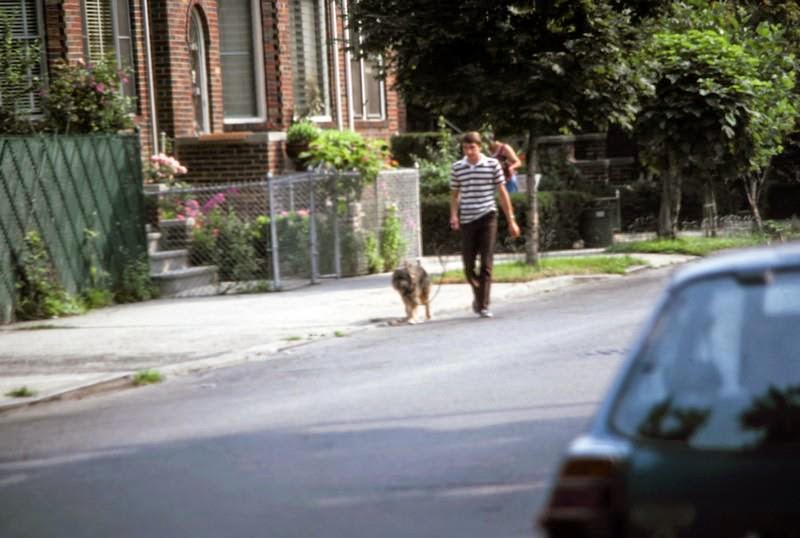
Once upon a time in the 1980s, I had a canine companion named Ginger. Dog owners one and all walked their beloved pets in the street back then. In my Bronx neighborhood, it was the recognized law of the land—the way things worked. Nowadays on the very same topography, dogs are almost invariably walked on the sidewalk, which is understandable considering the increase in traffic, not to mention the quantity of, and the size of, the parked vehicles on the street.

Faithfully, I walked Ginger in the street, weaving, as I recall, in and out of parked cars. On certain days of the week and times of the day, I often found ample road without, believe it or not, an obstructive parked car. “Curb Your Dog” was the city’s clarion call to dog walkers back then. Posted signs told us as much. Our dogs should do their “business”—as my father dubbed it—in the street but never, ever on the sidewalk proper or in a tree patch. Before 1978, "curbing" one's dog was enough to comply with the letter of the law. So long as the business at hand was conducted off the curb and in the street, one was not required by law to pick it up and discard it in the trash.

As I remember in those simpler times, the streets, and a lot of other places, too, were strewn with canine feces. After all, if curbing your dog was enough, a heaping helping of droppings naturally languished in the streets that all of us crossed—until, of course, the street cleaners came along to whisk it all away. It was, however, a vicious cycle. Stepping in it was commonplace. So, despite having received a $100 ticket more than thirty years ago—an awful lot of money at the time—for not picking up after Ginger, I think it is a very good thing that contemporary dog owners are required by law to pick up after their four-legged friends, or suffer the financial consequences.

Recently, I discovered that the city fathers have been systematically taking down all “Clean Up After Your Dog” and their forebear “Curb Your Dog” signs. The rationale for this undertaking is to reduce the city’s excessive sign clutter. Anyway, shouldn’t every single New York City resident know by now that it’s his or her business to pick up his or her dog's business? The vast majority of dog walkers do know. And those who don’t know, I suspect, actually do know. They just don’t care, and posted signs importuning them to pick up their dogs’ crap probably isn’t going to make much of a difference. Despite the sidewalks being dog-walking central in the twenty-first century—and the "Curb Your Dog" mantra being a relic of the past—I say good riddance to those ubiquitous signs. I've already paid my dues: a $100 fine when, in fact, I actually curbed my dog.

(Photo 1 from the personal collection of Nicholas Nigro)

Tuesday, May 20, 2014

Burger King and the Decline of Society

I haven’t eaten in a Burger King restaurant in more than twenty years. When I did frequent this fast-food chain, I preferred it to its chief competitor, McDonald’s. The reason I did was that Burger King enabled me to have my burgers “my way.” That is, I could “hold the pickles…hold the lettuce” and everything else without a big to-do. I ordered my burgers plain and ate them plain. At McDonald's, ordering a plain hamburger invariably initiated panic among the staff. I could never quite understand why getting a plain hamburger was such an ordeal. It would seem to me the simplest kind of order in a burger joint. But not, I suppose, when the burgers are born with pickles, ketchup, and chopped onions on them. I remember receiving “plain” burgers that had undergone a crude scraping off of the aforementioned fixings. Fully scraping off ketchup and chopped onions is well nigh impossible—and forget about the pickle taste.

That was then and this is now. I no longer patronize fast-food burger chains. Still, I was interested in the news that Burger King is scrapping its longstanding “Have It Your Way” slogan and replacing it with—drum roll, please—“Be Your Way.” Now, I don’t know what on earth that means. I do know that it’s a ridiculous reflection of the ridiculous times in which we live. How much money did this burger conglomerate invest to re-brand itself? McMahon and Tate. I daresay, would have delivered something a little more sensible for a lot less money.


In unveiling their new twenty-first century slogan, senior vice president of global brand management Fernando Merchado said, “We want to evolve from just being the functional side of things to having a much stronger emotional appeal.” How’s that? You sell hamburgers and French fries. How about serving better food with better service? Somehow in this day and age everything has to be about making a statement. Everything has to have some kind of narrative beyond the obvious. What does Burger King and a person’s “greater lifestyle” have to do with one another? Absolutely nothing. Where is the Duke of Doubt when we need him?

Thursday, April 10, 2014

The Tow-Away Zone Revisited


(Rare photo taken of Pet Nosh owner and business neighbor of real estate man Benjamin Scheckeler in close proximity to the latter's Tow-Away Zone, circa 1980)

I spied this man on the street this morning that managed to resurrect a ghost from my past. Actually, a rather obscure ghost whom I knew mainly as a colorful supporting character at a particular time in my life. Of course, the man I laid eyes on couldn’t have been Benjamin Scheckeler because he would be—if still among the living—pushing 105, I'd say, and I doubt very much he made it anywhere near that ripe old age.

Benjamin, you see, was a tightly wound man with an explosive temper. As a teen in the early 1980s, I worked in a mom-and-pop shop called Pet Nosh in Little Neck, Queens, and the septuagenarian Benjamin plied his trade in the real estate office next door. Our two businesses, plus a few others, shared a gravelly communal backyard parking lot. But only Benjamin had a parking space reserved for himself. There was a sign posted on a fence that stated in no uncertain terms that one particular spot was for Benjamin Scheckeler and Benjamin Scheckeler alone, and that any and all violators would be towed away—and toot sweet at that.

In fact, when I saw the Benjamin Scheckeler look-alike several hours ago, my brain—without any coaxing —retrieved a recording from more than three decades ago. “Tow away…tow away...tow away” played over and over in my head in a singsong German accent. On occasion, you see, somebody would pull into Benjamin’s sacred spot and shop in our store and the others. On Saturdays, in particular, this little parking lot of ours could get quite full and the temptation to pull into Benjamin’s sometimes-unoccupied space could be quite overwhelming. After all, shoppers would be in and out, so no big deal, right? Wrong! Whenever Benjamin pulled into the lot and found an interloper in his reserved parking spot, he went ballistic and stormed into the various stores hunting down the guilty party. In very angry and very loud tones, he invariably shouted: “Tow away! Tow away! Tow way!” Almost threateningly, Benjamin attempted to educate us on the importance of educating our clientele that they—under no circumstances—should park in the reserved spot for Benjamin Scheckeler while shopping in our store. Seriously, he wanted us to cross-examine each and every customer that entered our place of business: “You aren’t parked in Benjamin Scheckeler’s reserve parking spot, are you? If you are, please move your car immediately because it will be towed away.”

I never did find out how Benjamin Scheckeler and Benjamin Scheckeler alone qualified for a parking space of his own in that little parking lot in Little Neck. But he nonetheless left an indelible mark on me, because all these years later and I still encounter a signpost up ahead every now and then that alerts me of the next stop: the Tow-Away Zone. “

(Photo one from the personal collection of Nicholas Nigro)