Monday, October 9, 2017

A Picture Book to Remember Her By

On the shelves of my local Rite Aid drug store were Christmas items. This sighting got me thinking how time is accelerating. And so, I reached into my treasure trove of photos and compiled an eclectic hodgepodge of October to October snapshots. What follows is Part I:

A pizza flag that is no more points the way to a pizza shop that is no more. Actually, there is a pizza and deli combo joint in its stead.
Dugi's: Rest in Pizza. The place served a quality slice!
Autumn in Van Cortlandt Park. This particular spot was a badly-in-need-of-repair asphalt softball field in my youth. And for good measure, strewn with lots of broken glass.
What could be more American than McDonald's and McDonald's apple pie...
Pigeon catbird seat with a bird's-eye view of the comings and goings of the Number 1 train.
A long time ago, an aunt took me on field trips to this very perch overlooking the Number 1 train service yard. The cars were graffiti-laden in those days.
"And he waved goodbye saying: 'Don't you cry. I'll be back again someday.'" And I suspect he will.
Christmas 2016 weather was rather mundane, but a whole lot better than the seventy degrees of the previous year.
In early 2017, I discovered GrubHub and never looked back.
Who said Lucille Ball was dead...
Wintertime on Broadway. This particular Burger King has somehow managed to survive in the Smoothie Age.
How these many expired Metro Cards got here, I cannot say.
If waiter-extraordinaire Pete is wearing his pea jacket, it's wintertime on Riverdale Avenue.
Jerry Seinfeld savored a cup of coffee here and now it's in the history books.
A sixty-degree no service day for the Number 1 train...in February.
Sadly, there are all too many slobs where I call home.
No service with a smile.
How exactly did this happen?
Recipe for trouble: a texting track worker.

(Photos from the personal collection of Nicholas Nigro)

Sunday, October 8, 2017

George Washington and Crossing the Delaware

A week ago today, I crossed the Delaware—twice as a matter of fact. Despite being an automobile passenger, I couldn’t help but think of General George Washington. The first time I replicated the Father of Our Country’s feat was on the last leg of a Bronx, New York-to-Bangor, Pennsylvania expedition. I traversed the Delaware over the Portland-Columbia toll bridge. Eureka: one minute I was in Columbia, New Jersey and the next, Portland, Pennsylvania. One doesn’t have to travel very far from New York City to be in what amounts to another world entirely. On the trip’s flip side, I crossed the Delaware once more, traveling over a short two-lane span—the Riverton-Belvidere Bridge—in thirty seconds. The Delaware River is quite narrow there.

The Bronx-to-Bangor journey was completed in an hour-and-a-half. It necessitated crossing a decidedly grander and more heavily traveled bridge than the previously mentioned. I’m speaking of the George Washington Bridge, a.k.a the GWB, which spans the Hudson River. It was a Sunday and the traffic leaving the city moved right along. There are no tollbooths on the New York to New Jersey route. However, the piper is paid in full on the return.

Fortunately, the Chris Christie administration wasn’t conducting a traffic study across the bridge in Fort Lee. But one isn’t needed to create an ugly logjam on its tollbooth approach. It was smooth sailing on the return from Bangor to the Bronx. That is, until all roads pointed to the George Washington Bridge. The several miles leading up to the GWB added two hours to the—sans traffic—hour-and-a-half trip. Something to keep in mind: Sunday night isn’t a good time to be coming into New York. Saturday night isn’t too good, either. And, of course, weekdays have their rush hours.

The George Washington Bridge nonetheless played a memorable role in my youth. It was an imposing portal leading to the promised land of summer vacations on the Jersey Shore and visits with the grandparents in bucolic Bangor. It was also the road home, which when crossed to the Manhattan side meant that I was ever-so-close—fifteen minutes from my front door—to home. Vacations and good times ending with the crossing of the GWB were invariably melancholic, because “be it ever so crumble, there’s no place like home.” Major Charles Emerson Winchester actually said that when he came upon the friendly confines of the M*A*S*H 4077 after being hopelessly lost—or so he thought—in the dangerous wilds of war-torn Korea.

While the congestion at the bridge is nothing new, it’s definitely worse than ever. I wonder what George Washington would think if he found himself in contemporary Fort Lee, New Jersey. The town, after all, was an American war fort, directly across the Hudson from Fort Washington. It is home now to a lengthy toll plaza and a perpetual stream of gas-guzzling cars, belching trucks, and jockeying buses. Being a toll taker there has got to take a toll on the taker’s health. Fortunately, most of the lanes are non-cash E-Zpass lanes. I can’t imagine what the traffic would be like without them.

The George Washington Bridge as a gateway toys with one’s emotions—it always has. Looking heavenward, it’s a majestic sight—and the view from the bridge in every direction is spectacular. Still, when one draws near the GWB and lands smack dab in the middle of a recurrent traffic nightmare, it gives one pause. Thoughts of moving far, far away—once and for all—from the George Washington Bridge and its perpetual gridlock take center stage. Horace Greeley once said, “Go West, young man, go West.” Map Quest informs me that crossing the GWB is the best way to get there.

(Photos from the personal collection of Nicholas Nigro) 

Thursday, October 5, 2017

Bangor: Full of Bologna

It has been said that one cannot go home again. Well, since Bangor, Pennsylvania wasn’t my home—but my home away from home—I could and did return. It’s my mother’s hometown and where my maternal grandparents lived. My family visited Bangor on countless occasions during the four seasons. We spent weeks there in the summertime, which was a big deal because we got to frolic in an architectural marvel, the Bangor Park elevated swimming pool—girls’ locker room to the left; boys’ locker room to the right. Back home in the Bronx, a city-operated pool opened with great fanfare in the early 1970s in nearby Van Cortlandt Park. However, the chlorine adventure there wasn’t quite like the one at Bangor’s pool. The after-business hours mob scaling the Van Cortlandt Park pool’s fence to swim—and God knows what else—spoke volumes. It clued us in, too, on what the place was like in the daytime.

The return to Bangor—my Mayberry—was a pleasant stroll down memory lane. I am happy to report no seismic changes in the town and the surrounding area. Granted, there were more parked cars on the streets than I remember. Also, the locals were mesmerized—like everyone else in the wider world—by hand-held devices. And the old Colonial Hotel was now the Broadway Pub and serving pumpkin beer. Bangor has definitely become hipper. Broadway itself was an uninspiring hodgepodge of businesses, but this has been the case for a long time now.

Hipness aside, Heard’s Meat Market was still around and making what we always called “Bangor bologna.” It looked and tasted exactly as it did decades ago. I wish I could say the same for Devil Dogs and Carvel ice cream! And just as it’s impossible to eat only one potato chip, it’s likewise impossible to stop at one slice of Bangor bologna. Not too far from Heard’s is the Second Ward Company firehouse, which was just around the corner from where my grandparents lived. It borders a gravel alleyway where my younger brother and I visited Spot, a neighbor’s dog, in his outdoor doghouse. When we were young, we weren’t permitted to have a canine companion, so the opportunity to call on and pet the agreeable Spot was huge and further added to the Bangor aura.

Living all my life in the Bronx—in New York City—I have been witness to unrelenting and dramatic changes. There were still some empty lots when I was a kid, but gradually they’ve all been developed. Once upon a time, I could cross the street in front of my house and descend into a considerable “victory garden,” the last of its kind in the neighborhood. Now, the smallest patches of city earth are prized pieces of property. This is why I was pleased to see so much farmland still farmland in Bangor and the nearby towns. I would have hated to come upon rows and rows of condominiums where corn and apples once grew. I’m sure condos have popped up in a lot of places, but the back-road journey on the twisting and turning Richmond Road, with more curves than could be found at the junction, was like time travel. Even a couple of farm ponds, which intrigued me so much as a boy, remained. Okay, a little diving board on one of them was no longer there, but I’m not complaining. What would it have been like to dive into that pond with all the mud, algae, and dragonflies? I guess I’ll have to keep wondering.

After passing the aforementioned ponds, Richmond Road intersected with Koehler Road where there stood a solitary house painted yellow. It was exactly as I remembered it—still yellow, but in dire need of a paint job. What this yellow house signified—then as well as now—was that Gulick’s fruit farm was in the vicinity with a bird’s eye-view of a spewing power plant on the opposite horizon in a place called Martins Creek.

It took me all these years to put names on some of these back roads, like Koehler Road and then the Belvidere-Martins Creek Highway, which led us to the Riverton-Belvidere Bridge. The bridge is where a deceased Bangor resident from the past worked. To me, it will always be “Dutch’s Bridge.” Anyway, Hot Dog Johnny was still going strong and the package store on a sharp curve in Route 46 in New Jersey, which used to have the words “Eat” and “Liquor” on its rooftop, was still there. But whose bright idea was it to do away with the roof’s “Eat” and “Liquor?” 

(Photographs from the personal collection of Nicholas Nigro)

Saturday, September 30, 2017

Fifty Feet Underground

While a passenger on the Number 1 train yesterday morning, a man got on carrying a small American flag. I logically assumed the flag was a prop for an impending subway car performance. However, life is full of surprises, especially on a New York City subway. The fellow walked right past me and entered the adjoining car without so much as a peep. This transpired on my downtown ride. On the return trip home, the same man appeared, but this time he didn’t disappoint and promptly launched into his act. In good voice, he sang “God Bless America” while waving his little flag.

After the last verse, “God bless America, my home, sweet home,” the subway songster announced that he was not “homeless, hungry, harmful, or pregnant.” He then got to the business at-hand. “If you like what you hear,” he said, “I’d appreciate a donation.” To prove that his act was multi-dimensional—and included ample doses of comedy—he added, “If you do not hear what you like, I will take a bribe to shut up!”

This rather unique subway show was far from over as the man performed for the Spanish-speaking riders. He belted out the familiar folk song “La Cucaracha” and then supplied us with some blue biographical information. He referenced his previous night’s roll in the hay with his randy third wife. By the blank looks on their faces, I don’t think too many of my fellow passengers appreciated the width and breadth of this guy's talents. After mentioning the enchanted evening with his wife, he pretended that he was reliving it—on the morning after—and became breathless and temporarily lost in space. When he returned to earth—and the subway car—from this heavenly recollection, he thanked all of us for being “a captive audience fifty feet underground.”

I typically give to panhandlers on the subway—homeless or otherwise—but didn’t make the effort to bequeath anything to the man of song. I don’t exactly know why. For one, it’s not easy to get money out of your pocket when you’re crammed next to somebody on a subway seat. Perhaps I was thrown off my usual routine by his unusual routine, which was hardly run-of-the-mill subway entertainment.

Interestingly, just as the songster-comedian exited the subway car, another chap entered. He, however, said he was homeless, had experienced a run of bad luck, and was in dire straits. This time, I made the effort to unearth a dollar bill from my pocket. But I should have also given the “God Bless America” guy a “donation.” After all, his parting salvo noted the many payments that he accepted, including “credit cards” and “gift cards.” If there is a next time, he’ll get a well-earned couple of bucks from me.

(Photographs from the personal collection of Nicholas Nigro)

Friday, September 29, 2017

Old Ironside

Recently, I purchased the third season of Ironside starring Raymond Burr. Why the third? No special reason. It wasn’t that I remembered it as a stellar season or one that contained favorite episodes. I only know that—a couple of decades ago—I purchased the first two seasons of the show on VHS tapes. I would receive one tape every six weeks with four episodes on it. Getting the whole kit and caboodle at once wasn’t an option back then, which—if nothing else—prevented binge watching.

Just having the opportunity to revisit an old show like Ironside again, which was hard to come by in reruns, was pleasure enough. And even when old TV classics turn up in syndication nowadays, the commercial time has mushroomed well above the allotments of network television when Ironside first aired. Taking meat cleavers to shows from yesteryear—and chopping them down by ten to twelve minutes—leaves a lot unsaid. To make matters worse, it’s often clueless individuals who are given the task of gutting the likes of Ironside by some twenty percent. Doing this to Blue’s Clues might not blow holes in the plot, but 1960s and 1970s crime dramas lose a great deal in their abridged translations.

Anyway, back to Ironside, uncut and in living color. The show has got a winning opening theme by Quincy Jones. With its burly lead character, Chief Robert Ironside, wheelchair-bound throughout Ironside’s eight-year run, I will concede that the intro and episodes themselves have a somewhat campy feel all these years later. The irascible Chief twisting, turning, and chugging along can be a bit distracting at times. Let’s not forget that the man also loved canned chili, which he consumed regularly with undisguised glee. Although it always crosses my mind when the chili-loving is brought up, flatulence was never once addressed—as far as I know—on the show. It’s funny that Detective Columbo was partial to chili as well. A coincidence? If only Ironside and Columbo had done a crossover episode. They could have enjoyed a bowl together.

The filming side of Ironside runs the gamut: some atmospheric location shots in San Francisco and the surrounding area at one moment, then the actors sitting in front of a screen featuring moving traffic or some such thing. The Ironside players—the Chief, Mark, Ed, and Eve—are, too, frequently going to bat for friends, former lovers, or relatives in trouble. I suppose it’s not uncommon in life to have a pal who is accused of murder or an old classmate who is up to his ass in alligators with the wise guys. It just hasn't been my experience yet.

Now that Ironside’s peculiarities have been cataloged, I must say that I fancy it. I didn’t watch the show when it originally aired. In fact, when I was very young, the opening segment featuring the Chief getting gunned down—in the back no less—gave me the willies. Instead, I discovered Ironside in 1980s reruns, when New York City local stations showed such stuff during the afternoon hours and before the commercial deluge took so much away.

I can’t help when I watch shows like Ironside—and spy the copyright—but feel nostalgic. I find myself imagining what my life was like when an episode originally aired. Season three of Ironside appeared on the 1969-1970 prime time schedule. I was in the second grade at St. John’s grammar school. I had one of my all-time favorite teachers, Mrs. Kehayas, that school year. She had show-and-tell sessions. I recall bringing a clock that I received for Christmas—a unique timepiece that didn’t actually keep time. Rather, it chugged along—like Chief Ironside—in five-minute increments. It’s five after two; it’s ten after two; it’s a quarter after two. I believe I showcased my proficiency in telling time to my seven-year-old peers. If only I had that special clock now on my curio shelf. Apparently, though, time waits for no man and no woman, including Old Ironside and me.

(Photographs from the personal collection of Nicholas Nigro)

Tuesday, September 19, 2017

An Inconvenient Truth: We Are Living in a Bizarro World

This past weekend, I inadvertently stumbled upon two street trashcans with different tales to tell. One was a hipster receptacle in Battery Park City, home to hipsters and little hipsters on scooters who don’t watch where they are going. The other overflowing can underscored both New York’s incredible diversity and insatiable consumption and waste. It contained everything from a pair of sneakers to an empty wine bottle; decorative flowers to tiny plastic bags containing canine waste. The sight of this garbage reaffirmed to me that we are living in a Bizarro World.

Further reaffirmation occurred yesterday when I found myself in some serious traffic and staring out a car window. I spied numerous street vendors peddling a potpourri that included hot dogs, smoothies, and lamb and rice dishes, too. Fortunately, I was a passenger and not behind the wheel of the vehicle. The logjam was on Manhattan’s tony Upper West Side and the byproduct of our American president being across town at the United Nations. As if entertaining that thought wasn’t horrifying enough, crawling along streets and avenues at the antithesis of warp speed got me thinking. Yes, about the Bizarro World again. For only in this world would the President of the United States be best known for nastily insulting people whenever he feels inclined, which is often.

When I first attended grammar school in the late-1960s, the Cold War was still pretty frigid but there was ample evidence of a thaw. For instance, my classmates and I weren’t performing civil defense duck-and-cover drills—hiding under our desks—in anticipation of a nuclear exchange. I recently finished One Man Against the World: The Tragedy of Richard Nixon by Tim Weiner—a compelling read from beginning to end. In 1972, Nixon traveled to China in what was largely a symbolic visit. But it was so well choreographed. Despite the gangster-like goings-on behind closed doors and hidden microphones in our nation's capital, Nixon understood what the public expected of a president in public and, most especially, on the international stage. His successor—45—is completely undisciplined and the essence of boorishness. Like a Seinfeld character, there is no learning or growth. It’s not possible with him. On his best day, Trump couldn’t pull off anything close to Nixon-like diplomatic theater. This is, after all, a Bizarro World we are living in. The president threatened today to “totally destroy” a country lead by a bona fide nut job whom he dubbed “Rocket Man.” Perhaps, duck-and-cover drills are poised to make a comeback.

There’s so much more to this peculiar contemporary existence of ours than an insecure, narcissist in the White House: a man who would have been—by any measure in the pre-Bizarro World—deemed intellectually, psychologically, ethically, and aesthetically unsuited for the job. In yesterday’s slow-moving travels, I found myself passing through Columbus Circle and then on Columbus Avenue proper. It got me thinking about the New York City statue police considering removing “offensive” statues like the one of Columbus at Columbus Circle. I’m sorry but a statue of Christopher Columbus at Columbus Circle—with Columbus Avenue in the vicinity—seems quite logical. Columbia University is just a few miles north as well. Ah, yes, one thought led to another in this Bizarro World, which includes a key component to all the bizarreness: social media.

In the previous world I knew, Columbus Day was merely a Monday holiday and three-day weekend during the school years. Despite parades in parts of New York City and elsewhere that are essentially Italian-American pride parades, I never equated Christopher Columbus with my paternal Italian heritage. He was a fifteenth-century explorer, discoverer, and conqueror who, no doubt, committed a fair share of atrocities. But those were cruel times—a Bizarro World very different from ours—and it’s been quite a multi-layered evolution from that point to this point. Well, actually, we’ve been devolving quite a bit of late.

Nevertheless, like so many relationships on Facebook, Columbus Day and the reason for it is complicated. However, if it makes you feel better: Put up your anti-Columbus memes in the coming weeks. Preach to the choir or get into unpleasant, pointless arguments with people who hold different opinions. I will survive this annual silliness and—just to be on the safe side—be under my desk.

(Photos from the personal collection of Nicholas Nigro)

Monday, September 11, 2017

Turn and Face the Strange

I was in Battery Park yesterday morning. It was a comfortably crisp, bright sunny day. While Hurricane Irma was ravaging the state of Florida, New York Harbor was the picture of serenity. People have a knack of compartmentalizing. If it’s not happening to us in real time, it’s a CNN image, Facebook post, or Yahoo news story. Anyway, as is always the case in the environs of Wall Street, tourists were omnipresent with their smartphones working overtime. With imposing backdrops such as the Statue of Liberty, the Charging Bull, and, of course, the “Freedom Tower,” lower Manhattan is a photographic haven—a selfie paradise.

In my wanderings, I was thinking about today, the sixteenth anniversary of 9/11, a dreadful snapshot in time that seems—four Spellman cycles later—almost inconceivable. How could something like that have happened where it did and with such unimaginable consequences? Sitting on a tree-shaded bench on the grounds of Battery Park City, just due west of where the Twin Towers stood and fell, it was hard to envision what that peaceful setting was like on 9/11/2001. I remember that it was a September day not unlike yesterday—a winning weather hybrid of identical amounts of summer and fall.

Battery Park City was covered in toxic debris—a couple of buildings even damaged by airplane parts—after the two towers went down. All of the structures therein were evacuated and many residents couldn’t return for lengthy periods of time. A considerable portion of the area was deemed a crime scene. Approximately fifty percent of the city in a city’s residents permanently moved from Battery Park City because—for months—the air quality in the vicinity of Ground Zero was suspect. Ponder this: It was everybody out at a moment’s notice and no returning home until God knows when. No relocation help was afforded residents by the powers-that-were, either, and hotel rooms in New York City were near impossible to come by. And to add insult to injury, some of those who returned after their extended absences found their apartments ransacked. It took lower rents and some government subsidies, too, to convince people that Battery Park City was a nice place to call home. But that was then and this is now.

Ch…ch…ch…ch…changes: Battery Park City is presently where the elite meet to eat and then some. Built on landfill from the original World Trade Center’s construction, this development on what were then obsolete, decaying piers on the Hudson River took a while. For a spell there was what looked like a big sandy beach in the shadows of the Twin Towers. Just do a Google search on “Battery Park City landfill” or some such thing and see some amazing pictures of what that part of lower Manhattan looked like not too long ago in the scheme of things. I wish I had navigated that scene in the dirty-old-New York 1970s, which most definitely had a perverse charm—one that gets more charming with each passing day in this increasingly gentrified, Starbucks universe—but I was too young to explore that far a field. While New York City was a much more interesting place back then, it also was more dangerous.

In the original planning of Battery Park City, some low-income housing was included, but fierce opposition squashed that idea. And I don’t anticipate the soon-to-be reelected Mayor DeBlasio will be locating homeless families in transitional housing in that prized locale, which is not having any problem with vacancies nowadays. The bottomless bottom lines are there to stay and need no further enticements.

(Photographs from the personal collection of Nicholas Nigro)

Monday, August 28, 2017

It’s Not Michael V. Gazzo’s Parking Lot Anymore

I was on a mission this past Saturday, endeavoring to pinpoint the precise location of a parking lot—a very special one that existed, once upon a time, in lower Manhattan. The parking lot is no more, but has been forever immortalized—from my perspective at least—in a 1975 episode of Kojak called “A Question of Answers.”

In this season-three opener, the incomparable Michael V. Gazzo played Kojak’s chief antagonist, a super-bad seed named Joel Adrian, who owned and operated the parking lot in question. Actually, it was the ideal front business for a cutthroat loan shark. After The Godfather made such a splash, television mobsters—for some early politically correct reason—were often given generic-sounding, non-Italian surnames. But we the viewers knew better. For the year before his guest appearance on Kojak, Gazzo played Frankie Pantangeli in The Godfather: Part II and won a Best Supporting Actor Oscar.

It’s strange how things sometimes play out in life. Apparently, “Leave the gun; take the cannoli” Richard Castellano got too big for his already big britches and wanted complete control over his dialogue in the sequel movie. For the record: Castellano’s widow disputed this account, claiming that her husband didn’t feel his character would betray the Corleone family. Whatever was stuck in Castellano’s craw, the powers-that-be didn’t think Peter “Fat” Clemenza was worth it, so they killed him off and brought in Gazzo as Pantangeli. Castellano got to star in a 1975 sitcom, Joe and Sons, which I remember watching. The series lasted fourteen episodes. Had Castellano played “Fat” Clemenza in The Godfather: Part II, it’s unlikely Gazzo would have appeared in the Kojak episode. And it remains to be seen if I would have gone in search of an old parking lot, which wouldn't have been Michael V. Gazzo’s parking lot.
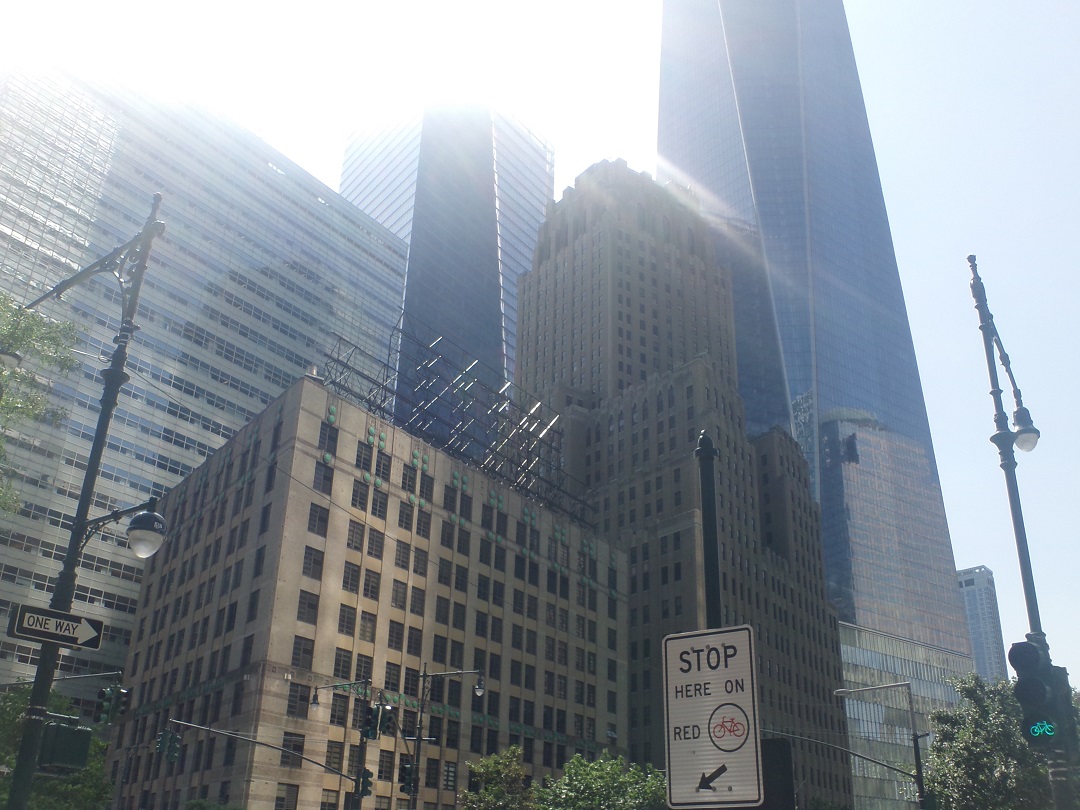
With that backstory properly digested, Kojak’s “A Question of Answers” was filmed entirely on location in New York City, when the metropolis was at its gritty and grimy best—picture perfect. The fiscal crisis was in full bloom then, impacting everything from the subways, which were graffiti laden and prone to breakdowns, and the various parks, which were barely maintained. Emblematic of the times, Michael V. Gazzo’s parking lot was the genuine article. It stood due north of the Twin Towers, which had opened only two years earlier, and the thirty-two story New York Telephone Company building, also known as the Barclay-Vesey building. Built in 1927, this latter edifice was badly damaged on 9/11, but soldiers on today as the Verizon headquarters on West Street. It served, too, as my mission’s vital landmark.

I had, in fact, passed by the Verizon building on West Street many times, but didn’t connect the dots vis-à-vis Michael V. Gazzo’s parking lot until recently. For that area of Manhattan, Tribeca, bares little resemblance to its former self. When Kojak filmed there, the old elevated West Side Highway was visible to the west, although it had been previously closed to traffic after an eighty-foot section collapsed and sent an asphalt truck—repairing the deteriorating highway—and automobile to the street below.

The dilapidated and increasingly obsolete elevated highway in lower Manhattan was not rebuilt and was gradually torn down. The West Side Highway is now on the street level—West Street—and zigzags through a rather hip, expensive part of town. When Michael V. Gazzo’s parking lot existed, virtually everything to its west was rundown and destined for the ash heap of history. There’s a new Department of Sanitation building in the vicinity now and still some factory remnants of what was. But the exact locale of the parking lot and the surrounding area is currently home to expensive high-rise buildings, residential and commercial, and a school.

Here’s what New York magazine had to say about the neighborhood that Michael V. Gazzo’s parking lot once called home: "By many criteria, Tribeca could be considered the best place to live in the city. It enjoys minuscule crime levels, great schools, tons of transit, well-planned waterfront access, and light-filled loft-type apartments in painstakingly rehabbed industrial buildings. But having already overtaken the Upper East Side as the city’s richest precinct, it is prohibitively expensive, and any traces of racial and income diversity are long gone.”

It’s not Michael V. Gazzo’s parking lot anymore—not by a long shot. Mission accomplished.

(Photos from the personal collection of Nicholas Nigro)

Thursday, August 24, 2017

New Bin on the Block

Big brown recycling bins were delivered to every single address in my part of the Bronx today. Beginning next month, New York City residents will be expected—or at least encouraged—to recycle food scraps, food-soiled paper, and yard waste. That is, unless we are guinea pigs in an experiment, which is possible. These organic materials will be picked up on our regular recycling day, a weekly occurrence. Recycling of any kind is a plus for the environment and worth giving the old college try. However, considering the number of self-absorbed, materialistic slobs that populate the five boroughs, I suspect this noble endeavor will be—at best—only mildly successful. One small step for man, though, and I will do my part.

If nothing else, the sight of Ryder delivery trucks in the neighborhood crammed with hundreds of New York City Department of Sanitation issue bins will at least give us residents something novel to talk about. When it comes to chance encounters with familiar faces—where a little small talk is in order—I like to keep things light and lean. That means: no politics. Let’s just say I find it difficult to listen to people defend the indefensible. So, we chat about the guy with the six-foot tomato plants. Some local yokels actually gripe that he has them in the front of his house and not out back. The fact that his backyard consists of concrete and a garage is not factored into the equation. And while I don’t consume any of them in their original incarnations, I happen to think tall tomato, pepper, and eggplant plants are a sight for sore eyes. Other timely topics of discussion include the awning that a neighbor recently erected over his front stoop: a Plexiglas monstrosity befitting the entrance of a hotel. It’s the sort of thing that might have worked at the Milford Plaza—“the lullaby of old Broadway”—but not in a row of attached houses on a tree-lined street.

But now we can discourse about the spectacle of every hearth and home receiving a fair-sized plastic bin with little plastic tubs inside of them for the interior gathering of organic wastes. I can’t help but wonder how much this thing will cost the city. After all, there are a lot of people in New York. This sort of government largesse—door-to-door freebies—is unprecedented and has to be an expensive undertaking. But why look a gift horse in the mouth?

Meanwhile, the city mothers and fathers are reviewing statues for potential removal. The statue of Christopher Columbus at Columbus Circle is foremost on the hit list. Leave it to pandering politicians to jump on the bandwagon and shoot themselves in the foot. Mixed metaphors, perhaps, but fighting this inane “culture war” is counterproductive. I fear that the Ralph Kramden statue at the Port of Authority bus terminal is on the list. Let’s face it: Ralph intimated violence against his wife on a regular basis, physically and verbally abused his best friend, and cruelly bullied a pipsqueak named George. What kind of message is that sending to weary travelers coming and going to the Big Apple?

(Photos from the personal collection of Nicholas Nigro)

Tuesday, August 15, 2017

August Thoughts

I will begin with some mundane but nevertheless august thoughts. I was on the shores of New York Harbor this past Saturday. Never forget that the Bronx is up but the Battery’s down. It was the ideal August day to be there: overcast, breezy, and no-jacket-required cool. There were tourists aplenty in the vicinity. Spanning the entire age spectrum, many of them appeared fixated on capturing every single moment of their New York experience on their smartphones. They weren’t quite living in the moment, I thought, but were instead captive to these ubiquitous hand-held devices. But what’s the point of pointing that out? Yada…yada…yada.

Once upon a time, I enjoyed riding the Staten Island Ferry, which departs from the Battery, the lower tip of Manhattan. The ferry has always been a bargain—it’s free to ride now. But for me it was never about traveling to Staten Island, which is one of the city’s five boroughs. I took the ferry for the ride—period and end of story. With the exception of the ferry terminal on Staten Island, I’ve never actually set foot in the borough. It’s hard to get around the place without a car and hard to get there—and expensive—with one. The short ferry trips supplied vivid panoramas, especially the return trips to Manhattan. The last time I was on the ferry, the Twin Towers were what loomed like colossi on the approach.

In the environs of Battery Park City, I saw people boarding boats to the Statue of Liberty. I was on Liberty Island once, but that was a long time ago—when Richard Nixon was the president. I watched the passengers getting on and disembarking the boats—navigating the unsteady gangplank, or whatever it’s called—and concluded my seafaring days are over.

I began this journey into Manhattan at the Van Cortlandt Park station—the first and last stop of the Number 1 train. I am always assured a seat and opt to sit in the lead car going downtown, which is typically the least crowded on southbound trains. Moments before take-off, I was alone in the car. But just before the buzzer sounded—and one actually does before the doors close—a fellow passenger materialized and chose a seat not too far from me. He had his breakfast with him—a sandwich—and proceeded to consume his morning repast. Its aroma wafted my way. I’ve smelled worse in the subway—a lot worse. Recently, I read where the Metropolitan Transportation Authority (MTA) was considering banning eating on the trains. I don’t see how that edict could be enforced, but—it cannot be denied—malodorous fare in cramped and closed quarters can be awfully nauseating. I won’t hold my breath on that one.

Permit me to switch gears now and offer one last august thought. Nowadays, there are all-too-many ridiculous memes floating around Facebook and elsewhere in the virtual ether. This week’s winner, in my opinion, declares: “President Trump says he’ll be encouraging stores to say ‘Merry Christmas’ instead of ‘Happy Holiday’ this Christmas. Do you support that?” The ridiculousness of this…well…let me count the ways. For starters, it’s the middle of August. And, too, there are certainly more pressing concerns on the president’s plate at the moment. Finally, my mother had a “Happy Holiday” banner on our front door in the early 1960s.

Composer Irving Berlin was the wind beneath the wings of “Happy Holiday,” which was first sung by crooner Bing Crosby in the 1942 film Holiday Inn. Since Christmas music is now played on the radio the day after Halloween, I would wager that an awful lot of men, women, and children have heard Perry Como’s version of the song. Don’t get me wrong: I’m all for saying, “Merry Christmas” when you feel like saying, “Merry Christmas.” However, I’m more concerned in the dog days of summer of a possible nuclear winter.

(Photos from the personal collection of Nicholas Nigro)

Thursday, August 10, 2017

The Code of Broccoli Rabe

When I was a boy, my paternal grandmother made broccoli and spaghetti that was otherworldly. When it was in season, she substituted with broccoli rabe, which was equally delightful. Often utilizing the most basic ingredients, my grandmother had a knack for turning out taste sensations. And her dishes always turned out as expected. She was nothing if not consistent. When broccoli rabe and spaghetti was served, I knew what it was going to taste like. For some inexplicable reason, spaghetti was only used with the garlic and oil fare: broccoli, broccoli rabe, and Christmas Eve’s Aglio E Olio. Her pasta dinners—likewise singular and unmatched—were typically of the homemade variety, but never what you would classify as spaghetti.

As with so many things in life, broccoli and broccoli rabe don’t seem to be packed with the same flavor punch as I recall from my youth. I prepare the aforementioned spaghetti dishes from time to time, but the end-results vary greatly. Sometimes the broccoli and broccoli rabe are practically flavorless, even when utilizing half a bulb of garlic. I remember when broccoli rabe was a seasonal vegetable, available during certain times of the year only. Now, just like countless other fruits and vegetables, it’s a year-round food. Does this contemporary growing fact have anything to do with the flavor drain? Only Andy Boy knows for sure. Of course, my grandmother isn’t around anymore. She would have managed, I’m certain, to extract the maximum flavors out of today’s unpredictable broccoli and broccoli rabe.

Shifting gears somewhat, but in keeping with this essay’s title, I was riding the subway recently when I had the misfortune to be in the same car with three generations of boors: grandmother, mother, and daughter, I surmised. Of course, the family elder in this instance was probably in her late thirties or early forties at the oldest. Anyway, they were misbehaving on public transit, which is very annoying indeed. Outrageously loud and vulgar, the threesome was getting on everyone’s nerves. One man sitting very near them—too close for comfort, as it were—got up from his seat and went into an adjoining car. This move angered the family. I mean—really angered them. Why? Because they lived by a code, you see, and felt dissed by this fellow passenger. The trio could actually see the man sitting in the next car. While contemplating whether or not they should confront him, the three generations made threatening faces. There are codes and there are codes. My grandmother, who grew up in genuine poverty in a rocky mountain town in Southern Italy called Castelmezzano, lived by a strong code of right and wrong. She literally counted her blessings, too.

I would be remiss if I didn’t recount a warped code story that is a personal favorite of mine. After a shopping spree at the Cross County Mall in Yonkers, New York, my elderly neighbor—pushing eighty at the time—returned to her car for the drive home. As she opened the driver’s side door, a complete stranger sidled up on the passenger side and demanded to be driven several miles to an address in the city of Mount Vernon. Justifiably fearing for her well-being, my neighbor reached for her pocketbook, which was on the front seat. The woman hijacker was indignant. She no doubt felt she was being profiled and said: “What are you reaching for that for? I ain’t gonna steal your bag!” And let me just say for the politically correct record: Warped codes recognize no race, creed, or ethnicity. They are at once bizarre and infuriating to behold.

(Photos from the personal collection of Nicholas Nigro)

Saturday, August 5, 2017

The Almighty Doesn’t Live Here Anymore

While in Manhattan yesterday, I spied something unusual sticking out of a sidewalk garbage can. It was a pair of crutches. The receptacle was located on the southeast corner of Seventh Avenue and 14th Street, a mile or so from 34th Street. The close proximity to where a celebrated miracle once occurred—with the real Santa Claus coming through as he did—made me wonder if another one had come to pass. Perhaps I just missed the miracle of somebody lame being made to walk. Timing, after all, is everything in life. I would have been more than happy to place my foldable cane in that container and hop on the subway sans an assistive device. Better luck next time.

While on the subject of matters ethereal, a local church is in the news. I just read where the Archdiocese of New York officially “deconsecrated” the Church of the Visitation of the Blessed Virgin Mary—Visitation, for short—a neighborhood institution for as long as I’ve been alive and then some. While growing up in Kingsbridge and Riverdale, Catholics one and all belonged to a parish. It was part of our DNAs—American, New Yorker, Bronx resident, and—in my case—member of St. John’s parish.

When I was a boy in the 1960s and 1970s, the Catholic Church was thriving. However, its days of wine and roses were numbered. The priests were still largely respected. St. John’s men of the cloth were on the benign side of the ledger, with one notable exception, the monsignor. While the church elders revered the guy—they loved the unbeatable combination of businessman and disciplinarian—the younger set, including me, saw something else. The monsignor was a self-righteous, petulant scold, certainly not what I perceived as a humble servant of God. But those were the days when priests aplenty received their “calling” from on high. Something happened on the way to the sacristy room. Nowadays, few are called and even less are chosen. Apparently, the Almighty is back at the drawing board with respect to His calling formula. The red flag: an all-too-high percentage of molesters getting accepted into that special fraternity.

I was educated in Catholic schools from the first grade through college. It was a solid, predominantly secular education in which students were thought to think for themselves and to reason. God as one entity was hard enough to conceptualize. But God in three persons—blessed trinity—was an even tougher pill to swallow. A good education teaches one not to accept things purely on faith and to follow the truth wherever it may lead. That’s the Catholic Church’s present-day dilemma.

The Church of the Visitation of the Blessed Virgin Mary was originally located to the east of its present location. It was compelled to move a short distance to the west during the building of the Major Deegan Expressway, I-87. Visitation’s current property is considerable and worth a whole lot as a piece of real estate. I suppose the Almighty Dollar trumps the Almighty in this instance. But far be it for me to believe the Catholic Church hierarchy would have anything but the best interests of their parishioners at heart. And if you believe that, I have a church to sell you in the Bronx.

(Photos from the personal collection of Nicholas Nigro)